



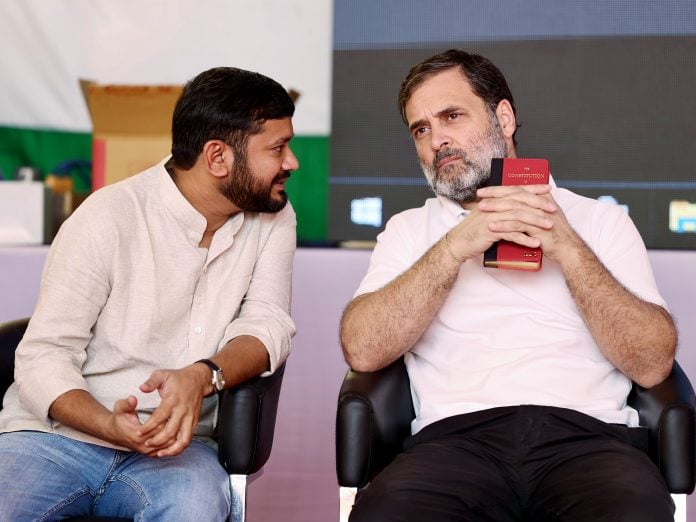
New Delhi: On a day Rahul Gandhi drew a large crowd at his Chhatron Ki Goonj programme in Indore, the Congress’ student wing NSUI was wiped out in the Delhi University Students’ Union (DUSU) elections—a contrast that has raised questions over Rahul’s flagship programme aimed at reconnecting the party with students and Gen Z.
Rahul’s office has sought a detailed report from Congress General Secretary (Organisation) K.C. Venugopal on why the National Students’ Union of India (NSUI) failed to win a single post on the four-member DUSU central panel, sources told ThePrint.
The result has also raised questions over Kanhaiya Kumar’s leadership, with two candidates rebelling and contesting independently. One of the independents, Deepanshu Shokeen, went on to win the vice-president’s post by a margin of over 13,000 votes.
Rahul’s office has sought details on how candidates were selected and the parameters used for giving tickets, the sources said. It has also sought an explanation on why Vir Chatrath, the son of Congress leader and AICC in-charge Manish Chatrath, was fielded for the vice-president’s post. Vir Chatrath finished third.
A former DUSU president and NSUI member has also approached Rahul and his sister Priyanka Gandhi Vadra with complaints against the organisation’s leadership under Kanhaiya Kumar, ThePrint has learnt.
The complaint raised questions about candidate selection, the handling of aspirants and the lack of the leadership’s involvement in campus elections. The former DUSU president alleged that Kumar was not sufficiently involved on the ground and took decisions without consulting student leaders.
“Kanhaiya wasn’t on campus—how would he know what was happening? He did not take anyone’s advice, just went and made decisions on his own. What he did with Shokeen was just one example. This has happened over the years. He was inactive during elections at all times,” the former DUSU president alleged.
Drew a blank
The NSUI drew a blank for the first time since 2015. The Akhil Bharatiya Vidyarthi Parishad (ABVP) won three of the four posts, while Shokeen, a former NSUI member who contested as an Independent, won the vice-president’s post.
The Congress leadership is also looking at campaign and election management, with sources pointing to infighting within NSUI as a key factor. But, the DUSU result is not the only instance that has raised questions over Rahul’s approach to student politics.
During the protests by the Cockroach Janta Party (CJP), Rahul had spoken out in support of students who were injured during a march and backed their concerns. However, he did not join the students or support the CJP at Jantar Mantar.
At the same time, Rahul launched Chhatron Ki Goonj in June as a nationwide student outreach programme to connect with students and Gen Z.
The Congress has planned multiple editions of the programme across states. A Congress Working Committee (CWC) resolution also stated that the programme would be organised in more than 800 cities.
The Indore event was the fifth edition of the programme. Rahul’s large reception there came almost simultaneously with the DU results.
The timing has added to the political significance of the defeat and raised a larger question for the Congress: whether the anger and discontent among young people that Rahul has sought to tap can actually be converted into votes and an organisation on the ground.
Political analyst and Delhi University professor Chandrachur Singh said large crowds were not enough and that the ground connection was missing.
“You can have crowds surging and people becoming part of such gatherings, but in order to transform that into real votes, it requires real, real people working on the ground. Younger people, Gen Z, are more prone towards revolutionary ideas,” Singh said.
“Rahul Gandhi was harping on Kanhaiya Kumar. Kanhaiya Kumar is a Left-oriented leader, and the Left style of politics is ‘dafali bajao, make sound’… they make sound because they don’t have the presence. And that sound itself is something that they can talk about but nothing else,” Singh added.
“The Chhatron Ki Goonj is basically harping on some kind of creation of Left-oriented dissent, which it is trying to brew here in India. That’s not going to happen. That’s not going to result in any kind of transformative change for them,” he explained.
(Edited by Sugita Katyal)