





It’s a measure of how much the Tata group impacts the lives of all Indians that so many of us — including those with no interest in corporate affairs — are following the current battle between Tata Sons, the holding company, and the Tata Trusts, which own two-thirds of the shares of Tata Sons.
I am not a business journalist, have not followed developments at Bombay House in recent years, and am as confused as most laymen by the technical details that seem to dominate recent coverage of the conflict. I don’t know exactly what Article 121 of Tata Sons’ articles of association means, or what the rules governing voting at the company’s board meetings are.
But perhaps that’s just as well because I feel too much detail often obscures the larger picture when it comes to the Tatas.
Let’s start with the most common misconception: that the Tatas are a family-owned company in which leadership is passed down from father to son in the manner of most Indian business houses. This is not only wrong, but it is also not how the Tatas themselves have ever seen the principle of succession.
Yes, the group was created (in its present shape) by the great Jamsetji Tata, but there is no evidence that he wanted only his direct descendants to run it. For instance, Nowroji Saklatvala ran it as chairman of Tata Sons in the 1930s.
Partly, this was because the family often did not have direct male heirs. Naval Tata (Ratan’s father) was a very distant cousin born into a family of modest means who was adopted from an orphanage at the age of 13. He played an important role within the Tatas but never got to head the group. That honour went to JRD Tata, a brilliant man who was not a direct heir either but whose father was a cousin of Jamsetji Tata.
So, even in the 1930s, though the Tatas drew their leadership from a small pool of Parsis, some of them distant relatives, father-to-son succession was never the guiding principle.
This was because the Tatas saw themselves as custodians of the empire, not as owners. The money was left to charitable trusts, and each Tata had separate private wealth to regard as their own, while making a distinction between group wealth and personal money.
Also Read: Why Tata Trusts’ Chandrasekaran challenge goes back to the Supreme Court’s 2021 Mistry ruling
A legacy without guaranteed heirs
When JRD Tata was planning the succession at the Tata group, Ratan Tata was far from the obvious choice, despite his surname. Ratan himself told me in an interview that he thought Rusi Modi would get the job. Or that JRD would choose Nani Palkhivala. It was also that Naval Tata and JRD were barely on speaking terms.
JRD first made Ratan head of Tata Industries, watched him closely and then decided that he was young enough but also mature enough to lead the Tatas into the next century.
Nothing in the Tatas was automatic because of accidents of birth. This became clear when Ratan had to choose his successor. He passed over his brother Noel Tata and selected Cyrus Mistry from the Shapoorji Pallonji family, the largest outside investors in the Tata group. When Mistry was sacked, Ratan went outside his family and outside the Parsi community to select N Chandrasekaran (Chandra), a Tata lifer who ran the group’s most successful company. Noel was passed over again.
So when the battle is portrayed in the media as being a battle between the owners and their managers, this is a gross oversimplification. As JRD and Ratan often made clear, the Tatas were not owners, just managers of a legacy.
None of this is to underestimate Noel Tata, who has proved himself to be a successful businessman in the companies he has run, including the group’s successful retail ventures. Just because Ratan did not have much time for him, it does not follow that he is not bright or capable.
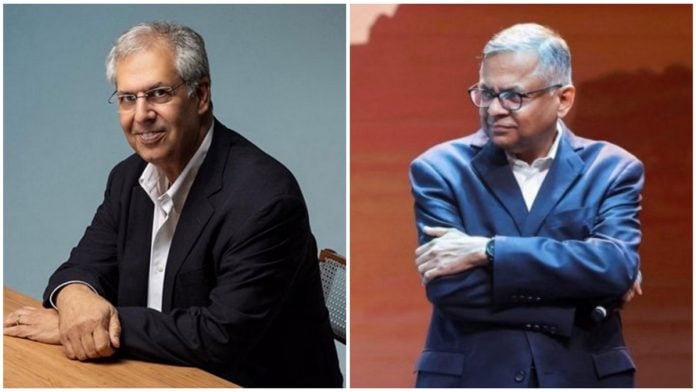
And yet, mostly through Noel’s own actions, he has made himself the key player in the story. He was the only person on the board of Tata Sons to oppose giving Chandra another five-year term, for reasons that are not entirely clear.
Is Air India the real problem?
The primary stated objection to giving Chandra another term has been the below-par performance of Air India. Here Chandra is to blame for letting Singapore Airlines (the Tatas’ junior partner in the venture) call the shots and send Campbell Wilson to run the airline. Wilson was clearly out of his depth and Air India has taken longer to turn around than it should have. But equally it has been damaged by events that were not Wilson’s fault: the Ahmedabad crash, the Iran war, the ban on flights over Pakistan, the collapsing rupee and the hike in oil prices.
The acquisition of Air India was JRD’s dream and one that Ratan acted on against the advice of many of his advisers, who told him that it would cost too much to turn around the airline.
Does Noel’s antipathy to Air India stem from some resentment of JRD and Ratan Tata?
I think that’s very unlikely: the losses are just a convenient stick to beat Chandra with. But many of Ratan’s friends argue that Noel’s personal resentments have led him to act against Ratan’s old colleagues and supporters on the boards of the trusts and within Bombay House. They suggest that having been passed over twice for the top job at the Tatas, Noel wants to leverage his position at the trusts to take full control of the empire.
This is a harsh and unkind view unsupported by much evidence. But there are tensions, feuds and problems within the trusts. Trustees have raised objections to decisions and appointments made within the trusts and the Charity Commissioner has got involved. More recently Venu Srinivasan, a trustee, voted to give Chandra another term at Tata Sons despite Noel’s objections.
This matters because many of Noel’s defenders take the line that because the trusts control two-thirds of the shares of Tata Sons, the view of the trusts should prevail.
Even if this is true, what is the view of the trusts? Is it just Noel’s view? Given the current problems at the trusts it is difficult to be entirely sure.
The question of listing
And then there is the matter of going public. The Reserve Bank of India has been insisting that Tata Sons should be publicly listed. The Tatas have fought this demand for years but their position has recently been overruled. They could delay going public by petitioning the courts but there is a new complication: the board of Tata Sons now says it wants to go public.
To get his own way, Noel would have to remove some board members at a shareholders’ meeting. He may have the numbers needed to do this but such a move may be difficult given the problems with the trusts and the restrictions imposed by the Charity Commissioner.
It’s easy to see how the Tata Sons board would benefit from going public. Noel would no longer have an effective veto power over its decisions and regulators would look closely at anything the shareholders — including the trusts — would do.
Supporters of the trusts say that going public would change the culture of Tata Sons, which is true, but given that the big Tata companies are already listed, it’s hard to argue that going public would damage the Tatas irreparably.
Also Read: Desperate Indians want Batman to take charge. We have reached that stage
Power vs moral authority
I sometimes think that the problem may be that Noel lacks the moral authority that Ratan possessed. Younger people remember Ratan as being the unquestioned head of the Tatas. But they forget that early into his term he found that the bosses of the major Tata companies did not take him seriously.
His solution was to introduce a retirement policy that would force the company bosses to retire soon. The policy was opposed from within the group but JRD backed him and one by one the old men stepped down. Some went quietly but some, like Rusi Modi, put up a fight. Ratan held firm and when he had won, he recast the entire empire, putting everything under the control of Bombay House.
That experience gave him the authority to do whatever he wanted. He used that power responsibly and even when his decisions seemed autocratic, such as the sacking of Cyrus Mistry, they were widely welcomed because they came from Ratan. By the time Cyrus was fired, Ratan was only chairman of the trusts but the directors of Tata Sons did as he asked.
Unfortunately, Noel doesn’t (as yet) have the moral authority to behave as Ratan did. At the trusts there have been open conflicts and at Tata Sons he was the only director to vote against Chandra’s reappointment. All the others broke with him.
Perhaps he did not realise that though he had Ratan’s title and the trusts’ shareholding behind him, he did not have Ratan’s stature.
Sadly, judging by how things are playing out, we are in for a period of protracted litigation. That is not a result anyone can look forward to. The Tatas are too important to India for the whole group to be paralysed because of one man’s (Noel’s) hostility to another man (Chandra).
I don’t know if things have gone too far for a compromise. But a cessation of hostilities would be in the best interests of the Tatas. And of India.
Vir Sanghvi is a print and television journalist, and talk show host. He tweets @virsanghvi. Views are personal.
(Edited by Asavari Singh)