






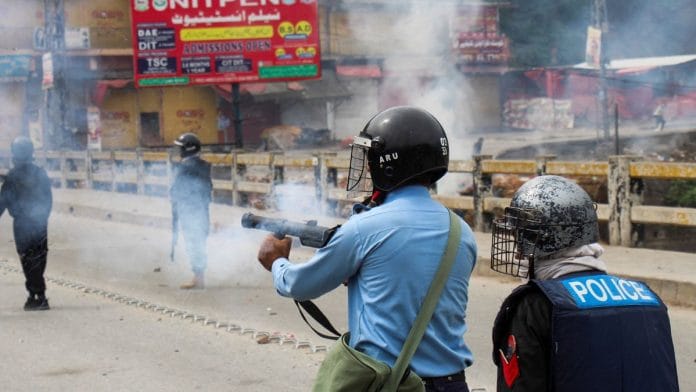


The 1971 Bangladesh Liberation War moment has come back to haunt Pakistan. This time, it’s closer to Islamabad, on its northwestern border in the illegally occupied areas of Kashmir or Pakistan-occupied Kashmir.
In a violent reaction to protests spearheaded by the Jammu Kashmir Joint Awami Action Committee (JAAC), the Pakistani Rangers and police cracked down on the protestors, resulting in dozens of deaths in police firing and several injuries. Founded in 2023, the JAAC organised protests demanding subsidised flour and lower electricity tariffs.
The logic was to plough back to the locals, the revenue earned by the government through power generated by the multipurpose Mangla Dam—the seventh-largest in the world—situated on the Jhelum River in Pakistan, lying in the Mirpur District of Pakistan-occupied Kashmir (POK) and the Jhelum District of Punjab.
What began as a demand for daily needs and electricity escalated into mass demonstrations across major towns in PoK. A highly rattled Islamabad deployed heavily armed police to quell the protests. JAAC, which led the protests, came up with a 38-point Charter of Demands and began negotiations with the government, but it was very unwisely banned last week.
New Delhi’s role
The immediate cause of the present protests, which led to a major law and order breakdown and administrative crisis, stems from a heady mix of several factors. Economic woes, lack of avenues for political representation, Islamabad’s insistence on granting reserved seats in the provincial assembly, refugees in PoK, opposition to frequent interference from Islamabad and army HQ in the internal affairs of the province are only some of the 38 points presented by the JAAC.
While New Delhi should closely monitor the situation, several actions can be initiated to reach out to the people of PoK, who, by virtue of living under occupation forces, are no less Indians than Indian citizens in any other part of the country, including Jammu & Kashmir. In April 2019, the Ministry of Home Affairs announced the suspension of trade with PoK at the two designated points in Salamabad and Chakan-da-Bagh, citing concerns about “illegal weapons, narcotics and fake currency” being transported into India.
It was also argued that the zero-tariff barter arrangement is being violated through under-invoicing and the exchange of third-party items such as California almonds. While the home ministry’s concerns are very valid, no corrective arrangement has been put in place to conduct trade on legal lines since 2019. The home ministry can resume this trade to reach out to the people of PoK reeling under food shortage and repression by Islamabad’s authorities.
New Delhi can also initiate suitable action, military and/or diplomatic, to intervene and stop the infrastructure projects under the China-Pakistan Economic Corridor (CPEC). Under the 1963 Sino-Pakistan Agreement, a boundary treaty signed between Pakistan and China to establish the border between China’s Xinjiang region and the PoK, Pakistan ceded approximately 5,180 sq km of territory, known as the Shaksgam Valley (or the Trans-Karakoram Tract), to China.
Incidentally, Article 6 of this agreement stipulated that the boundary was provisional and both nations agreed to renegotiate the border once the ‘broader Kashmir dispute between India and Pakistan was resolved’. India has consistently maintained that the 1963 Sino-Pakistan Boundary Agreement is completely illegal, invalid, and lacking in legal standing, as PoK historically and legally belongs to India, and that India rejects any claims, construction projects, or changes to the ground reality in the area by either country, Pakistan or China.
There is an urgent need to increase vigilance on the border and fortify security arrangements, as Islamabad will be tempted to push militants and non-state actors along the border to divert attention and dissuade PoK citizens from establishing contacts with the Indian side.
Also read: India’s nuclear doctrine was built for 2003. The logic of deterrence has changed by 2026
PoK’s sentiment
If the ongoing protests and repressive actions by Islamabad are any indication, public sentiment in PoK and Gilgit-Baltistan is increasingly tilting towards frustration. But it would be wrong to read this frustration as an urge or immediate readiness across the region to join India.
While large-scale protests against Pakistani military brutality, high inflation, and a lack of basic rights have sparked local demands to merge with India, the overarching goal for many protesters is socio-economic reform, greater autonomy, and total freedom from Pakistani state control. While resentment against Islamabad is gaining ground, a significant section of civil society in POK is not averse to reaching out to India for socio-economic and political needs.
Of the 114 seats in the Jammu & Kashmir Assembly, 24 are reserved for representatives from PoK. So far, no one has been elected or nominated from PoK. The Central government can seriously begin moves to grant statehood to J&K and also nominate 24 members from PoK to facilitate the process of people-to-people contact, which has been articulated by several sections of India’s civil society.
Neither religion nor ideology nor brute military force has been able to keep Pakistan glued together. What people yearn for is the fulfilment of shared aspirations, a firm anchor to the cultural and historic roots and a liberal, inclusive secular democracy, which India chose in 1947. A natural realisation of the futility of the past events leading to the tragic Partition is surely dawning in the minds of several groups on both sides of the border.
New Delhi can hasten, but slowly, the process of asserting one nation as a unifying theme.
Seshadri Chari is the former editor of ‘Organiser’. He tweets @seshadrichari. Views are personal.
(Edited by Saptak Datta)
Let Pakistan stew in its own juices. 2. Some games can be played by both sides.