








This is a most unpleasant subject, and hopefully, the world will never go anywhere near it. Like all grandfathers of the world, I love my grandchildren, now living all over the world, but duty calls. India rightly weaponised its nuclear capability in 1998. The great minds that drove our narrative, jocularly called the “Tamil Club”, then acquired the requisite stature to incorporate logic, modesty, and as much ethics as possible into our nuclear doctrine. The triple factors of technology, the arsenal, and doctrine, each deeply dependent on the others, have now been upended by galloping technology, which destroys the logic of the Indian arsenal’s composition and of the doctrine, designed for the world of 2003 but becoming obsolescent in 2026 and beyond.
The arguments supporting this anxiety have been researched by almost all worldwide research centres, with the first shot being fired by our own Centre for Land Warfare Studies in 2011, which said that conventional weapon stocks and accuracy in some countries were adequate to execute a successful first strike. Since then, the advent of real-time satellite surveillance, AI-driven tracking, hypersonic weapons, and long-range cruise missiles with pinpoint accuracy, followed by mathematical studies describing the vulnerability of even mobile ICBM launchers, has multiplied the concerns outlined below.
The erosion of survivability
The central problem is simple, though its consequences are not. Nuclear deterrence rests on survivability. If a retaliatory force cannot be confidently preserved after a first strike, the logic of deterrence begins to fray. For decades, survivability was ensured through hardened silos, dispersion, mobility and opacity. Today, each of these assumptions is being steadily eroded.
The first blow has come from transparency. Persistent satellite constellations, synthetic aperture radar, infrared tracking and data fusion have transformed the battlefield into a continuously observed space. Mobility, once the guarantor of survival, is now shadowed in real time. Patterns are detected, movements are predicted, and anomalies are flagged.
The second blow is precision. Conventional weapons have acquired accuracies that were once the preserve of nuclear delivery systems. Long-range cruise missiles, hypersonic glide vehicles and advanced terminal guidance now allow hardened targets to be struck with a high probability of kill. The distinction between nuclear and conventional counterforce is narrowing. What was once unthinkable — the neutralisation of strategic assets without nuclear use — is now a serious possibility.
The third blow is speed. Detection, decision and delivery are compressing into ever shorter timelines. The interval between locating a target and striking it is shrinking to minutes. This creates a crisis of instability that doctrine has not fully absorbed. If forces are vulnerable on the ground and warning times are minimal, the pressure to act early — or risk losing the capability altogether — becomes acute. Deterrence, instead of stabilising, may begin to incentivise pre-emption.
India’s nuclear doctrine, articulated in the early 2000s, was built on assured retaliation and a belief in credible second-strike capability. It assumed that enough of the arsenal would survive any first strike to impose unacceptable damage in response. That assumption now demands re-examination. If surveillance can locate, and precision can destroy, then the survivability of even mobile systems is not guaranteed.
Also read: The third nuclear age is here. With more dangers
Conventional and nuclear worlds
Equally troubling is the rise of dual-use systems. The same delivery platforms and sensors may support both conventional and nuclear missions. Nuclear deterrence was only meant to deter the use of nuclear weapons. The new danger is a disarming conventional first strike. A conventional strike on strategic infrastructure could be misinterpreted as the opening phase of a nuclear disarming attack. The risk of inadvertent escalation grows, not from intent, but from ambiguity.
The huge danger is the structure and design of China’s Strategic Rocket Force, which has 2,200 conventional missiles, including 600 hypersonic missiles, clubbed together with its nuclear arsenal comprising 40 brigades. The command structure and targeting facilities are common; the implications are obvious. Pakistan today has no such capability, but we should not be surprised by Chinese satellite data transfer, AI-enabled targeting systems, and missile technology, as we were by the transfer of nuclear weapon material and technology.
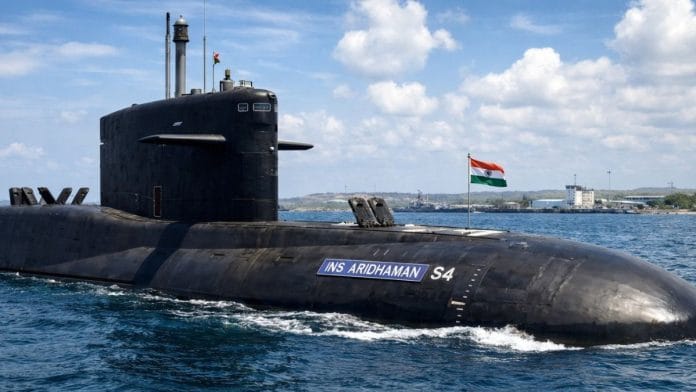
None of this renders India’s nuclear deterrence obsolete. But it does make it more dependent on its nuclear-powered ballistic missile submarine (SSBN) force. A land arsenal designed for concealment must now contend with exposure. A doctrine premised on retaliation must now consider vulnerability. Strategic stability, once anchored in mutual uncertainty, is being unsettled by mutual visibility.
Also read: India’s nuclear doctrine is useless. Discard no-first-use, say nukes are for China threat
What India should do
For India, the implications are clear. The question is not whether to retain nuclear deterrence, but whether the current mix of forces, basing modes and doctrinal assumptions remains adequate. Survivability must be reassessed in the light of persistent surveillance. Dispersal and mobility must be rethought against predictive tracking. Command and control must be hardened against both speed and ambiguity.
The answer cannot come from any single institution. It requires the meeting of many competent minds, who must first be convinced that there is a problem. A useful starting point would be for the Strategic Forces Command leadership and heads of nuclear planning bodies to study the growing body of international scholarship on the new era of counterforce (MIT, 2017), the emergence of disruptive technologies (SIPRI, 2024), strategic stability (IISS, 2026), inadvertent escalation (Union of Concerned Scientists), and mathematical modelling formulas (Science and Global Security, 2024-25).
After evaluating these references, India should constitute a task force of military practitioners and defence scientists to recommend both temporary solutions like enhancing survivability and reducing vulnerability, and permanent solutions like expediting and expanding the SSBN programme and also evaluate the results of the solution contained in the paper by Michael Galileo in the Yale Journal of International Affairs, May 7, 2026.
Above all, doctrine must be revisited with intellectual honesty. The language of 2003 cannot be allowed to drift unexamined into the realities of 2026. Deterrence works only so long as the adversary believes it. If technology is steadily undermining that belief, then silence is not prudence; it is risk. This is not an argument for alarm, but for adaptation. Nuclear weapons remain the ultimate guarantor of national survival. But their credibility rests on relevance, not legacy. In an age of relentless technological change, relevance must be continually earned.
Rear Admiral Raja Menon, a gold medallist from the NDA, retired as the Assistant Chief of the Naval Staff (Operations). He is the author of ‘Maritime Strategy and Continental Wars’ and ‘A Nuclear Strategy for India’. Views are personal.
(Edited by Prashant Dixit)