





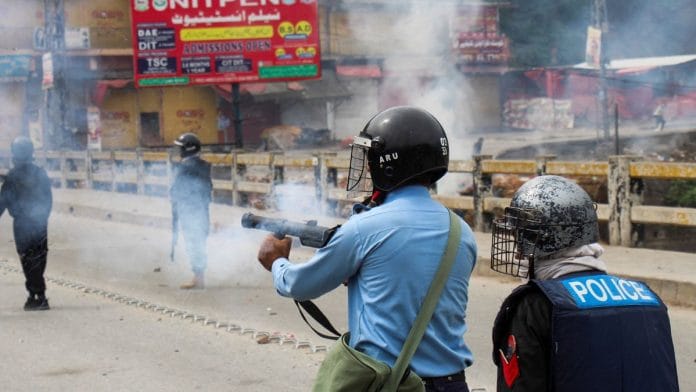

New Delhi: A political confrontation between authorities and a grassroots protest movement in Pakistan-occupied Kashmir that resulted in at least seven civilian deaths and mass protests is now being discussed in British Parliament.
One of the most serious crises to hit the region in recent years, the unrest centres on the Jammu Kashmir Joint Awami Action Committee, or JAAC, a grassroots coalition that emerged from economic protests in 2023 and has since expanded its demands to include constitutional reforms like political representation.
Tensions had been building for weeks ahead of a planned 9 June protest over the status of 12 seats in the PoK Legislative Assembly. These seats were reserved for refugees from Kashmir in India who settled in Pakistan after 1947. JAAC leaders argue that the seats allow Pakistan’s major political parties to exert disproportionate influence over governance in Muzaffarabad, Dawn reported.
More than 50 members of the British Parliament signed a letter Monday expressing concern about the situation, including allegations of repression, communications blackouts and restrictions on civil liberties like local representation in the 45-member legislative assembly.
Also read: In Lahore, Islampura is now Krishan Nagar—Pakistan is changing street names to honour history
What are the demands?
On 5 June, the PoK government declared the JAAC a prohibited organisation under the Anti-Terrorism Act 2014 and placed 31 core committee members and leaders on Schedule I (a list of individuals associated with banned organisations).
The immediate trigger for the 9 June protest was the committee’s demand to abolish 12 legislative seats reserved for Kashmiri refugees from India living outside Kashmir in Pakistan. The committee argues that these seats create constitutional and political problems and wants reforms before upcoming elections on 27 July.
Amid concerns, the PoK government on 5 June designated JAAC a prohibited organisation under anti-terrorism laws, asserting that it was engaged in activities threatening public order and security. Thirty-one members and leaders were reportedly placed on a list of individuals associated with the banned organisation.
Authorities said intelligence reports indicated that planned demonstrations could turn violent. Government officials claimed that some activists possessed weapons and intended to block roads, disrupt economic activity and damage public property.
JAAC leaders denied the accusations, insisting that their movement had remained peaceful and that the ban reflected official anxiety over growing public support rather than genuine security concerns.
The situation deteriorated rapidly over the following days. Soon after, the same tried-and-tested playbook followed.
Authorities suspended mobile internet services across Pakistan-occupied Kashmir, told tourists to leave the region or postpone planned visits, and deployed additional federal paramilitary forces to reinforce local police.
Over the weekend, security forces launched a crackdown against JAAC leaders and activists across several districts. Arrests were reported in multiple towns, and authorities sealed the organisation’s headquarters.
According to local news reports, clashes in Rawalakot erupted Sunday after a trader in the area was allegedly shot down by the police during a confrontation. Supporters and relatives of the man demanded action from the government as the trader’s body remained at Combined Military Hospital in Rawalakot. They also asked the Pakistan government to remove the ban on JAAC.
According to reports, at least seven civilians were killed in the violence. Authorities also reported that four police officers, including a sub-inspector, died during the unrest and that many were injured.
The government accused demonstrators of attacking the military hospital. Protest leaders disputed that characterisation and blamed security forces for escalating the confrontation.
As news of the clashes spread, reports emerged alleging a broader security operation across Rawalakot involving the army, Rangers and police.
By Monday, shuttered markets and business districts went on strike across much of the territory. Demonstrations were reported in Rawalakot and surrounding areas, including Trarkhal, Thoraar and Baloch, where residents called for participation in a planned long march, according to PoK activist and poet Ahmad Farhad.
Additional protests and strikes were reported in Bagh, Muzaffarabad, Haveli, Hajeera, Jandala and other towns. In Mirpur and Kotli, local organisers appealed for public participation in further demonstrations.
“Bans targeting popular movements are undemocratic, and have, throughout history, failed to suppress dissenting voices. At the other end, the JAAC, too, should take a less hard-line position. While the group had earlier called for civic and governance reforms, it is now demanding constitutional changes, such as the abolition of refugee seats. These delicate constitutional matters must be decided in the House, after thorough debate by all sides,” Dawn wrote in its editorial Tuesday.
The confrontation has now drawn attention beyond the region.
The former Pakistani accountability adviser under Imran Khan, Mirza Shahzad Akbar, criticised the government’s response. He argued that authorities should respect citizens’ rights to life, assembly and expression rather than rely on force. He said the international community should continue scrutinising developments in the region.
Pakistani journalist Raza Ahmad Rumi suggested that concern among British lawmakers reflected pressure from constituents and warned that political grievances could not be resolved through crackdowns on dissent.
Human rights advocates voiced similar concerns. Pakistani activist Mehlaqa Samdani on X questioned whether an impartial account of the violence would ever emerge amid internet restrictions and widespread distrust of official investigations.
Political analysts also warned that the government’s decision to ban JAAC could deepen rather than resolve the crisis. It was pointed out by a senior journalist, Hamir Mir, that the authorities had repeatedly negotiated with JAAC. Was the organisation not a security threat then?
In a Daily Jang article in Urdu, Mir wrote: “It is a strange government. Those with whom it negotiates and then enters into a written agreement, after some time it declares them terrorists. It bans them.”
Former senator Mushahid Hussain Syed described the ban as part of a recurring pattern in which governments respond to dissent with coercive measures that ultimately worsen political tensions.
Pakistani professor Adeel Malik also criticised the ‘authoritarian structure’ of the military.
“Pakistan’s entrenched authoritarian structure has once again shown itself to be a major threat to national security. Military establishment appears more willing to jeopardize the country’s future than relinquish its grip on politics,” he wrote on X.
Others agreed.
“By the end of this latest brutal military dictatorship, let’s hope there is anything left of Pakistan to save”, Pakistani entrepreneur Hussain Nadim wrote on X.