



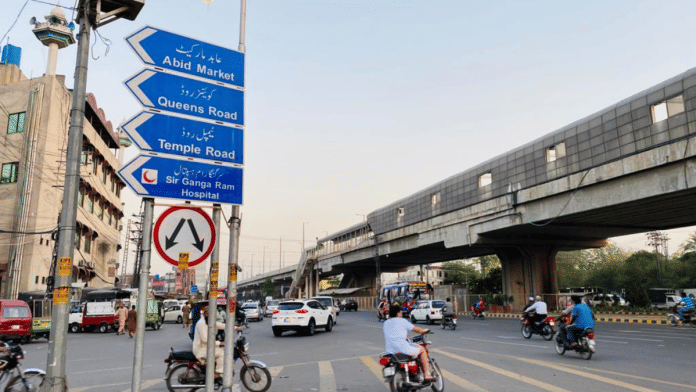
New Delhi: In Pakistan’s cultural capital Lahore, official signboards are now catching up with what its residents had quietly preserved all along—its syncretic tradition. Seventy-nine years after Partition, officials in Lahore have replaced signboards bearing Islamised names with older Hindu, Sikh, and colonial ones; for example, Islampura is Krishan Nagar, Babri Masjid Chowk has reverted to Jain Mandir Chowk. Within the past two months, nine locations have been renamed.
It is former Pakistan PM Nawaz Sharif’s dream project. He wants to restore Lahore to its “old glory”.
Sunnatnagar has reverted to Santnagar, Maulana Zafar Ali Khan Chowk is Lakshmi Chowk, Mustafaabad is now officially Dharampura, Sir Aga Khan Chowk has reverted to Davis Road, Allama Iqbal Road is again being referred to as Jail Road, Fatima Jinnah Road is once again Queens Road, and Bagh-e-Jinnah is reclaiming its colonial association as Lawrence Gardens.
In a country long shaped by decades of Islamisation, the changes have unfolded with almost no organised opposition.
The renaming campaign forms part of a much larger urban conservation drive known as Lahore Authority for Heritage Revival, or LAHR, an ambitious attempt of approximately 50 billion PKR to restore the city’s architectural and cultural fabric after decades of neglect, haphazard urbanisation and ideological rewriting. It was started by the Punjab Chief Minister Maryam Nawaz in 2025.
“The entire thing is part of revival or restoration. Mian Nawaz Sharif keeps mentioning why names should not change when the history or the original names, which are so common, popular and depict a certain time frame, should remain intact. And then we all agreed because in many cases, even when the names have been officially changed, the people still call them by the old names,” former Director-General of Walled City of Lahore, Kamran Lashari told ThePrint. Lashari is also the secretary of LHAR.
The LHAR is a dedicated body tasked with restoring and preserving the city’s historic sites, with PML-N president Nawaz Sharif appointed as the patron-in-chief of its steering committee.
Lahore is home to at least 115 buildings classified as heritage sites. Of the 75 colonial-era structures identified, restoration work is currently underway on 48 buildings. Alongside the steering committee headed by Sharif, a separate sub-committee comprising relevant government officials has also been formed to oversee the initiative.
For years, Lashari said, restoration efforts focused narrowly on segments of the walled city and monuments such as the Lahore Fort. But it all changed about two years ago when Sharif personally intervened, Lashari added, expanding both the ambition and funding of the project.
“One day, I got a call from Mian Nawaz Sharif’s staff. They said Mian Sahib wants to meet you,” he recalled.
At the meeting, Lashari said, Sharif spoke emotionally about restoring Lahore “to its original glory.” He said, “If not now, then never.”
The initiative now stretches far beyond the old city walls. Colonial-era districts along the Mall Road are being incorporated into the project. Historic promenades are planned. Overhead electrical wires are to be buried underground. Sewerage and drainage systems are being rebuilt. Encroachments near historic gardens and monuments are being removed. Entire stretches of the seven-kilometre wall surrounding the old city are expected to be reconstructed.
“This earlier project was maybe 15 or 20 per cent of the walled city. Now the model is being replicated to the whole city,” Lashari said.
He described a transformation intended not simply to conserve monuments, but to restore the layered identity of Lahore itself—Muslim, Sikh, Hindu, Christian, colonial and Mughal at once.
“Whether it is Christian, Sikh, Hindu or Parsi, it doesn’t matter. Inside the fort, there are many names of non-Muslims. We take them with great joy and enthusiasm,” he added.
Also Read: Who is Madam Pinky? Pakistan’s cocaine ‘queen’ who got ‘VIP treatment’ after her arrest
Restoring the cultural centre of Indo-Pakistan
Among the projects already completed or underway are the restoration of churches, gurdwaras, temples and other 19th-century Sikh structures associated with the empire of Maharaja Ranjit Singh.
Lashari said that the government had twice in the past attempted to install a statue of Ranjit Singh in Lahore, though both attempts were met with vandalism. Yet, now he insists the broader climate has shifted.
“To be honest, in the last couple of years, there has been a very relaxed, open and all-inclusive approach,” he said.
He further added that a painting of Princess Bamba Sutherland, the last descendant of the Sikh royal family, has been restored at the Sikh gallery in Lahore fort. The Kharak Singh Haveli, named after Ranjit Singh’s eldest son, has been rehabilitated under its original title. Gurdwaras near the Badshahi Mosque have also undergone conservation work.
Lashari pointed to the restoration of churches as another sign of changing attitudes. One recent project involved St. Mary’s Church, among the earliest churches established by the British in Lahore.
“The corps commander of the army himself was very keen. He said that the Punjab government should help restore it,” Lashari shared.
There was no major backlash, he added. Pakistan banned the far-Right Islamic party Tehreek-e-Labbaik in November 2025, days after the party clashed with the Punjab Police over a solidarity march for Palestine. The party was active in Lahore as well.
When LAHR was formed in March 2025, Sharif stated that restoring Lahore’s historical identity would benefit people across the country, adding that before the creation of Pakistan, Lahore was considered the cultural centre of Indo-Pakistan.
“Anarkali Bazaar, Neela Gumbad, Mall Road, these names are famous even in India. Nawaz Sharif told me that whenever he visited India, people remembered these places,” Lashari said.
Zeeshan Hussain, the founder of Lahore first online vlog and the coordinator for LAHR told ThePrint that the names had never changed in official papers and the people of Lahore never used the new names.
“Now under the restoration project, the street signs have also been reverted to its original pre-Partition era names,” Hussain said.
(Edited by Insha Jalil Waziri)
This is just superfluous, the crazy dream of a powerful politician.. It does not reflect the will of the people who are deeply fanatic and fundamentalists.. Just a gimmick.. If you really believe in this trying quashing the Blasphemy law.. That would be something..
Hiba Ji, Maybe you are delusional about what India is doing ! India is also reclaiming its history . So if Allahabad was renamed by Islamic plunderers , it has been right reverted back to Prayagraj ! The issue is Pakistani history is India history. The same doesnt work the other way round. This is not some competition that who is naming their places in a more secular way which seems to be the wrong conclusion your esteemed self has arrived at ! By the way, there are still practicing Zoroastrians in India. Not sure about Pakistan though. For Pakistan this may be a synthetic exercise , whitewash but for India it comes naturally.
@Hiba Your sheer audacity! After wiping out and forcibly converting almost all non-Muslim population from Pakistan and now Bangladesh, and multiplying here in India, after every other archeological site showing a temple brutality converted to a mosque, after making Kashmiri Pandits refugees in their own country, after renaming every ancient city and site in India to propagate your cult, you have the audacity to give us lecture on how we shouldn’t revert back to the original names of our places. Shameless!
Meanwhile India is doing the reverse, erasing literally every single Perso-Arabic name the puritanical eye can see.
Two nation theory out for the world to see?