




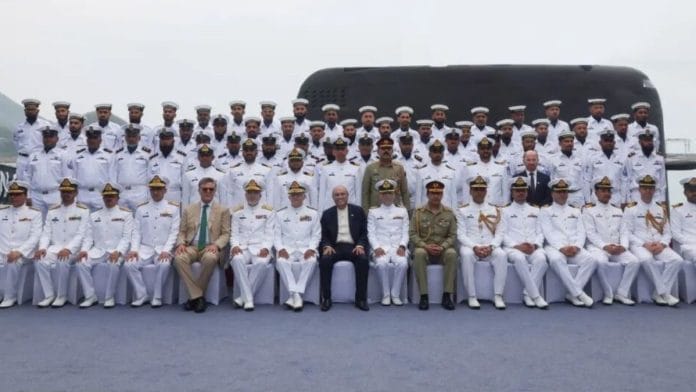

Pakistan’s high-level visits to China are typically rich in optics, carefully choreographed to project the strength of an all-weather partnership. Yet Pakistan President Asif Ali Zardari’s week-long visit departed from this familiar script.
The visit, from 25 April to 1 May, was unusually subdued, drawing little media attention at first. The low-key tone reflected China’s somewhat quiet delivery of the first S26P (Kirin/Hangor-class) conventional submarine to Pakistan. Zardari, accompanied by Pakistan Chief of Naval Staff Admiral Naveed Ashraf, visited a naval port in Sanya to receive the vessel. The submarine is part of an eight-boat agreement signed in 2015, valued at around $5 billion and structured under a 4+4 model, with four submarines built in China and four in Pakistan under a technology transfer arrangement.
The S26P is expected to feature air-independent propulsion (AIP) to enhance underwater endurance and is reported to be capable of carrying torpedoes, anti-ship missiles, and the Babur-3 submarine-launched cruise missile, reinforcing Pakistan’s sea-based deterrence posture.
A Chinese commentator notes that the name “Hangor” references a Pakistani submarine credited with sinking India’s INS Khukri in 1971. Pakistan’s current submarine fleet mainly consists of upgraded French-built Agosta-class vessels, while earlier efforts to acquire newer European submarines did not materialise due to financial and political constraints. In effect, China is seen as the principal external supplier filling this capability gap.
Liu Zongyi, director of the Center for South Asian Studies at the Shanghai Institute for International Studies, argues that Pakistan’s priority is to draw on China’s experience to strengthen its industrial base and advance modernisation. Wu Peixin, a Beijing-based commentator, notes that these are the first submarines in South Asia fitted with an AIP system, using China’s domestically developed Stirling engine. This enables prolonged submerged operations at low speeds for several days. The capability marks a clear generational shift from conventional diesel-electric submarines and narrows the operational gap with more advanced undersea platforms.
On Chinese social media, the delivery has been framed as a milestone in China-Pakistan defence cooperation, with wider implications for maritime security dynamics in the Indian Ocean.
The India factor
At the commissioning ceremony, Pakistan’s leadership emphasised the submarines’ role in deterring potential aggression and securing sea lines of communication across the Arabian Sea and the broader Indian Ocean Region (IOR). Interestingly, Chinese discourse overwhelmingly interprets the development through the prism of India and regional balance in the IOR.
A Baijiahao commentator described the delivery in hyperbolic terms, claiming Pakistan had staged an event “enough to shake the Indian Ocean” and suggesting that Indian Prime Minister Narendra Modi would be “unable to sleep”. The same commentary framed the induction of the Hangor-class submarine as a qualitative leap in Pakistan’s undersea capability that would undermine India’s ambition to dominate the IOR.
Within this narrative, the S26P is presented as a platform capable of altering India’s naval posture. Some analyses argue that its low acoustic signature could complicate India’s anti-submarine warfare environment, including against nuclear-powered submarines. They further suggest that once all eight submarines are operational, Pakistan’s undersea fleet could reach its most capable state to date, with implications for regional naval balance.
Other assessments extend this argument further, highlighting potential risks to high-value Indian naval assets, including carrier strike groups, and pointing to perceived gaps in India’s anti-submarine warfare capacity. The submarines are also linked to Pakistan’s evolving sea-based nuclear deterrent, with suggestions that they could strengthen a credible second-strike capability.
One commentator distils the submarine cooperation framing into four elements: enhanced strike and deterrence capability, including sea-based nuclear second-strike potential; an asymmetric naval strategy designed to offset India’s numerical advantage and raise the costs of anti-submarine warfare; India’s vulnerabilities, particularly an ageing submarine fleet and slow modernisation; and broader regional implications, including an expanded Chinese strategic footprint and a gradual shift towards a more contested undersea balance in the Indian Ocean.
Also read: Colombo Security Conclave is shaping India’s security architecture in the Indian Ocean
Between capability and hyperbole
At the more extreme end of online discourse, a viral Weibo post claimed that Pakistan could one day supplant the US as a military hegemon in the Middle East. In a similar vein, a vlogger described the emerging equation as a mix of “China’s sword, Saudi money, and Pakistan’s guts”.
Such narratives extend beyond assessments of naval modernisation. They reflect a highly politicised and speculative discourse on China–Pakistan defence cooperation, in which strategic developments are amplified and reframed across both official and online spaces. China has been using Pakistan as a proxy in the regional balance against India, with Pakistani narratives also amplified in the aftermath of Operation Sindoor.
Beijing’s sustained defence support is part of a broader effort to expand Pakistan’s maritime power in ways that are attempts to constrain India’s position in the Indian Ocean, while feeding into a wider regional strategy that extends toward West Asia and beyond.
Sana Hashmi is a fellow at the Taiwan Asia Exchange Foundation. She tweets @sanahahsmi1. Views are personal.
(Edited by Saptak Datta)
Felt concerned to read that Pakistani submarines will have Air Independent Propulsion systems before ours will. Of course, as a dove, feel India’s $ 92 billion defence budget is already too high. That apart, why are we struggling in terms of capabilities against Pakistan, not China.
Do not worry Pakistanis and Chinese. He is anyway an insomniac as claimed by him. Did Pakistanis forget how they were bombed in the dead of night. A sleeping person would not choose such a timing.