




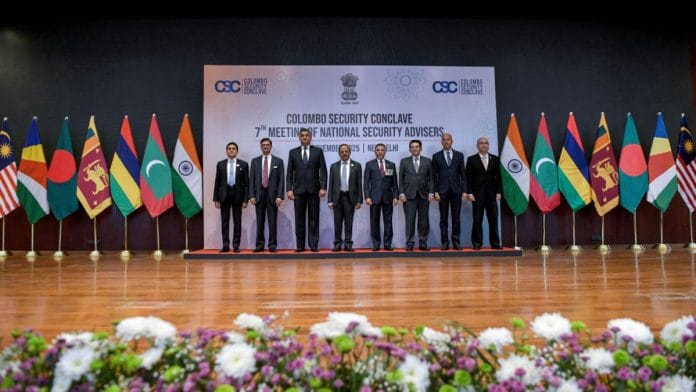

In a region that has groupings such as QUAD, BIMSTEC and IORA, the Colombo Security Conclave has garnered relatively little attention. The CSC is deliberately narrow in scope and operational in design. It focuses on maritime domain awareness, counter-terrorism, cyber security and transnational crime. It reflects an important shift in India’s regional security approach—away from large membership groupings, which are based on consensus-driven multilateralism, toward smaller, trusted and functionally effective coalitions in its immediate maritime neighbourhood. It is precisely because of these characteristics that the CSC may prove to be one of the most consequential instruments in shaping India’s security architecture in the Indian Ocean.
Since its launch in 2011 as an informal trilateral dialogue on maritime security between India, Sri Lanka and the Maldives, the CSC has steadily broadened both its membership and its mandate. It has evolved into a more structured and ambitious regional mechanism. The inclusion of Mauritius as a full member and the addition of Bangladesh and Seychelles as observers signalled an early expansion of its geographic reach. But the more significant shift has been functional. The CSC’s agenda has moved beyond maritime domain awareness to encompass counter-terrorism, cyber security, trafficking, organised crime and humanitarian assistance. This widening scope has been accompanied by greater institutionalisation through regular meetings, working groups and coordinated capacity-building efforts, transforming it from a dialogue platform into a more operational security framework.
The recent move to internationalise the CSC marks the next phase of this evolution. The attempt is to scale its model beyond a tightly knit mini-lateral arrangement, while retaining its core emphasis on practical issue-based cooperation in the Indian Ocean.
At the 7th Colombo Security Conclave National Security Advisor (NSA)-level meeting held in New Delhi in November 2025, chaired by Indian NSA Ajit Doval, the importance of enhancing cooperation under the identified pillars, including through training and capacity building, was discussed. Commitment to the vision and objectives of the CSC was reiterated, and the CSC members welcomed the decision of Seychelles to accede to the CSC as a full member.
On 19 April 2026, India’s foreign secretary, Vikram Misri, announced the upgradation of the CSC during his visit to Colombo. It signalled a decisive step toward transforming the grouping into a more structured and outward-looking regional security framework. In his remarks, Misri emphasised the need for greater institutionalisation and broader international engagement, indicating that the CSC would move beyond its current format as a tightly knit mini-lateral platform. This announcement builds on the earlier push by NSA Doval, reflecting continuity in India’s strategic thinking.
Also read: theGrey-zone warfare to Chinese spy ships—India’s undersea cables need a security doctrine
Advantages for India
These recent developments suggest that the CSC is entering a new phase that seeks to combine its operational focus with a wider regional role in shaping security cooperation across the Indian Ocean.
While this upgradation has an impact on all countries in the Indian Ocean, for India, it serves multiple strategic functions that other groupings cannot fully deliver. First, it consolidates India’s role as a net security provider in the Indian Ocean. Unlike the Quad, where India is one among four major powers, the CSC places India at the centre of a regional security network. Second, it addresses non-traditional threats with direct domestic implications. For instance, drug trafficking routes through the Bay of Bengal have a direct bearing on India’s northeastern states, and maritime crime and illegal fishing affect our coastal economies. The CSC allows India to tackle these issues collectively rather than unilaterally. Third, it provides a subtle mechanism for strategic balancing. Without explicitly referencing China, the CSC builds resilience among smaller states, reducing their dependence on any single external actor.
India has already helped link coastal surveillance radars in the Maldives, Sri Lanka, Mauritius and Seychelles to its information fusion architecture. This matters because the Indian Ocean carries the bulk of India’s external trade—roughly 95 per cent by volume and about 70 per cent by value—and is also a conduit for illicit flows. Shared “white-shipping” data and coordinated patrols improve detection of illegal fishing, trafficking and suspicious vessel movements in the Bay of Bengal and western Indian Ocean. The Bay of Bengal has seen repeated large seizures of methamphetamine tablets routed from Myanmar (which is one of the largest producers of synthetic drugs in the world) toward South Asia, which underscores the need for cross-border intelligence and interdiction. In November 2024, the Indian Coast Guard intercepted a vessel from Myanmar near the Andaman and Nicobar Islands. They found around 6,000 kg of methamphetamine onboard. The estimated value of the consignment was a staggering Rs 36,000 crore or approximately $ 4 billion. It was the largest haul of narcotics ever to be seized by the Indian Coast Guard. It is evident that the only way to mitigate these growing threats is by institutionalising information sharing amongst the coastal countries. The CSC, to this end, has the capacity to turn fragmented bilateral efforts into networked enforcement.
Finally, the CSC consolidates India’s position in different ways. In recent years, the Indian Navy and Coast Guard have undertaken many humanitarian aid and disaster relief missions, such as cyclone relief in Sri Lanka, earthquake relief in Myanmar and emergency assistance in the Maldives. The CSC provides a framework that will enable standard operating procedures, making aid deployment smoother and quicker, traversing through any red tape.
From all the possibilities that the CSC promises for the region, perhaps the most important and not explicitly stated is how the CSC offers a low-friction way to shape regional order. Many states in the Indian Ocean follow multi-vector foreign policies. Through the CSC, they can participate fully without any diplomatic repercussions because the grouping is not positioning itself as a deterrence mechanism for expansionist regional presence or for port arrangements in the Indian Ocean.
Nevertheless, India’s encouragement of the CSC to become increasingly institutionalised is not incidental. It is arguably one of the most calibrated moves in recent times, as a response to evolving security anxieties in the Indian Ocean, especially its eastern littoral. Post the inclusion of Bangladesh in 2024, the CSC has widened its area of influence from a Western Indian Ocean initiative to a Bay of Bengal and Indian Ocean Region security grid. If one were to read between the lines, the CSC is India’s move to regionalise security before it is internationalised by others.
Rami Niranjan Desai is a Distinguished Fellow at the India Foundation, New Delhi. She tweets @ramindesai. Views are personal.
(Edited by Theres Sudeep)