




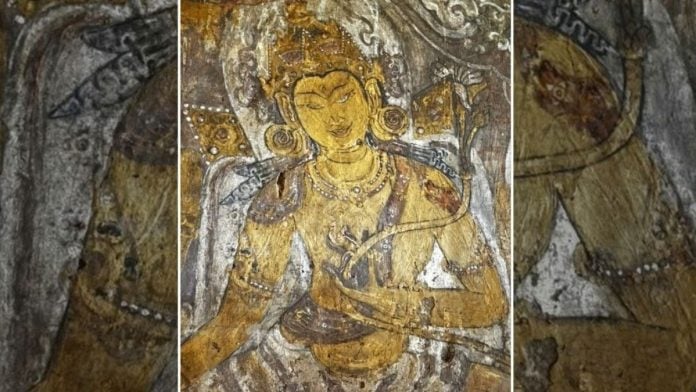

Barely a few hours’ drive from a frontier of the Myanmar civil war, in a dark corridor covered in bat droppings, are the most glorious surviving murals produced by medieval Bengali artists.
They cover the wall from floor to ceiling, still retaining some of their lustre. You can still make out—in the delicate black outlines, the deftly-painted fingers, the painstakingly rendered textiles—the hands of several master artists.
How did these painters end up so far from home? And how did their work survive here, in politically unstable Myanmar, when no traces remain in West Bengal and Bangladesh?
A lost Buddhist kingdom
The kingdom of Bagan was Myanmar’s most powerful medieval state. Established in the ninth century and wiped out by the Mongols in the 13th century, it was an almost exact contemporary of South India’s Chola empire. Like the Cholas, the apogee of Bagan was in the 11th century, when two successive kings, Anawrahta or Aniruddha (r. 1044–1077 CE) and Kyanzittha (r. 1084–1112/13), established their authority over neighbouring polities and sent out several high-profile embassies.
Kyanzittha, for example, wrote a letter with vermillion ink on gold leaf to an Indian ruler called the “Choli prince” — very possibly the Chola emperor Kulottunga I (r. 1070–1122). His letter, he claimed, convinced the Choli to “cast off his adherence to false doctrine” and convert to Buddhism. The Choli then sent precious gifts of pearls, a bejewelled tree, and a daughter for Kyanzittha to marry. (Epigraphia Birmanica I, p. 165) Kyanzittha also paid for repairs at the Mahabodhi temple, which in his words “had been destroyed by other kings”. This was more than a century before any Turk army had set foot in Bihar.
At the end of September this year, I visited Bagan. A walled city of brick on the shores of the Irrawaddy, this medieval capital was able to source precious woods, elephants and aromatics from upriver, while maintaining a flourishing connection with the Indian Ocean through its vassal-states downriver on the Irrawaddy delta. These downriver Irrawaddy states had been Buddhist from the early centuries CE, when the first missionary monks and merchants crossed the Bay of Bengal.
They largely followed the conservative Theravada or “Way of Elders” branch of Buddhism, even as Northern India transitioned into new forms such as Mahayana (the worship of future Buddhas) and eventually, esoteric Vajrayana: a tantric methodology, including sacred diagrams, goddesses, and offerings. For context, Theravada is still popular in Myanmar and Sri Lanka, while Vajrayana underpins Tibetan and Nepali Buddhism.
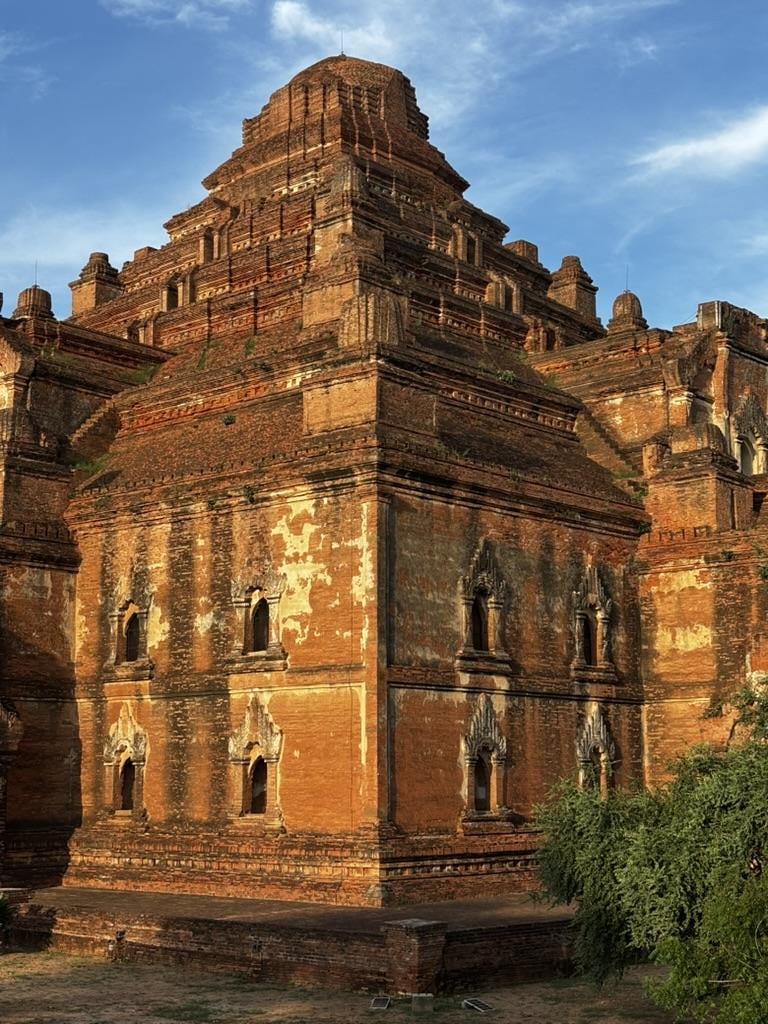
Bagan was a Monsoon Asian state, and shared many features with its Indian contemporaries. Like the Cholas on the other side of the ocean, the kings of Bagan used monumental temples to establish authority and redistribute resources. Unlike the Cholas, who built in stone, the Bagan kings preferred to build in brick. High vaults and windows allowed sunlight to pierce the interior, shining off towering gilded Buddhas.
Over the centuries, the aristocracy of Bagan commissioned dozens of temples large and small. Families built temples together over generations, seeking to generate merit for better future lives. The inscriptions they issued mention rich gifts of land, water tanks, gold, and enslaved people.
Since the country’s independence in 1948, the rulers of modern Myanmar have portrayed Bagan as a Theravada power, in much the same way as Indian nationalism claims medieval kingdoms as “Hindu” or “Muslim”. The wall-paintings of Bagan, though, tell a slightly different story.
Also read: How Rajput patronage turned Krishna into Mughal India’s most popular god
The three teams
In an as-yet unpublished paper, art historian Claudine Bautze-Picron, one of the leading scholars of Bagan art, argued that Anawratha and Kyanzittha invited teams of Bengali painters to properly decorate the new ritual spaces growing in the city. No earlier temples in the region had painted interiors, and the styles, motifs and techniques of the Bagan murals match those with manuscripts produced in Comilla, now in southeastern Bangladesh.
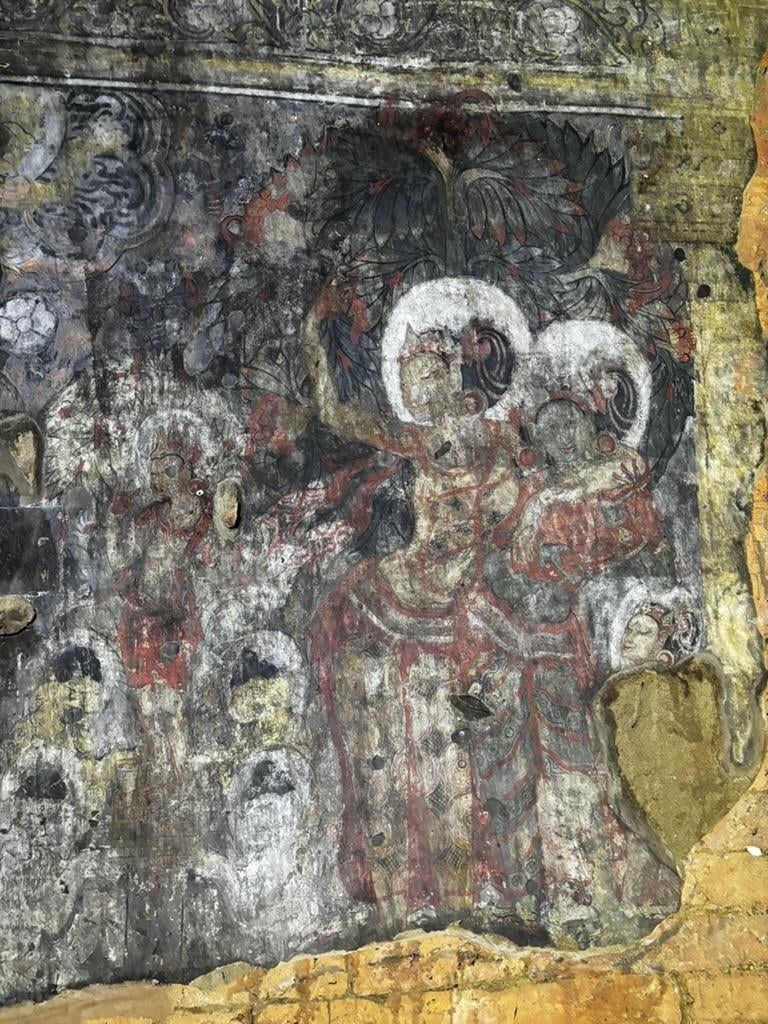
Bautze-Picron argues that three teams were active in Bagan — each with a slightly different approach. One group was deployed in the older portion of Bagan city, working on the Pahtothamya, Kubyauk-gyi, Lokahteikpan, and Myebontha temples. Another team worked on the Nagayon and Abeyadana temples, commissioned by the king Kyanzittha and his queen respectively.
How can we tell? This latter team used yellowish and ochre tones to a much greater extent than those of the old city. But both shared some techniques: square panels in jewelled borders, red grounds seen in Bengali Buddhist manuscripts, and lotus-petal eyes for divine figures. Bagan artists quickly learned from the Bengali masters; by the mid-12th century, they had a distinct local tradition, and, according to Bautze-Picron, increasingly looked to Chinese motifs in their art.
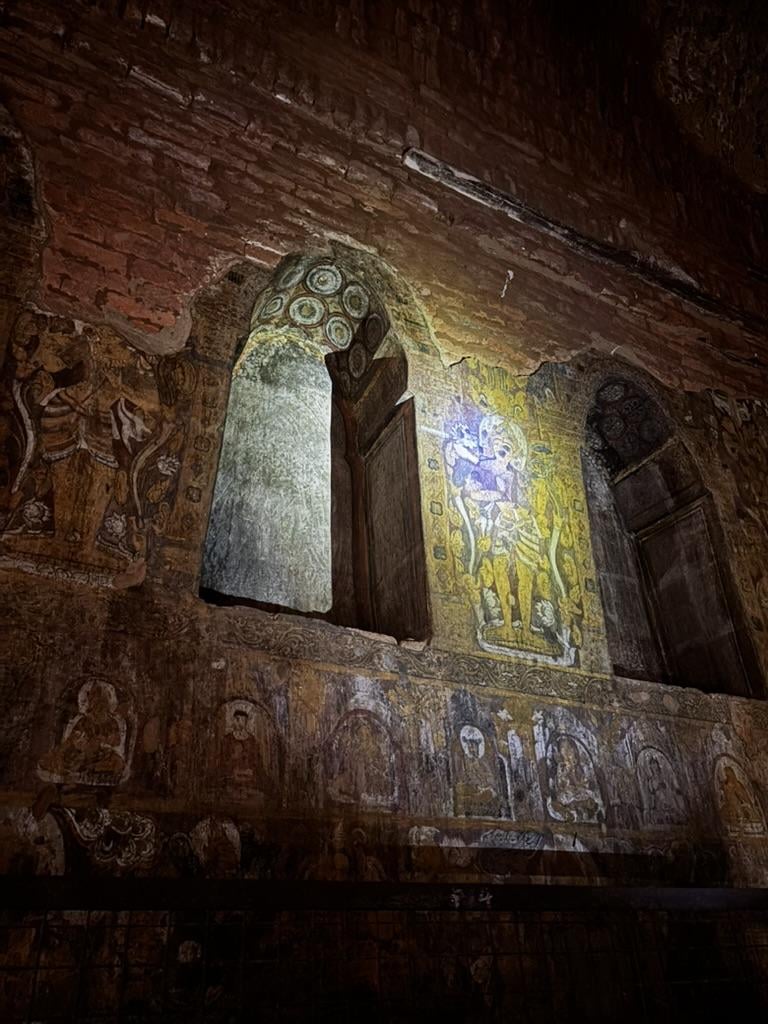
With all this said, the early Bengali painters weren’t simply “Indianising” Bagan: they were working to exact schema provided by local patrons. The labels are in the local Mon script, suggesting that the painters were supervised by monks who had a clear idea of what was to go where. Surviving Bengali Buddhist manuscripts today are overwhelmingly Mahayana and Vajrayana, which see the historical Siddhartha Gautama as one Buddha among many. They emphasise future Buddhas like Avalokiteshvara and Manjushri, as well as the goddess Tara.
While the Bagan murals use similar artistic styles, the actual programme is very much Theravada, following texts like the Buddhavamsa and the Jatakas, which are interested in Gautama Buddha’s life and his previous incarnations.
The great exception to this is the Abeyadana temple — a queen’s temple, with a decidedly Vajrayana programme. Hindu deities are shown revering Buddhas. Avalokiteshvara and Manjushri are depicted teaching disciples. And, most enigmatically, several yoginis appear, female magicians with the heads of dogs and horses. I also spotted a multi-armed figure wearing a garland of skulls. Given the history of yogini worship in India, what the queen sought to achieve with these figures, and what rituals might actually have happened within the dark corridors under the calm eyes of the Buddha.
Also read: India was once home to free-flying, meat-eating goddesses. Yoginis were feared and respected
End of Bagan and Bengali Buddhism
Bagan’s decline followed the trajectory of many premodern states in Monsoon Asia. As Buddhist patronage widened, kings grew weaker in comparison (helped along by dynastic infighting). Neighbouring Bengal saw similar trends. In the 1200s, Central Asian expansion ended both powers: the Turks rampaged through Bengal, while the Mongols sacked Bagan.
In the centuries after, though, Buddhism rapidly recovered in Myanmar, while Bengal transitioned towards Vaishnavism and Islam. Bengal’s great Buddhist temples and monasteries, once sacked, fell into ruin and were probably pillaged by locals for their bricks. In Bagan, however, several Burmese dynasties undertook restoration programmes, including the Konbaung as late as the 1700s. Old Bagan locals sheltered in the temples in rainy seasons, but otherwise left them largely as they were. In its brief moments of political and democratic stability, Myanmar has received sustained help from international partners to restore and preserve the murals — including the Archaeological Survey of India and UNESCO.
Bagan today attracts a mere trickle of tourists, compared to nearly 2,00,000 at its peak before the 2021 military coup. While Indians continue to live and work in Myanmar’s capital, Yangon, few are able to visit Bagan, further inland. And so the handiwork of the 11th-century Bengali masters sits silent in the terracotta temples — a vivid, but fading, reminder of the ties that crisscrossed the ancient ocean.
Anirudh Kanisetti is a public historian. He is the author of ‘Lords of Earth and Sea: A History of the Chola Empire’ and the award-winning ‘Lords of the Deccan’. He hosts the Echoes of India and Yuddha podcasts. He tweets @AKanisetti and is on Instagram @anirbuddha.
This article is a part of the ‘Thinking Medieval‘ series that takes a deep dive into India’s medieval culture, politics, and history.
(Edited by Saptak Datta)