






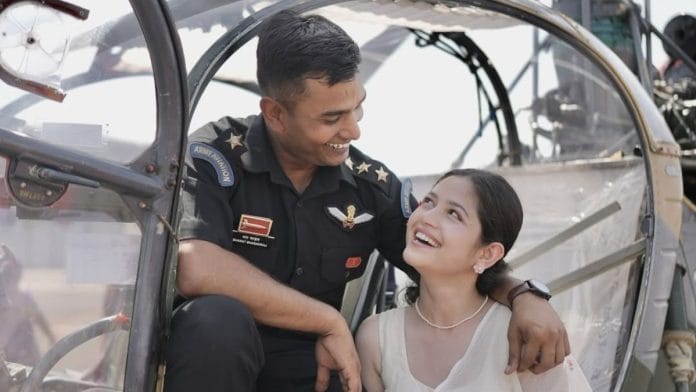


An Indian Army captain completed his helicopter training, walked across the tarmac after the passing out parade, dropped to one knee and proposed to his long-time girlfriend. There was a helicopter in the background. There were cheers and photographs from friends and colleagues. There was, by all accounts, a young couple celebrating a milestone.
But because this is India, a controversy was born.
India has a peculiar relationship with its armed forces. The ideal Indian soldier, at least in the public imagination, is to exist in a permanent state of duty. He is brave but never playful. Patriotic but somehow detached from the ordinary joys and anxieties of life. He can stand guard on a glacier, he can fight a war, he can die for the country. But laughing, loving, flirting — that too publicly — is just not acceptable. That will lead to an internet debate and even a reprimand from the Army.
The objections were as old as time. How could a military officer use a helicopter as a backdrop? Was the uniform being “misused”? Has professionalism been sacrificed at the altar of social media?
India’s adoration of the armed forces has a curious strain of moral puritanism that elevates military personnel into national icons and then resents them for behaving like ordinary people.
We have turned soldiers into stained-glass figures.
Army reportedly expresses displeasure over proposal in uniform during military ceremony 🇮🇳
According to Army sources, Captain Bharat Bhardwaj allegedly violated military decorum and protocol by proposing to his fiancée while in uniform during a Passing Out Parade-like ceremony… pic.twitter.com/3F6cFeF2nv
— Raksha Samachar | रक्षा समाचार 🇮🇳 (@RakshaSamachar) June 3, 2026
No office abolishes human nature
Military service already demands more from an individual than most professions ever will. Long postings away from home, missed birthdays and anniversaries, frequent relocations. And the possibility that a routine phone call may one day become life-altering news.
We invoke them in election speeches, deploy them as characters in nationalistic movies and summon their sacrifices whenever patriotism needs theatrical reinforcement. Yet the moment one of them acts just remotely human, the public reacts as though a sacred covenant has been violated.
There is a saying: “On the highest throne in the world, we still sit only on our own bottom.” It is a reminder that no office, however exalted, abolishes human nature.
Yet India’s relationship with the military often demands precisely that abolition. The uniform must consume the individual and the institution must eclipse the person.
This burden does not stop with soldiers themselves. It extends to wives, husbands, children and parents. Military families are expected to embody a kind of permanent public virtue. Society demands that they must be dignified but not expressive. Just see how the new Navy chief Admiral Krishna Swaminathan’s daughter and wife were castigated for flaunting tattoos at his swearing-in.
The Army took cognisance of the matter and relayed to the young officer that he had violated several rules while posing with the chopper. The Army also has a clear stance against using military equipment for their personal social media posts.
There are, of course, questions of protocol in any institution, especially the armed forces. But this prudishness is a bit far-fetched. They should be lenient, it is 2026 and social media is a part of life. More than that, having fun should not be banned. Even retired officers agree.
Also Read: The Navy chief’s daughter’s tattoos and our obsession with ‘good women’
Custodians of ideals
The captain and his fiancée were being judged as custodians of an ideal, not as individuals. And Indians are notoriously demanding custodians of their ideals.
Soldiers must carry the burden of national defence and even our fantasies about discipline, masculinity, sacrifice and patriotism. We expect them to be braver than us, stronger than us, more restrained than us and place them on a pedestal. Then we complain when they behave like the rest of us.
The result is a form of admiration so excessive that it becomes dehumanising.
Which is why maybe it is easier to love an ideal than a person. Ideals do not age, make mistakes, fall in love or seek happiness. People do.
And India’s self-appointed guardians of military virtue might have become incapable of recognising simple joy.
A proposal on a parade ground is not a constitutional crisis. Sometimes a helicopter is just a helicopter. But in this case, the Cheetah/Chetak helicopter, originally French Allouette, is a museum relic. The real outrage from the prudes of the internet should have been against our officers still flying one of these.
Views are personal.
ThePrint has found a worthy successor to Ms. Karanjeet Kaur in Ms. Stela Dey.
Ms. Kaur reports on nothing else but Goa and consistently thunders against ‘outsiders’, especially Delhi-walas, ruining pristine Goa and innocent Goans. The irony is that she herself is from Delhi/NCR and Punjab – the irony is not lost on anyone.
Ms. Dey seems to have accepted Ms. Kaur as her guru. Pointless fulminations and rants against society in general, and men in particular, seem to be her forte.