






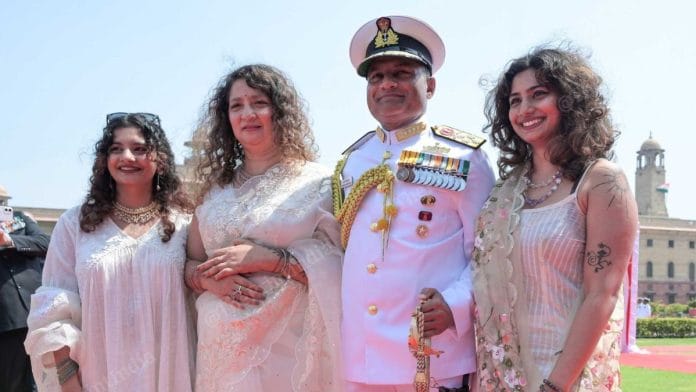


A new Navy chief had just taken charge. The photograph from the ceremony contained all the ingredients of a state occasion: Admiral Krishna Swaminathan’s immaculate white uniform, rows of medals earned over decades of service, the grandeur of the South Block, and a family assembled around a moment of professional triumph.
Yet, as often happens in India, the national gaze wandered away from the officer and his achievement, and settled instead on a woman’s body. This time, the target was Admiral Swaminathan’s daughter, standing next to him, smiling and flaunting some tattoos.
Within hours, the internet had done what it does best. A photograph became a Rorschach test. Some saw tattoos while others saw rebellion. Many saw evidence—somehow—of declining values, changing culture, parenting failure, and a dozen other complaints that had little to do with the woman in the frame, who was almost entirely absent from the conversation.
What unfolded on India’s Orwellian internet over the last two days was never really a debate about tattoos.
The country has settled that argument years ago, whether it realises that or not. Tattoos adorn our favourite stars, cricketers, corporate executives, and social media influencers. Just go to rural India. Tattoos have been tradition across communities, from central India to the Northeast, for centuries.
The same civilisation that produced intricate traditions of body marking now behaves as though tattoos arrived in India on a flight from Los Angeles.
And yet, the male gaze is one of control.
The daughter of a senior military officer occupies a peculiar place in the Indian imagination. She is expected to embody a certain ‘respectability’, to perform it for the public. She is seen less as an individual than a reflection, a surface upon which society projects its expectations of family, culture, and tradition.
Even in matters and moments of patriotism, Indians obsessed with nationalism don’t spare women. They want to have a say in how any woman walks, talks, or behaves.
This instinct is older than social media and older than the republic itself.
Indian society has long treated women as repositories of collective meaning. We burden them with civilisation, honour, and identity. Self-appointed watchdogs control how women dress, speak, marry, and move through the world. For centuries, the female body has functioned as a public noticeboard onto which men (and many women) pin their anxieties about culture and morality.
The strange thing is that the noticeboard is expected to remain blank unless approved by the mob. A tattoo disrupts that arrangement.
Unlike clothing, which can be changed, or jewellery, which can be removed, a tattoo is permanent. It implies deliberation and commitment, that someone chose it for life.
For societies invested in regulating women, that is an unapproved, unsurprisingly radical move.
Also read: After unbeaten 75 in IPL final, Virat Kohli wears a ‘Work in Progress’ tee
Anxieties of masculinity
Another patriarchal anxiety was lurking beneath the outrage over Admiral Swaminathan’s photo—a particular idea of masculinity and authority.
Many comments questioned the new Naval chief. How could the daughter of a naval chief be inked? Why had the man of the house “allowed” it?
For generations, Indians have romanticised the uniform as the ultimate symbol of discipline, order, and command. Many began to assume that these qualities ought to extend beyond the parade ground and into the living room. In this fantasy, the ideal officer is supposed to protect the borders as well as command his household.
But leadership is not ownership. Authority over a fleet does not confer authority over another adult’s body.
Yet, much of the outrage seemed rooted in the belief that a “real man” keeps the women in his house within prescribed boundaries. That their appearance, choices, and self-expression somehow reflect the strength of his character. This parochial idea—that a man’s honour resides in his ability to regulate the women in his family—still persists.
This same society is remarkably quick to blame women for their actions or inactions.
If a child succeeds, families quickly claim collective credit. But if children stray from convention, the mother is still summoned to the dock.
In the photo, the Admiral’s wife, too, was flaunting a tattoo near her collarbone.
The accusations then just wrote themselves. It started with “Oh, she learned from her mother” to “the mother should have paid more attention” because the father was busy protecting the country.
For all our talk of progress, the script remains stubbornly familiar.
Women are the de facto custodians of culture. And when they choose to exercise freedom, they’re accused of failing to protect the nation and society’s values.
Respectability politics, meanwhile, reveals its contradictions with lightning speed the moment a woman chooses to do what she wills with her body—from her choice not to have children, cutting her hair short, the clothes she wears, and even the colour of her lipstick.
And public conversations about women are so often reduced to appearance. Because criticising someone’s appearance is easy. It requires no effort, curiosity, or engagement with the actual person standing before us.
So a young woman’s work in environmental sustainability and climate action was eclipsed by her tattoos.
The eye does not go to the substance of a life but to the surface of skin.
Views are personal.
(Edited by Prasanna Bachchhav)
I completely agree with the author of last comment. The responsibility lies with the platform owner on what topics they allow to be discussed on their platform. I do respect The print that when it comes to political topics they seem to be balanced.
However when it comes to social and gender topics, contributors like Stela and Karanjeet all they do is man bashing. Pouring their frustration and literary skills by going against a particular community of society, men, which majority of them are more engaged in earning the livelihoods for their families.
I tagged The print in different social media platforms to bring their attention to a new porter service named CarryMen and how that is sexist. Let’s see if they cover that.
People like Stela Dey is exactly what is wrong with Indian journalism. She wrote a lengthy article on what? Some idiots who trolled a woman on social media. Those idiots and trolls, she assumed (despite her education and journalistic experience), are authorised representatives of Indian society.
Rather than reporting on issues which actually impact people’s lives – for example, the govt’s absolute apathy in dealing with the heatwaves which has resulted in hundreds of deaths across the country in the last two weeks – she wants to lecture us Indians on non-issues like social media stupidity.
What is really sad is that ThePrint seems to have become a platform for such pointless fulminations and pontifications. Ms. Karanjeet Kaur is another example of such pointless journalism -again a regular ‘contributor’ to ThePrint.