



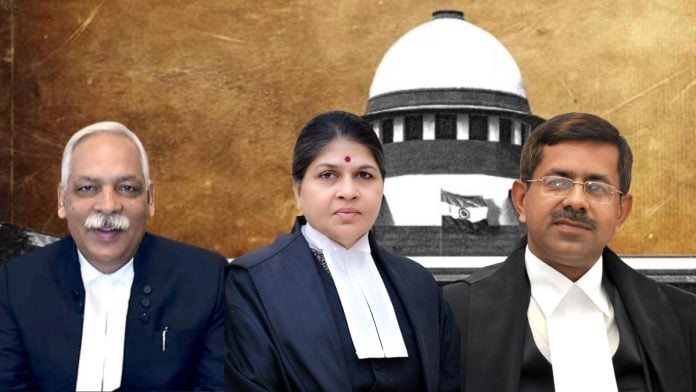
New Delhi: President Droupadi Murmu has cleared the appointments of three judges to the Supreme Court a week after the SC Collegium made its recommendation. The three judges—Justice Sunita Agarwal, Chief Justice of the Gujarat High Court; Justice Devendra Kumar Upadhyaya, Chief Justice of the Delhi High Court; and Justice Aparesh Kumar Singh, Chief Justice of the Telangana High Court—are set to take oath on Tuesday, 6 October.
With this, the number of Supreme Court judges now stand at 37 with one vacancy remaining. The number of women judges has risen to three, alongside 34 men. The apex court’s sanctioned strength was increased from 34 to 38 judges earlier this year through a Presidential Ordinance, which was subsequently made an Act.
The Collegium’s recommendation had once again raised questions over the criteria for superseding senior judges and the lack of transparency in the selection process. Justice Sunita Agarwal, Justice Devendra Kumar Upadhyaya, and Justice Aparesh Kumar Singh are ranked fourth, fifth and sixth, respectively, in the all-India seniority list. Their recommendation effectively supersede the three senior most judges ahead of them. None of the three, however, is in line to become Chief Justice of India (CJI).
According to a report by The Leaflet, Justice Shree Chandrashekhar, who was appointed to the Supreme Court on 2 June, was junior to Justice Singh. Yet Justice Singh was superseded at the time. With Justice Singh now being elevated, he will enter the Supreme Court as junior to Justice Chandrashekhar. No reasons were given for Justice Singh’s supersession in June.
The Collegium made its recommendations at a meeting on 28 September. It did not provide reasons for selecting the three judges.
Here’s a look at the three judges and some of their notable judgments:
Justice Agarwal: Allahabad to Gujarat to SC
Justice Sunita Agarwal was born in 1966 and practised as a lawyer at the Allahabad High Court before being appointed a judge of the court in November 2011. In July 2023, she was appointed Chief Justice of the Gujarat High Court by the then CJI DY Chandrachud-led Collegium, becoming the second woman to head the court.
In February 2025, nearly two years after her appointment as Chief Justice, the Gujarat High Court Advocates’ Association passed a resolution seeking her transfer. It cited concerns over “judicial independence” and changes to the judicial roster, raising questions over propriety and the exercise of master-of-the-roster powers.
Senior advocate Asim Pandya had written a letter saying, “Another incident that might have prompted the chief justice to change the roster was the remarks made by the second judge against the current registrar (SCMS & ICT) with regard to missing files from the high court registry”.
Hours after the resolution was circulated, the Law Ministry issued a notification appointing the next senior most judge, Justice Biren Aniruddh Vaishnav, as Acting Chief Justice, with Justice Agarwal having gone on a two-week leave.
In her most recent ruling, delivered on 29 September, a day after the Collegium recommended her elevation, a bench led by Justice Agarwal dismissed former Delhi Chief Minister Arvind Kejriwal’s appeal against a 2023 Gujarat High Court order concerning disclosure of Prime Minister Narendra Modi’s educational degrees.
In 2016, the Central Information Commission (CIC) had directed Gujarat University to provide information concerning degrees in Modi’s name. The university challenged the direction before the High Court.
In March 2023, a single-judge bench set aside the CIC’s direction, holding that information concerning the Prime Minister’s educational degrees was exempt from disclosure under Sections 8(1)(e) and 8(1)(j) of the Right to Information Act in the absence of a larger public interest justifying disclosure. It also imposed a Rs 25,000 fine on Kejriwal.
Kejriwal challenged the order, but a division bench of Chief Justice Agarwal and Justice D N Ray upheld the fine and dismissed his appeal. It held that no larger public interest had been demonstrated in seeking the PM’s educational records.
As Chief Justice of the Gujarat High Court, Agarwal also took suo motu cognisance of several matters of public concern.
In September 2023, following an Ahmedabad Mirror report on the alleged sexual harassment of two students at Gujarat National Law University (GNLU), a bench led by Justice Agarwal took suo motu cognisance of the issue. The bench was critical of the university’s initial response and observed that its in-charge registrar had made an “overt anxious effort” to dilute the matter through a summary inquiry.
The court was subsequently informed that a High-Level Committee has been constituted comprising a former Supreme Court judge, the Attorney General of India, a member of the university’s governing council, and a former Additional Chief Secretary of Gujarat’s Finance Department. The committee was tasked with assessing the university’s performance over the previous five years in academics, administration, finance and student safety and security, and suggesting corrective measures.
In its final order, the court said the university director had “utterly failed in discharge of his duty” in responding to the proceedings.
Another notable case in which a bench led by Agarwal took suo motu cognisance was the January 2024 Harni Lake boat tragedy, which killed 12 schoolchildren and two teachers. The bench repeatedly questioned the Vadodara Municipal Corporation over its supervision of the contractor.
In June 2024, the court made a prima facie finding against two former municipal commissioners, saying they were guilty of dereliction of duty and misuse of position in connection with the award of the contract.
Justice Agarwal was also part of a case arising from a 2022 Gujarat government resolution that sought to introduce the values, principles and prayers of the Bhagavad Gita into the school curriculum for Classes 6 to 12.
The policy was challenged by Jamiat Ulama-e-Hind Gujarat and Jamiat Ulama Welfare Trust through a PIL, which argued that the mandate violated the secular spirit of the National Education Policy and Article 28 of the Constitution, which prohibits religious instruction in state-funded educational institutions.
The petitioners sought an immediate stay on the curriculum, but a separate Gujarat High Court bench declined to grant interim relief. They subsequently approached the Supreme Court, which dismissed their appeal and declined to interfere with the High Court’s interim order, leaving the substantive matter to be decided by the lower court.
The case remains pending before the Gujarat High Court for a final judgment. In recent hearings, the division bench led by Chief Justice Agarwal questioned the PIL and orally described it as “propaganda” and a “stunt”. The bench also observed that teaching the Gita could be treated as moral science and cultural education rather than religious instruction.
Before her transfer to the Gujarat High Court, Agarwal was part of a seven-judge Allahabad High Court bench that, in 2023, framed contempt charges against seven office-bearers and members of the Kanpur Bar Association and Lawyers’ Association for continuing their strike despite court orders. The court described the strike as “illegal and paralysing judicial work”.
The protest followed allegations that a district judge had used “improper and unbecoming language” during court interactions.
Earlier, in 2021, an Allahabad High Court bench of Justices Agarwal and Sadhna Rani (Thakur) heard habeas corpus petitions filed by six anti-CAA-NRC protesters detained under the National Security Act. The bench quashed the detention orders and their extensions, criticising the administration for relying on vague, non-existent and misconceived grounds and for the arbitrary use of preventive detention.
Also Read: 16 lakh criminal cases stuck on charges, ‘judicial defiance’, severe staff shortages—Allahabad HC
Justice Upadhyaya: Allahabad to Bombay to Delhi to SC
Justice DK Upadhyaya, 61, also comes from the Allahabad High Court. He began practising as an advocate in 1991 and was appointed a judge of the Allahabad High Court in 2011, along with Justice Agarwal.
He became Chief Justice of the Bombay High Court in 2023 and was transferred to the Delhi High Court as Chief Justice in January 2025. He is the second judge from the Lucknow bench of the Allahabad High Court to be elevated to the Supreme Court.
As Chief Justice of the Delhi High Court, Justice Upadhyaya played a key role in the controversy surrounding Justice Yashwant Varma in March 2025, after burnt and unaccounted cash was found at Varma’s official residence in Delhi.
Upadhyaya initiated an in-house inquiry into the incident, collected evidence and submitted a report to then CJI Sanjiv Khanna. The preliminary inquiry report said four to five semi-burnt stacks of Indian currency notes were discovered in the storeroom or outhouse of Varma’s official residence during a firefighting operation on the night of 14 March 2025.
After the Supreme Court Collegium decided to repatriate Justice Varma to the Allahabad High Court, Justice Upadhyaya said he was deeply pained by the incident. When an advocate mentioned the matter before his court and sought administrative steps to prevent similar incidents, he said, “We are conscious…some of us are deeply pained” by it.
In another notable case, Justice Upadhyaya rejected applications filed by Arvind Kejriwal and others in April this year seeking the recusal of Justice Swarana Kanta Sharma from hearing the Delhi excise policy case.
The petitioners cited propriety concerns, including Sharma’s previous association with the ABVP and the fact that her children were on the central government panel counsel. Her bench was scheduled to hear the CBI’s revision petition challenging a trial court order in March that had discharged Kejriwal and other AAP leaders in the excise policy case.
Rejecting the recusal plea, Justice Upadhyaya observed that there was “no reason” to intervene and that any recusal could be undertaken by the judge herself.
Justice Upadhyaya also led a bench that directed authorities to monitor the health of climate activist Sonam Wangchuk, who was on an indefinite hunger strike at Jantar Mantar as part of the Cockroach Janta Party protests demanding the resignation of Union Education Minister Dharmendra Pradhan over alleged NEET examination paper leaks.
A PIL was filed in the Delhi High Court after Wangchuk’s hunger strike crossed 20 days and his health deteriorated. The bench directed authorities to provide urgent medical care, observing that every citizen’s life is precious, but also questioned whether the petitioner had the legal standing to bring the case.
The following day, acting on court orders, Delhi Police shifted Wangchuk from Jantar Mantar to the government-run Safdarjung Hospital.
His wife, Gitanjali Angmo, challenged the move as arbitrary. After a single-judge bench of Justice Mini Pushkarna declined to permit Wangchuk’s transfer out of the government hospital, Angmo challenged the order before a division bench.
After hearing the matter, a bench of Chief Justice Upadhyaya and Justice Tejas Karia held that Wangchuk should be allowed medical treatment of his choice. It ordered his immediate transfer from Safdarjung Hospital to Medanta Hospital in Gurugram, with round-the-clock specialist monitoring and visitation rights for his wife.
The protests also figured in another matter when the court refused to urgently list a petition concerning the Delhi Police’s “use of excessive force” against students who had participated in protests on 20 July. “Don’t drag the court into all this,” a bench of Chief Justice Upadhyaya and Justice Tejas Karia told the petitioner on 21 July.
A week later, while parallel proceedings were underway in the Supreme Court, the bench issued notice on the pleas and sought a response from the Delhi Police over the alleged violence. The matter was listed for 11 September, nearly two months after the incident.
By then, the Supreme Court had taken up the matter and constituted a High-Powered Enquiry Committee (HPEC) to investigate the alleged police excesses.
Upadhyaya has also been dealing with a separate case concerning the Prime Minister’s bachelor’s degree records. The case has been pending before the Delhi High Court since 2017 amid repeated adjournments, procedural delays and a prolonged legal dispute over the scope of the Right to Information Act.
Between 2017 and 2024, the matter saw very few substantive hearings and was repeatedly deferred because of procedural requests, scheduling conflicts and the non-availability of counsel, including the Solicitor General representing the university.
The dispute initially centred on the balance between public transparency and an individual’s right to privacy. It later moved into the appellate stage after Justice Sachin Datta, in a 2025 judgment, quashed the CIC order.
Following the single-judge verdict, RTI activist Neeraj Kumar and AAP’s Sanjay Singh filed appeals before a division bench challenging the ruling. The matter is currently before Justice Upadhyaya’s bench, which adjourned it in September for a hearing in December.
Before his transfer to the Delhi High Court in January 2025, Upadhyaya delivered several significant judgments in the Bombay High Court.
In December 2024, a bench of Chief Justice Upadhyaya and Justice Amit Borkar upheld the Maharashtra government’s award of the Dharavi Redevelopment Project to Adani Properties. It held that the state’s tender process and cancellation of the previous 2018 bid were valid and free from arbitrariness.
The judgment, authored by Upadhyaya, found no “arbitrariness, unreasonableness or perversity” in the government’s decision. It rejected the argument that the 2022 tender had been tailored for Adani, noting that three bidders had participated. Adani’s bid was Rs 5,069 crore.
In another December 2024 judgment, his bench dismissed a petition challenging a Maharashtra government contract awarded to the Adani Group for the supply of renewable and thermal power. The court imposed a fine of Rs 50,000 on the petitioner, Shriraj Nageshwar Aepurwar, describing the plea as “unsubstantiated and reckless”.
Aepurwar had argued that he had a fundamental right to access electricity at a fair and reasonable rate. He also alleged that former Maharashtra Chief Minister Eknath Shinde, now the Deputy Chief Minister, had been involved in corrupt practices in awarding the contract to the Adani Group.
In July 2024, Justice Upadhyaya’s bench struck down a Maharashtra government notification exempting private unaided schools within 1 km of a government or aided school from the 25 percent quota for children from economically weaker and disadvantaged groups under the Right to Education (RTE) Act. The court held that the notification violated Article 21-A of the Constitution, which guarantees free and compulsory education to children aged 6 to 14, as well as RTE Act. It stressed that the right to free and compulsory education also applies to private unaided schools.
In May 2024, a division bench of Chief Justice Upadhyaya and Justice Arif Doctor dismissed several petitions challenging the Maharashtra government’s decision to rename Aurangabad district as Chhatrapati Sambhajinagar and Osmanabad as Dharashiv. The petitions alleged that the changes were “politically motivated”. The bench held that the state government’s notification did not warrant judicial interference.
Justice Singh: Jharkhand to Tripura to Telangana to SC
Justice Aparesh Kumar Singh, born in 1965, comes from the Jharkhand High Court. He enrolled as an advocate in 1990 and was appointed a judge of the High Court in January 2012.
In April 2023, he was appointed Chief Justice of the Tripura High Court and was transferred to the Telangana High Court as Chief Justice in July 2025.
Justice Singh comes from a family with a long judicial lineage. His maternal great-grandfather, Justice Bhuvneshwar Prasad Sinha, was the sixth CJI. His maternal uncles, Justices Bisheshwar Prasad Singh and Shiva Kirti Singh, were Supreme Court judges, while his maternal grandfather, Justice Shambhu Prasad Singh, was a former Acting Chief Justice of the Patna High Court.
In his most recent decision last month, a bench led by Justice Singh set aside the Telangana Speaker’s decision rejecting disqualification petitions against Congress MLA Danam Nagender. The bench declared Nagender disqualified from the Telangana Legislative Assembly and the seat vacant.
The court held that Nagender had contested the 2024 Lok Sabha election from Secunderabad as a Congress candidate while still being a BRS MLA and was therefore disqualified under the Tenth Schedule of the Constitution.
The matter began in March 2026, when BRS MLAs challenged the Telangana Speaker’s rejection of disqualification petitions against 10 MLAs who had defected to the Congress. A bench led by Justice Singh and Justice G.M. Mohiuddin issued notices to the Speaker and seven of the MLAs.
By August, the bench was hearing arguments on whether “government stability” or party strength could be considered while deciding anti-defection petitions under the Tenth Schedule.
The September 18 judgment ultimately resulted in Nagender’s disqualification.
In another significant judgment, a bench led by Singh in November 2025 rejected a challenge to a Telangana law that disqualifies people with more than two children from contesting certain local-body elections.
The petitioners argued that the Telangana Panchayat Raj Act had not received the President’s assent. The bench, however, held that the provision did not violate Article 14 (Right to Equality) and 19 (Right to Freedom) of the Constitution.
While he was with the Jharkhand High Court, Singh’s bench in 2021 granted bail to former Bihar Chief Minister Lalu Prasad Yadav in the Dumka treasury fodder scam case after he served half of his 14-year sentence.
The bench was dealing with Yadav’s application seeking suspension of his sentence in one of the convictions arising from the fodder scam. The order paved the way for Yadav to seek release from custody after securing bail in the remaining cases.
Nearly a decade earlier, during the 2012 Rajya Sabha elections in Jharkhand, a bench of then Chief Justice Prakash Tatia and Justice Singh dismissed Congress candidate Pradeep Balmuchu’s challenge to the Election Commission’s decision to countermand the election.
Describing the episode as involving “money power, horse trading and influence”, the bench directed the Commission to hand the matter over to the CBI to investigate possible criminality. It also imposed Rs 1 lakh as fine in a separate PIL on the matter.
In April 2026, a bench headed by Justice Singh upheld the Telangana government’s power to constitute the Justice P.C. Ghose Commission to investigate alleged irregularities in the Kaleshwaram Lift Irrigation Project, but set aside its adverse findings against former Chief Minister K. Chandrashekar Rao, former minister T. Harish Rao, IAS officer Smita Sabharwal and former Chief Secretary S.K. Joshi.
The court held that the findings violated the principles of natural justice and statutory safeguards, and therefore could not form the basis for coercive action against the four.
(Edited by Chingkheinganbi Mayengbam)
Also Read: SC says accused can use documents not relied upon by prosecution at appropriate stage of trial