





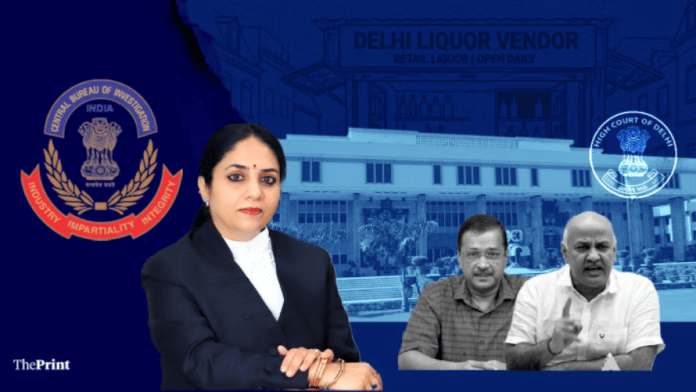


New Delhi: In her order initiating contempt action against former Delhi chief minister Arvind Kejriwal and others, High Court judge Justice Swarana Kanta Sharma said there was a coordinated attempt to lower the authority of the court through letters, videos, and social media posts after she refused to recuse herself from hearing their plea related to excise policy case.
The oral pronouncement about the contempt case was made Thursday evening, and a 68-page order was uploaded by the Delhi High Court early Friday in which the court has noted reasons for the contempt action.
The original case emanates from alleged irregularities in formulating the Delhi Excise Policy 2022 by the AAP government led by Kejriwal. On 27 February 2026, a Delhi court discharged Kejriwal, Manish Sisodia, and 21 others in the CBI case related to the alleged scam. The discharge order was challenged by the CBI.
The CBI’s appeal has seen many twists and turns. The matter was being heard by Justice Sharma. Six respondents, including Kejriwal, moved a petition seeking her recusal, which she had refused via a detailed order.
“Judicial integrity cannot be put to trial by a litigant,” that order said, adding such a recusal would set a troubling precedent, and that litigants cannot be allowed to forum shop. Calling the allegations of bias against her unfounded, the judge said that a recusal would amount to abdication of judicial duty.
Thursday’s order noted that when hearing and deciding the applications for recusal filed by the six the court had proceeded on the assumption that the issue would “remain within the discipline of law, the dignity of pleadings, and the boundaries of judicial adjudication”.
But, after the pronouncement of the refusal to recuse, the court became aware of certain materials on social media which caused it “shock and concern,” leading to the contempt proceedings, the judge said in the order.
In the court’s view, these were not “isolated acts” as initially believed, rather a “calculated campaign of vilification in the digital space”.
Emphasising the political influence and substantial public following of the respondents on social media, the court found that their actions displayed “deliberate malice” and were an attack on a constitutional court rather than a personal injury to the judge herself.
Central to the court’s view was that the respondents’ posts were not only against an individual judge, rather against “the entire institution of the judiciary and the adjudicatory process itself”.
The order noted said they chose not to pursue legal remedies such as an appeal to the Supreme Court against the adverse ruling, but moved the dispute into the public domain through social media posts, selectively edited videos and allegations that the Bench was politically influenced, the outcome was predetermined, and that there could be no expectation of justice from it.
The initial trigger for subsequent contemptuous acts and posts, the court noted, was a letter and video posted online by Kejriwal boycotting the proceedings after the recusal applications were rejected. The order recorded that the posts suggested that the Bench would not rule against the Union government, the Bharatiya Janata Party (BJP) or the solicitor general.
The court repeatedly mentioned a video which in its view was “distorted and selectively edited in a calculated manner”. The video in question was widely shared on social media. In this regard, the court noted that multiple news organisations had fact-checked the said video and deemed it to be misleading.
In the view of the court, this letter resulted in other leaders of the Aam Aadmi Party (AAP) posting about boycotts and bias. Stating that such views “cast aspersions upon the independence and integrity of the court”, the court said that they were not a bona fide expression of grievance and would fester distrust in members of the public and undermine the authority of the courts.
In all humility and with complete respect for judiciary, I have written the following letter to Justice Swarna Kanta Sharma, informing her that pursuing Gandhian principles of Satyagraha, it won’t be possible for me to pursue this case in her court, either in person or through a… pic.twitter.com/HmyOyNYug8
— Arvind Kejriwal (@ArvindKejriwal) April 27, 2026
“A lie spoken a thousand times does not become the truth, just as intimidation clothed as legitimate criticism does not become immune from the law of contempt”, the order read.
The court took issue with the posts attributing political allegiance to Justice Sharma, and also alleging a lack of judicial independence.
Further, the court said that public confidence forms the “soul of the institution”, and undermining that by creating a negative impression interferes with the administration of justice.
The court said the “tone, tenor and manner” of respondents’ posts fell in the category of contempt rather than legal disagreement. It also said the respondents have sufficient legal knowledge, and they “aimed at achieving indirectly…what could not be achieved directly”.
The order also objected to the “equally serious” declaration of ‘Satyagraha’ to justify a boycott of the proceedings. In the court’s view, this was not a neutral choice of abstaining from a case but part of a messaging campaign that the judge and the institution could not be trusted to act fairly.
“In this Court’s opinion, this will lead to anarchy where accused persons of petty as well as serious offences may take the same path, thereby shaking the edifice of judicial system itself,” the court said.
It framed the case as an attack on the institution itself, not merely a personal affront to the judge. This distinction is important because contempt law draws a line between fair criticism and scandalising the court.
Section 2(c) of the Contempt of Courts Act defines criminal contempt as any act or publication that scandalises or lowers the authority of any court, prejudices or interferes with due course of any judicial proceeding, interferes or obstructs the administration of justice.
The precedents
Justice Sharma relied on landmark contempt judgements in her order. The Supreme Court has repeatedly held that courts are open to reasonable criticism, and that the law of contempt exists to protect public confidence in the administration of justice.
In the Brahma Prakash Sharma v. State of Uttar Pradesh (1953) case, the Supreme Court held that contempt is not made out when a judge is personally insulted, but when any act or publication is likely to erode public confidence in the justice system.
Similarly, in Haridas Das v. Usha Rani Banik (2007), the court reiterated that fair criticism is permitted so long as it does not lower the dignity and authority of the court.
Also, in the E.M. Sankaran Namboodiripad vs T. Narayanan Nambiar (1970) case, the court held that free speech under Article 19 is subject to reasonable restrictions, and can attract contempt charges in certain situations. In 2020, the court convicted lawyer Prashant Bhushan for two social media posts criticising sitting judges.
Acknowledging that contempt jurisdiction must be exercised with utmost restraint, Justice Sharma said that contempt law exists because judges have limited means to protect themselves. The order also noted that the contemptuous acts could have been noticed and addressed only by this court.
(Edited by Ajeet Tiwari)
Also Read: ‘Cloud of grave, unresolved questions’—Why Kejriwal won’t appear in Delhi HC judge Sharma’s court
If I were a minority or an opposition member, I will not expect a fair hearing from a RSS bhakth! I can’t believe people find it difficult to realise that this lady has been given responsibility of this case for a reason. The CJI, CEC and even CDS are political appointments and they owe their political masters.