





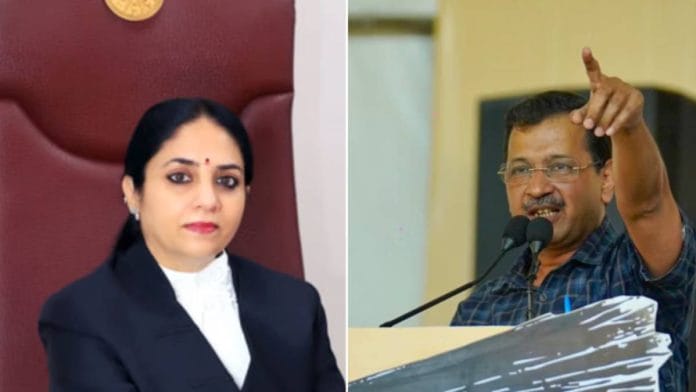

New Delhi: Former Delhi chief minister and Aam Aadmi Party (AAP) leader Arvind Kejriwal has written to Delhi High Court judge Swarana Kanta Sharma underlining his inability to participate in further proceedings “in her court” in connection with the excise policy case, stating that his faith in the legal process “stands deeply shaken”.
In February, the trial court had discharged all 23 accused in the case, including Kejriwal and senior AAP leader Manish Sisodia, holding that the Central Bureau of Investigation’s (CBI) case against them did not withstand judicial scrutiny.
The agency subsequently challenged the order in the high court.
The letter comes after Justice Sharma refused to recuse herself from hearing the CBI’s challenge to the trial court discharge order. Kejriwal had filed a plea seeking her recusal.
“I write this letter with utmost respect to your office and to the institution of the judiciary, which has for decades stood as one of the principal sentinels of our great Republic. At the very outset, I wish to state clearly and unambiguously that this letter is not written in anger, nor in disrespect, nor in any spirit of personal confrontation with Your Ladyship,” Kejriwal’s letter states. The four-page communication was shared on his X handle Monday.
In all humility and with complete respect for judiciary, I have written the following letter to Justice Swarna Kanta Sharma, informing her that pursuing Gandhian principles of Satyagraha, it won’t be possible for me to pursue this case in her court, either in person or through a… pic.twitter.com/HmyOyNYug8
— Arvind Kejriwal (@ArvindKejriwal) April 27, 2026
“My only interest in writing this letter is the strengthening of judiciary, and prevent its weakening,” writes the AAP leader.
Kejriwal goes on to mention that neither he nor his counsel will participate in the case proceedings—an assertion that was confirmed to ThePrint by his lawyer.
“In my own conscience, I have now reached a point where I can no longer meaningfully participate in these proceedings without feeling that I am lending my presence to a process in which my faith, in this specific context, stands deeply shaken,” he says.
Adding, “My objection is not to the institution of the High Court or the larger judicial system, but only to the continuance of this matter before Your Ladyship under a cloud of grave and unresolved questions and circumstances that have generated grave public doubt in your ability to dispense impartial justice.”
Also Read: Is Kejriwal vs Justice Swarana Kanta unprecedented? How recusals work in Indian judiciary
Kejriwal’s argument
One of the key reasons behind his decision outlined in the letter is the 20 April ruling where Justice Sharma rejected his recusal request which, he states, led to “loss of confidence in the fairness of further proceedings” before the court.
“After the said judgment, I am left with the painful and inescapable impression that what I had urged as a lawful plea of apprehension was received and answered as a personal attack upon Your Ladyship and as an assault on the institution itself,” the letter states.
Asserting that a litigant can live with an adverse order but not with a judgement whose language conveys that his plea is being viewed as a “challenge” to the judge’s dignity, oath and institutional standing, the letter says that Kejriwal’s plea of apprehension has been judicially understood as a “personal and institutional affront”.
Finding it hard to believe that he will now receive a fair hearing in the case, Kejriwal states that his application seeking recusal was filed due to the “genuine apprehension” that justice must not only be done, but also be seen to be done, which draws on an oft-quoted English maxim.
Pointing to the principles of Satyagraha espoused by Mahatma Gandhi, Kejriwal writes that when a citizen senses injustice, his first duty is not defiance, but dialogue. “By first placing the perceived injustice before the authority competent to correct it, he must give that authority a fair opportunity to reflect and rectify,” Kejriwal says, adding only after the possibility of dialogue has been exhausted should one submit to the consequences.
Recalling his concerns against Justice Sharma hearing his case that involved her repeated participation in Akhil Bharatiya Adhivakta Parishad events as a sitting judge, and the empanelment of her children as central government panel counsel, Kejriwal also pointed to instances from history where judges like Sujoy Paul and Atul Sreedharan had recused themselves on the basis of their children practicing in the same court.
“Former Hon’ble Mr Justice Abhay S. Oka recently stated publicly that, had he been invited by Adhivakta Parishad while serving as a sitting judge, he would have politely declined because, in his understanding, the organisation had political inclinations,” says the letter.
“Mr Tushar Mehta, the Solicitor General is the advocate on the opposite side. Both children of Your Ladyship are directly assigned cases by Mr Tushar Mehta,” it adds.
Finally, Kejriwal made it clear that he was in no way “against” the judiciary since he was granted relief by the courts, including orders of bail and the present discharge. “Today, I walk free because of judiciary. Let there exist no figment of imagination that my present stand is against the institution. It is only against a situation in which public faith risks being asked to bear more than it reasonably can,” Kejriwal says in the letter.
He also states that “for avoidance of doubt, I wish to clarify that my present inability is confined to this matter and to such future proceedings in which these very apprehensions arise with equal force. It should not be understood as a refusal to appear before Your Ladyship in all cases. I shall continue to appear in matters where these serious and unreconciled concerns do not arise”.
(Edited by Nida Fatima Siddiqui)