






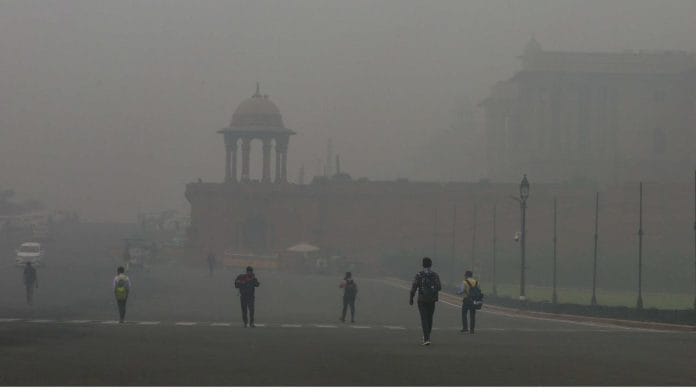


Indian youth have been trending on Instagram for the past few months for protesting rising pollution, degrading air quality, and the felling of trees for developmental projects. Public discourse is slowly turning from the Indian growth story manifested in skyscrapers to the lack of green spaces, walking tracks, and clean shores.
Pushing for faster GDP growth for a population of more than 1.4 billion is a task no less than an elephant winning a marathon, while cheering the crowds.
The Economic Survey 2026 highlights that climate resilience and adaptation can no longer be limited to managing forests, water bodies or coastlines alone. “They must be built into the economic and business frameworks that sustain livelihoods and cities,” it added. The survey indicates a need for a paradigm shift—moving away from siloed and short-term approaches—in the way our natural resources have been managed so far.
The Indian Forest Service (IFS) officials have largely managed the natural resources like forests, water bodies and wildlife since 1867. However, India’s environmental crisis today is unfolding outside forest boundaries. In cities, industrial zones, and peri-urban areas, there is no dearth of administrative and regulatory authorities, but still, there are dirty waterbodies, untreated waste dumps, and contaminated groundwater outside all habitations, leading to a rise in the number of cancer cases, which stand at 15 lakh annually.
IFS officials need to reimagine their role in a larger interlocking climate crisis today and to get a new avatar as indian environment services. And officers must act on a larger stage unfolding across the country that has a widespread impact, beyond the management of forests alone.
Scattered responsibility
The problem behind grim pollution scenarios is not intentional, but of capacity, since there is no single empowered environmental authority that can be held accountable. Largely due to institutional fragmentation and scattered responsibility, India today remains locked in a cycle of damage, litigation, partial repair and overall decline in ecological health.
In almost all states, regional offices of pollution control boards (PCB) monitor pollution levels and their causes, but they often lack enforcement powers, such as directly registering FIRs, which are usually done through Nagar Palika/Urban Improvement Trusts (is this okay?) (UIT) and SDM offices. The District Environment Committees, chaired by District Magistrates, meet sporadically and delegate the issues to various departments. The urban local bodies like Nagar Palika/UITs are tasked with waste, sewage, and air management in the short term, but they lack technical expertise.
This vacuum has forced courts to step in, especially for choked rivers and water bodies. However, despite years of activism, action plans and judicial monitoring, the Yamuna River failed to rejuvenate and largely remains an open drain fed by untreated sewage and industrial effluent.
One such example is the seasonal Jojeri and Luni rivers in the Thar region of Rajasthan, which carry textile industrial waste, contaminating breathable air, groundwater and farmlands. There are about 88 to 100 large, critically polluted zones in the country, and people are forced to migrate from such ghettos.
The sad reality is that only a fraction of the industries are licensed, which may be monitored for violation of environmental rules by PCBs. Most of these establishments are largely unregistered and part of the unorganised sector, blessed by the compulsions of vote-bank politics of a democracy.
Also read: Toxic air is driving people out of India’s cities, threatening urban growth
Need for Indian Environment Service
The higher Judiciary, however, has repeatedly invoked Articles 21 and 48A of the Constitution, issuing directions to the governments for ensuring the citizens’ right to a healthy environment, but it is mostly episodic and reactive. Even if billions are spent on remediation, the authorities are generally burdened with routine tasks, and due to a lack of technical know-how, court directions compliances are mostly delayed and cosmetic.
While judicial intervention is welcome, environmental protection needs preventive regulation through institutions and not litigation. Scandinavian countries that invested in integrated environmental administrations have achieved decentralised sewage treatment, clean urban water bodies, and near-zero waste systems.
So, isn’t it time that India should also consider having an Indian Environment Service, perhaps? A technically specialised cadre within the executive that is rooted in environmental law and forms the missing spine between monitoring bodies like PCBs and implementation agencies.
A cadre of officials who can contribute meaningfully to long-term city/town planning to optimise the sustainable utilisation of natural resources and mitigate the impacts of climate-related environmental hazards.
Savita Dahiya is an IFS officer of the Rajasthan cadre and is currently posted in the Barmer-Balotra districts. Views are personal.
(Edited by Saptak Datta)