





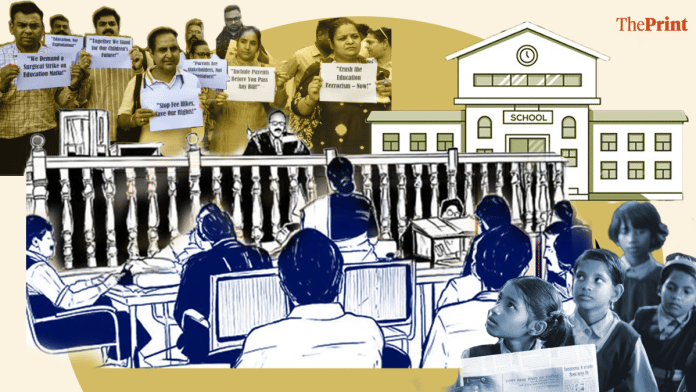


New Delhi: Every March, just ahead of the new academic session, an all too familiar ritual unfolds across unaided recognised private schools in Delhi. Schools announce fee hikes. Parents push back. Children get caught in the crossfire of a dispute they neither caused nor understand; sometimes they are even denied access to classes, facilities, or certificates. The courts intervene, temporary relief follows, and then, until the next year, nothing fundamentally changes.
This year proved no different. With several petitions pending before the Delhi High Court on the recurring issue of school fee hikes, Justice Jasmeet Singh reportedly remarked during one such hearing on 6 April, “What is this? Every year, the same circus!”
The remark, though verbal, captured the exhaustion of a judiciary repeatedly forced to intervene in what has become an annual crisis.
Behind this cycle lies a deeper, unresolved conflict pending in the Delhi High Court for eight years, the uneasy balance between private school autonomy, regulatory oversight by the Delhi Government’s Department of Education (DoE), and the rights and welfare of students and parents.
Also read: What’s in Delhi govt’s new private school fee regulation bill & why are parents concerned
An overburdened judiciary, an unresolved problem
More than 150 matters involving over 450 private schools currently crowd the Delhi High Court’s docket. These cases span parent-school disputes, challenges by schools against DoE fee regulation directives and broader constitutional questions about fee regulation.
At the centre of this legal tangle lies the question of whether unaided recognised private schools require prior approval from the DoE to hike fees, especially those allotted land by the Delhi Development Authority (DDA) at concessional rates (termed land-clause schools).
Action Committee I: Answer that didn’t end debate
The issue of prior approval for fee hike from DoE was squarely addressed in a Delhi High Court judgment delivered in Action Committee Unaided Recognised Private Schools (Action Committee I) vs. DoE in 2019. A single-judge bench of Justice C. Hari Shankar held that private unaided recognised schools, including land-clause schools, do not require prior DoE approval to increase fees.
As for DoE’s role, the Bench said, it was supervisory, confined to examining accounts to determine if schools were making profits or diverting funds. The Delhi School Education Act, 1973, and its rules do not establish a general price-control regime for school fees, and, therefore, schools enjoy autonomy to set fees according to genuine educational needs.
An appeal was filed against the Action Committee I judgment by DoE with the Division Bench, which gave an interim order, restraining land-clause schools from collecting the disputed interim fee hike.
But it did not quash or set aside the single-judge Bench’s conclusion on DoE’s legal position. Which means that schools, including land-clause schools, do not need DoE’s pre-approval before a fee hike.
Action Committee II: Back to square one
Amidst the pending appeal before the HC’s Division Bench and despite the 2019 ruling of the single-judge bench, the DoE issued fresh circulars in 2024, attempting to reintroduce prior approval requirements for fee hikes, primarily targeting land-clause schools.
Predictably, schools returned to court, giving rise to what is now referred to as Action Committee II, and questioned the March 2024 DoE circular.
The matter was once again listed before Justice Hari Shankar’s court, which stayed the operation of the DoE circular.
In an interim order passed in April 2024, the court said an unaided, recognised private school is not required to take DoE’s prior approval before increasing its fees.
The court added that its Action Committee – I ruling would apply, and the DoE was required to respect that position. The DoE’s appeal against the April 2024 order of the single judge bench is pending.
So, the legal standing today is that no prior approval of DoE is required to hike fees, regardless of whether they are land clause schools or not.
Fee Regulation Act, 2025: Breakthrough or breakdown?
Delhi’s struggle with fee regulation did not begin in 2019. A decade earlier, the Delhi School (Verification of Accounts and Refund of Excess Fee) Bill, 2015, proposed an ambitious framework by implementing mandatory audits and refunds of excess fees.
Though passed by the Legislative Assembly, it was never implemented, leaving Delhi without a dedicated statutory fee-regulation mechanism.
Meanwhile, private schools sent their proposals on fee hikes to the DoE.
According to parents, the last clear approvals were issued for the 2015-16 academic session; thereafter, most proposals were rejected or left undecided, effectively enabling fee increases by inaction.
Delhi School Education (Transparency in Fixation and Regulation of Fees) Act, 2025, was intended to fill this regulatory void. Instead, it has become the latest point of contention.
Both parents and schools have challenged its provisions before the Delhi High Court. The Supreme Court declined interim interference, citing pending high court proceedings and concerns over rushed implementation, leaving the Act’s validity unresolved.
Cost of endless litigation
These are not abstract legal debates. They affect nearly 1,000 schools, millions of parents, and countless children. Currently, fee regulation in Delhi exists in a state of chronic uncertainty. It has been largely operating through interim and stay orders rather than a settled law.
Talking to ThePrint, Advocate Khagesh Jha stated, “The current situation is deeply disappointing and reflects a systemic failure. This issue demands serious and immediate attention from both the government and the judiciary.”
The absence of judicial finality has fostered confusion, repeated litigation, and prolonged distress for parents and institutions alike, with no solution in sight.
Alfreza Ahmed is a TPSJ alumna currently interning with ThePrint.
(Edited by Viny Mishra)
Also read: Why Delhi private schools are opposing new fee regulation law & how it’s playing out in high court