





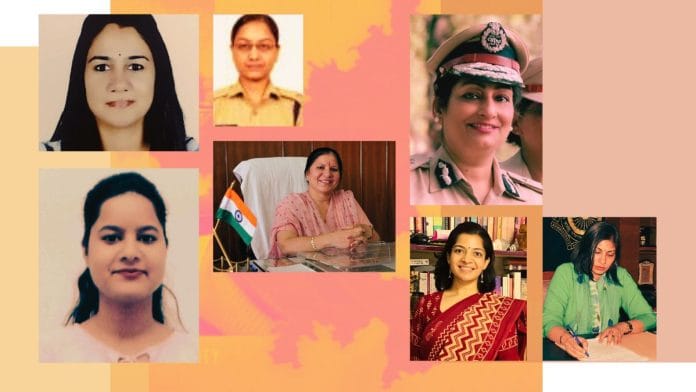


Gurugram: Walk into a government office in Jhajjar, and chances are a woman officer will be behind the desk. The district’s elected representative, its senior most civil servant, its police chief, and its key law-and-order and civil administration officials are all women, all at the same time—in what may be a first-of-its-kind occurrence in the country.
Varsha Khangwal is the Deputy Commissioner. Dr Rajshri Singh is the Jhajjar police commissioner. The two deputy commissioners of police (DCPs)—Dhaarna Yadav and Deepti Garg—are women.
So are the City Magistrate Ritu Bansiwal and Sub-Divisional Magistrate (SDM) Renuka Nandal, posted at Beri.
The list goes on. Nisha Tanwar heads the district development and panchayat department, Dr Manju Kadian is the civil surgeon, Shweta Sharma oversees district welfare department, Anju serves as district town planner (DTP), and Renu Bala heads the district’s social welfare arm.
Add to this Geeta Bhukkal—a five-time Congress MLA who has won the Jhajjar assembly seat four consecutive times since 2009. Bhukkal is a veteran politician and former state minister who represents the constituency in the Haryana Vidhan Sabha.
Jhajjar has an estimated population of around a million, and lies 60 kilometres west of Delhi. In a state not particularly known for progressive gender outcomes—Haryana consistently figures among states with the most skewed gender ratio—the picture is striking.
“It is a reflection of the government’s willingness to post officers on merit, without gender bias,” DC Khangwal told ThePrint. She added, “When women serve in important positions, it inspires society and encourages other women to play a meaningful role in public life.”
Police chief Dr Singh, who has been in the district for 13-14 months, sees the current administration as something worth pausing over, even if it arrived without a considered plan.
The postings, she said, evolved incrementally. “When I joined first, I had one woman DCP, Jasleen Kaur, now SP (superintendent of police) at Dabwali. When she left, I got two women DCPs, Deepti Garg and Dhaarna Yadav,” she said.
On the significance, she said, “By deploying so many women officers at the top level, the state government has presented a model of ‘Beti Bachao Beti Padhao’. This will encourage parents to focus on the education of their daughters, and it will also work towards changing the mindset towards girl children,” the police chief told ThePrint.
She also noted that Jhajjar has had women DCs before, though rarely. “Earlier, Anita Yadav was DC here during the Jat agitation in 2016, and Sonal Goel in 2018,” she said.
MLA Bhukkal welcomed the development but quickly steered the conversation to the numbers. “Haryana has earned a bad name for its poor sex ratio. Of all districts, Jhajjar has always been among those at the bottom of the table. When all women officers are at the helm, one hopes they will work towards improving it,” she said.
In 2011, Jhajjar recorded an overall sex ratio of 862 women per 1,000 men, and a child sex ratio of 782 in the 0-6 age group. Figures for sex-ratio at birth for the first four months of 2026 hover around 876, a marginal improvement over the years but still among the lowest in Haryana, ThePrint reported earlier this month.
Bhukkal, however, struck a note of cautious optimism.
“Despite a poor sex ratio, Jhajjar has given the country international shooters like Manu Bhakar and Palak Gulia. With women officers now holding charge of important departments, one should hope that more women will come forward to shine the name of the country,” she said.
Women’s rights groups welcomed the development, though not without conditions.
“People can expect that they are in better hands than they have been so far. Women are known to have more empathy than their male counterparts, so one can expect that people’s concerns will be heard and addressed in a better manner. People are normally hesitant to go to government offices—particularly when it comes to meeting top functionaries. With women at the top, one can expect that they will approach officers without hesitation,” Jagmati Sangwan, national vice-president of the All India Democratic Women’s Association, said.
Reicha Tanwar, former professor and director of Women’s Studies Research Centre at Kurukshetra University, said the development was heartening.
“All of the top administration headed by women, including the police chief—the credit certainly goes to the Chief Minister for his vision. My best wishes, and I hope some positive change will take place,” she said. Transfer orders involving IPS, IAS, Haryana Civil Services (HCS) and Haryana Police Service (HPS) officers are issued by the CM’s Office.
(Edited by Prerna Madan)