





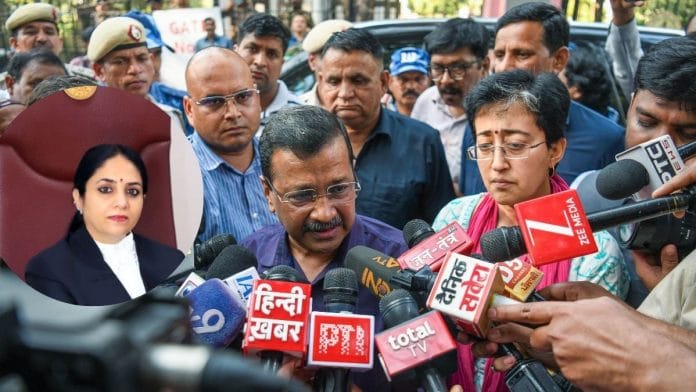


New Delhi: Former Delhi chief minister Arvind Kejriwal’s plea for the recusal of Delhi High Court judge Justice Swarana Kanta Sharma has put the spotlight on judicial recusals in India, an area governed more by precedent than legislation.
Kejriwal, who argued his application in person, is relying on “reasonable apprehension of bias” and “conflict of interest” standards in his plea for the judge to step aside from the hearing of the Central Bureau of Investigation’s (CBI) appeal against a trial court order discharging him and 22 others.
As part of his argument about potential ideological bias, he pointed to the judge’s attendance at events organised by the Akhil Bharatiya Adhivakta Parishad on at least four occassions. The Parishad is the legal arm of the Rashtriya Swayamsevak Sangh (RSS).
The Solicitor General, representing the CBI, has opposed the plea, saying that accepting the request could set a bad precedent and risk every adverse order being seen as a sign of bias.
India has no express law on recusal, and the Constitution too is silent on the subject. Instead, it rests upon a smattering of precedents, the discretion of individual judges, and judicial self-discipline. As a result, Kejriwal has relied on past orders and courtroom interactions to argue his case. The Supreme Court has held that a “reasonable apprehension of bias” is enough to justify recusal with no proven conflict required.
Historically, Supreme Court judges have stepped aside even where the connection appears slight or even speculative, prioritising the appearance of impartiality.
Constitutional and common law roots
Black’s Law Dictionary defines recusal as the “removal of oneself as a judge or policymaker in a particular matter, especially because of a conflict of interest”. In India, the doctrine has been built on the constitutional guarantee of equality and fair process, read with the principle that justice must not only be done, but also be seen to be done.
The idea goes back to the 1924 British case of R v. Sussex Justices, where Lord Hewart observed: “It is not merely of some importance but is of fundamental importance that justice should not only be done but should manifestly and undoubtedly be seen to be done.”
Judges in India are also guided by the ‘Restatement of Values of Judicial Life’, adopted by the Supreme Court in 1997, which emphasises the perception of fairness.
Building the Indian doctrine of recusal, the Supreme Court has drawn on the principles of natural justice, particularly the rule against bias, Nemo judex in causa sua, or no man should be a judge in his own cause. To this end, rules of recusal from Commonwealth countries have also been drawn upon.
Supreme Court precedents
In the absence of a codified framework, the Supreme Court has established judicial recusal from this blend of constitutional values and borrowed doctrine.
Two types of recusal have emerged: self-recusal and recusal on request.
Self-recusal refers to a judge voluntarily stepping aside on discovering a link such as past representation, family connection or pecuniary interest.
In the case of requested recusal, the apprehension of bias in the “mind of the party” and the judge’s discretion are paramount.
Several judgments have hardened this flexible standard into a working norm.
In the 1957 Manak Lal vs. Dr. Prem Chand Singhvi case, the Supreme Court held that even a small pecuniary interest was enough to wholly disqualify a member from acting as a judge, and actual proof of bias wasn’t necessary. Further, the court also said that a party that is aware of potential bias but does not object at the relevant time cannot strategically use it at a later stage. Essentially, the protection of the rule against bias can be waived.
Nearly three decades later, in the 1987 Ranjit Thakur vs. Union of India case, the court shifted the focus from actual bias to reasonable apprehension.
The court held that if a party can show a reasonable apprehension that the judge may be biased, the judge should recuse himself, even if there is no evidence of real prejudice.
Subsequently, in the 1998 State of West Bengal vs. Shivananda Pathak case, the Supreme Court held that prior expression of opinion on a case does not disqualify a judge from later hearing the same matter.
At the same time, it also emphasised that “judicial obstinacy”, or clinging to an earlier view without openness to reconsideration, was a distinct form of bias.
The court held that recusal is necessary when a judge’s mindset obstructs fair adjudication. It further held that bias undermines fairness and renders justice meaningless.
In the 2011 State of Punjab vs. Davinder Pal Singh Bhullar case, the court tempered the Ranjit Thakur standard, holding that mere suspicion, vague apprehension, or emotional distrust cannot justify a request for recusal. It further ruled that recusal requests must be backed by strong evidence of bias.
It also emphasised that the test here is not mere dissatisfaction with unfavourable orders but rather whether a reasonable, informed observer would apprehend that the judge may be biased.
Subsequently, in the landmark 2015 National Judicial Appointments Commission (NJAC) case, a recusal plea was raised against then Supreme Court judge Justice J.S. Khehar on the ground that he had a future institutional stake in the outcome.
It was argued that there was a conflict of interest because he was a member of the Collegium system that the NJAC was seeking to replace.
Justice Khehar refused to recuse himself, saying it would set a wrong precedent. He further held that when all judges are equally conflicted, as they were in the NJAC case, the court must still hear the case, invoking the “doctrine of necessity”.
Despite periodic calls for reform, India has retained an informal, conscience‑based system of recusal. In 2025, a Supreme Court bench of Justices Abhay S. Oka and Ujjal Bhuyan dismissed a petition seeking binding recusal guidelines, holding that recusal is a matter of individual judicial discretion and that Article 142 cannot be exercised to frame guidelines.
Article 142 of the Constitution empowers the Supreme Court to pass any decree or order necessary to achieve “complete justice”. The court reiterated that the decision to recuse and the reasons for disclosure are at the discretion of the concerned judge alone.
Notable recusals
Over the decades, the Supreme Court has seen several notable instances of recusals that underline how even slight or speculative links have been regarded as sufficient grounds to step aside. Where the link is financial, the court has been uncompromising.
In any case where a judge is shown to have a direct pecuniary interest in the outcome, the norm is automatic recusal with little scope for balancing of interests.
This rigidity at the pecuniary end of the spectrum stands in contrast to the flexibility applied to non‑pecuniary conflicts.
Some recusals in the pecuniary interest category have been controversial.
In 2009, then Supreme Court judge Justice S.H. Kapadia withdrew from a case involving the Vedanta Group, citing a conflict of interest as he was a shareholder in Vedanta’s sister company, Sterlite. The Supreme Court had issued a contempt notice to advocate Prashant Bhushan for making remarks tying Justice Kapadia to Sterlite.
Later that year, Justice Kapadia also recused himself from a case involving ITC after disclosing that he and his wife held shares in the company.
Also in 2009, then Supreme Court judge Justice R.V. Raveendran recused himself from adjudicating on a dispute between brothers Mukesh and Anil Ambani on the grounds of a familial connection. His daughter was associated with a law firm advising Mukesh Ambani.
“My conscience is clear and I feel that justice should not only be done but should seem to be done. That is the tradition of this court,” Justice Raveendran had said at the time.
In 2021, Justices Indira Banerjee and Aniruddha Bose recused themselves from sensitive cases related to West Bengal.
While Justice Banerjee did not provide a reason for her recusal, Justice Bose simply cited “reservations” without elaboration. Justices Banerjee and Bose were both formerly of the Calcutta High Court, and hence had a “history of practice” in West Bengal.
Recusals on this ground in sensitive matters are seen as erring on the side of caution to avoid any conflict of interest.
Many judges of high courts and the Supreme Court are elevated to the bench after a career at the Bar. This background can lead to the need for recusal due to a potential conflict of interest stemming from their history as advocates.
One prominent example is of Justice U.U. Lalit’s 2019 recusal in the Ram Janmabhoomi dispute after a party pointed out that he had previously appeared as an advocate for a related matter.
There were no allegations of bias or impropriety but Justice Lalit decided it was “not appropriate” for him to continue. His withdrawal signalled the court’s willingness to treat any prior advocacy connection, however remote, as a potential source of reasonable apprehension.
More recently, the April 2026 recusal of Justice K.V. Viswanathan from the Alchemist Asset Reconstruction Company (AARC) case sparked a debate about the appropriate timing for a judge’s recusal.
The Supreme Court bench of Justices J.B. Pardiwala and K.V. Viswanathan had already reserved judgment in the matter when Justice Viswanathan informed the chief justice of the prior advocacy conflict. The matter will now be heard again by a fresh bench.
This was a rare case of recusal at the stage of the pronouncement of the verdict.
Previously, in 2009, Justice Markandey Katju had recused himself from a matter concerning Reliance Industries almost two months after he reserved judgment in the case.
The constitutional challenge to the Chief Election Commissioner Act, 2023, has also seen successive recusals by two chief justices.
The law under challenge replaces the Chief Justice of India with a Union minister on the panel appointing Election Commissioners.
In 2024, then Chief Justice Sanjiv Khanna recused himself from the matter, and in 2026, current Chief Justice Surya Kant recused himself, citing a conflict of interest.
The recusals have sparked discussion on whether this is a collective conflict for all judges, like in the NJAC case, or an individual conflict for the chief justice alone.
Notably, Chief Justice Surya Kant stated that the matter should be before a bench of judges not in the line of succession to the post of chief justice.
Earlier, in 2019, five Supreme Court judges recused themselves in quick succession from the Elgar Parishad case, alleging links between activists and Maoist groups.
All five judges—Justices Ranjan Gogoi, N.V. Ramana, R. Subhash Reddy, B.R. Gavai and S. Ravindra Bhat—did not provide substantive reasons for their recusal from the politically charged matter.
By contrast, the Supreme Court has also seen refusals to recuse. In 2019, Justice Arun Mishra refused a request for his recusal in the Indore Development Authority case, which dealt with land acquisition laws.
The 2019 Constitution bench was re-examining a 2018 matter in which Justice Mishra had authored the majority opinion. “I may be criticised for my view, I may not be a hero and I may be a blemished person but if I am satisfied that my conscience is clear, my integrity is clear before God, I will not budge. If I think I will be influenced by any extraneous factor, I will be the first to recuse here,” he said.
This case upholds two key points—firstly, recusal is at the sole discretion of the individual judge, and secondly, a judge can sit on a bench re-examining his prior ruling.
In the case of former IPS officer Sanjiv Bhatt, Justice M.R. Shah declined a request for his recusal. Bhatt had argued that Justice Shah’s earlier observations in a related matter would influence his current role. The court upheld the settled standard from the Davinder Pal Singh Bhullar case, that prior adverse orders do not by themselves constitute bias and the standard is reasonable apprehension of bias, not mere dissatisfaction.
These refusals, juxtaposed with the recusals in the Ram Janmabhoomi, AARC and CEC cases, showcase the varied application of the “reasonable apprehension of bias” test.
Indian judicial recusal remains, in essence, a doctrine of conscience, anchored in the principles of natural justice. While the Supreme Court has repeatedly affirmed that a “reasonable apprehension of bias” is sufficient to trigger recusal, it has also warned that the standard is not a licence for forum‑shopping. The resulting practice is both flexible and uneven, leaving the ultimate decision with individual judges.
Saumya Sharma is alum of ThePrint School of Journalism, currently interning with ThePrint.
(Edited by Sugita Katyal)
Also Read: How CBI case against Kejriwal, Sisodia unravelled. ‘Failed to establish even policy manipulation’