





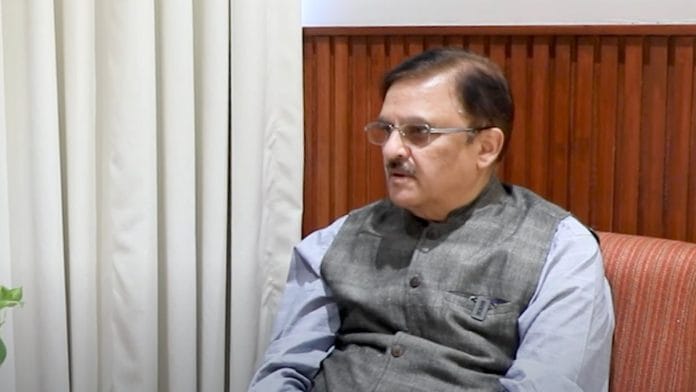

New Delhi: At a virtual event organised by the Akhil Bharatiya Adhivakta Parishad (ABAP), affiliated with the Rashtriya Swayamsevak Sangh, retired Supreme Court judge Abhay S. Oka said that if he would have been invited by the organisation as a sitting judge to speak, he would have politely declined.
“If as a sitting judge, I was invited by Adhivakta Parishad to speak on their platform, I would have politely said no because Adhivakta Parishad does have political inclinations,” he said.
The retired judge was speaking at the event hosted by RSS legal arm’s Supreme Court unit on the topic, ‘Robes cannot be rented’.
Notably, one of the reasons cited by AAP leader and former Delhi chief minister Arvind Kejriwal in his plea for Justice Swarana Kanta Sharma of the Delhi High Court to be recused from hearing the liquor policy scam case is the judge’s attendance at Adhivakta Parishad’s events, which, he says, has created an “apprehension of bias”.
Also speaking on the recent controversy sparked by retired top court judge Deepak Verma testifying as an expert witness for fugitive diamantaire Nirav Modi, alleging a high risk of “custodial torture” if extradited—although UK courts ultimately found Indian government assurances reliable—Justice (Retd) Oka deprecated the practice on the personal front.
“There are cases of fugitive offenders or fugitive accused. These are the people who don’t want to face trial in Indian courts and therefore, they manage to escape out of the country. And that leads to the Government of India or any other authority applying for their extradition before the competent court,” he said. “If such a person who has escaped from India as he doesn’t want to face trial seeks the opinion of a retired judge in his favor, my personal view is that considering the dignity of the office which is the judge’s court, the retired judges should not accept the assignment.”
However, he added, “That is my personal view. Somebody may have quarrels with this personal view.”
Stressing on the need to examine what exactly Justice Verma has said in his testimony, Justice Oka said: “Unfortunately, the entire text of the opinion or deposition is not available.”
Speaking on Justice Verma’s opinion about the assurances given by the government of India or the investigating agencies, Oka said they had given certain assurances that in what manner he will be kept in jail, he will not be interrogated by certain agencies, etc.
“All that the retired judge says is that the assurance in Mr Modi’s case therefore appears to be a diplomatic promise rather than a legally enforceable formal assurance in India. So his comment is that the assurance given by the Indian agencies or government of India is not an enforceable promise, but it is some kind of a diplomatic promise,” he added.
“Whether the judge should have responded to the request of this fugitive person or not, I express my opinion he should not have, but he seems to have given facts about what happens in Indian jails based on the record of the government of India.”
On reforms by the Indian judiciary
“Perhaps, Adhivakta Parishad will be in better position (than many other organisations) to persuade the ruling party to act on increasing judge-to-population ratio, bring some timeline in appointment of judges by the High Court and give better infrastructure to the judiciary,” he said in his short speech, urging the Adhivakta Parishad to take up causes ailing the judiciary and bring reforms.
“Nobody has taken this seriously, I have said this many times. Unless we have a proper judge-to-population ratio, we can’t have justice.”
“In 2002, the Supreme Court passed an order that within five years, the judge-to-population ratio in India should be 50 per million, 50 judges per population of 10 lakhs. Today, we are struggling at 22 or 23 after 24 years of the Supreme Court order. In the meanwhile, the population has increased, new categories of cases have come up, filing has increased. Now, this very elementary issue, we are not able to address.”
Noting that talk about the poor infrastructure of the courts is common, Justice Oka said: “There are some states where infrastructure is good, some districts may be good, but generally infrastructure is poor. That is where we want to work. We must work on these aspects.”
“People are tempted to say something against the Indian legal system, because there are facts which glare at the face,” he added.
In his concluding remarks, Justice Oka also mentioned that his agreement with the resolution that retired judges should not take up the prefix of ‘Honourable’.
(Edited by Nardeep Singh Dahiya)
Also Read: ‘Law is always in dialogue with time’—what CJI Surya Kant said at 4th Ashok Desai Memorial Lecture