





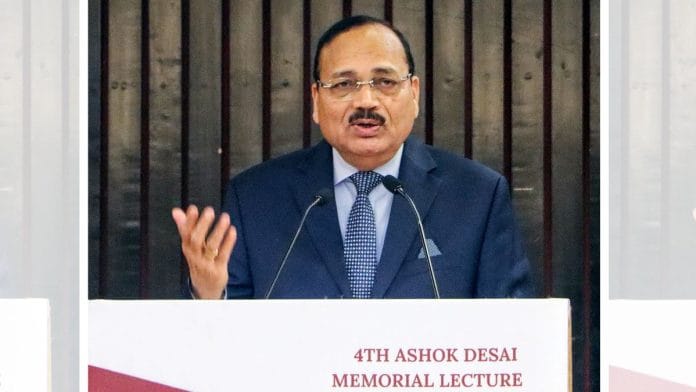


New Delhi: “Degree of apprehension is understandable, but important to recognise we stand at the threshold of generational change,” Chief Justice of India Surya Kant said Monday at the 4th Ashok Desai Memorial Lecture in New Delhi.
Speaking to a packed auditorium at the India International Centre in the evening, the CJI’s remarks were on the topic, ‘Reimagining Justice: The Indian Judiciary 50 Years Hence’.
Senior Advocate Pallav Shishodia, in his introductory remarks, welcomed the presence of several sitting and retired Supreme Court and high court judges as well as senior advocates. Senior Advocate Menaka Guruswamy, who was recently elected as a Rajya Sabha member, was also in attendance.
The evening’s first address was by Author Manu Pillai, who spoke on the topic, ‘Resisting Injustice: the Raj, the Law, and the Making of Modern India’. Pillai spoke of his Keralite Nayar descent, while highlighting the matrilineal system the community previously followed.
Through a series of anecdotes, Pillai traced the journey of India’s legal system, from the traditional caste and religious order to the introduction of common law by the British and today’s constitutional framework. Citing women stalwarts of Indian history, such as Savitribai Phule, Sethu Lakshmi Bayi, and Justice Anna Chandy, he stated that “history offers a little thing called hope”.
Paying homage to Senior Advocate and Former Solicitor and Advocate General of India Ashok Desai, CJI Surya Kant recounted encountering him as “senior opposing counsel” in his litigation days. He said, “The strength of our legal system rests not only on our institutions, but also on the individuals who enlighten them.”
On the evolving nature of law, Kant said that law “is not linear” but rather a tapestry of the past, present, and future and that “law is always in dialogue with time”. Recounting memories of how the introduction of colour television felt extraordinary at the time it hit markets, he observed that it was quite mundane today.
He also recounted the slower pace of court processes when he entered the profession in 1984. However, he added that even then, that era had produced enduring judicial decisions on constitutional matters.
The CJI hypothesised that traditional notions of jurisdiction would be challenged in the future.
He also postulated that irreversible harm to the environment might be included within criminal jurisdiction as ecocide.
Speaking about digital sovereignty and the decentralisation of justice, he said that the judge of the future “cannot be a jurist alone”. “Justice must be accessible, responsive, and seamlessly integrated into the daily lives of citizens,” he said.
Speaking extensively on the impact of technology and AI on the administration of justice, the CJI struck a positive note: “In a nation such as ours…the character of justice must evolve”.
CJI Surya Kant also talked about the benefits of AI use in judicial processes for work that did not require human nuance, thereby saving time and the all-consuming paperwork that courts had to deal with. He, however, emphasised that AI should be an “enabler of better judgment and not a substitute”.
He further stressed the balance between efficiency and due process, saying, “The human context must remain at the core…even as tools evolve”.
“The Indian judiciary of 2076 will not be defined solely by technology…it will be defined by its ability to remain moored in constitutional values,” CJI Surya Kant opined.
He expressed confidence in the constitutional edifice crafted by the founding fathers, saying it would stand the test of time. He also referred to the Constitution as a living, dynamic document, capable of adapting to change.
He ended on a contemplative note: “Justice cannot be measured in orders delivered or decrees pronounced, its real strength lies in the confidence it inspires in the ordinary citizen.”
(Edited by Madhurita Goswami)