





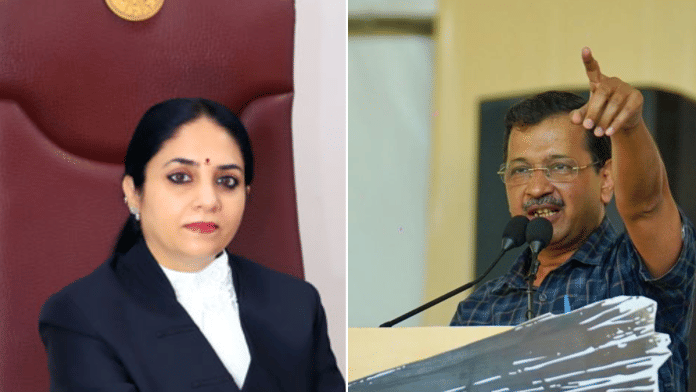


New Delhi: In yet another twist to the recusal case unfolding before the Delhi High Court, former Delhi Chief Minister Arvind Kejriwal, who along with 22 others has been accused in the Delhi excise policy case, has now emerged with an additional affidavit containing fresh facts about the judge’s children being empanelled by the Central government.
Relying on journalist Saurav Dass’s report and RTI response, Kejriwal’s affidavit seeking Delhi High Court judge Justice Swarana Kanta Sharma’s recusal says: “I state that subsequent to filing of my recusal application, certain material facts came to my knowledge when they were released in the public domain on 9 April 2026 by a legal reporter, Mr Saurav Dass.”
Kejriwal says that according to the official public records of the government’s Department of Legal Affairs, advocates Ishaan Sharma and Shambhavi Sharma, who happen to be the son and daughter of Justice Kanta Sharma, have been empanelled by the Centre.
While Ishan Sharma has been empanelled by the Central government as a Group A panel counsel for the Supreme Court, Shambhavi is also empanelled by the Centre as a government pleader for the Delhi High Court, and holds a Group C Panel Counsel position, Kejriwal has disclosed in his affidavit. Prior to this, Justice Sharma’s son Ishaan was empanelled with the Delhi High Court, he adds.
An empanelled counsel is a lawyer selected by a government body, public sector undertaking or organization to represent them in legal matters for a specific tenure. They are added to an approved list or panel of government lawyers to handle litigation or provide legal advice based on defined terms and fee structures.
Kejriwal also points out that these are continuing professional engagements under the Central Government, carrying with them government briefs, government work, court visibility and financial benefit arising from the allocation of legal work by the Centre.
Citing the notification released by the Centre on 13 September 2022 on allocation of case records of matters before the top court, Kejriwal said that it is the Solicitor General of India who allocates matters to Additional Solicitors General and Panel Counsel, including Group A and C counsel.
Kejriwal further adds that in the excise policy case against him, the Solicitor General of India (Tushar Mehta) is opposing his recusal application, and arguing against the discharge order passed in his favour.
Underlining how this gives rise to a direct and serious appearance of conflict of interest, Kejriwal says, “The very law officer and legal establishment representing the prosecuting side” is also part of the institutional mechanism by which Central government cases and government work are allocated to immediate family members of the judge hearing the matter.
Besides this, Kejriwal has also sought extra time for oral arguments, stating that the court on Monday had not indicated it would conclude the hearing on the same day by sitting beyond its usual working hours.
Asserting his right to make rejoinder submissions as well, Kejriwal said that in 2023 alone, 2,487 cases were given to Justice Sharma’s son by the Centre, whereas last year 1,663 cases were given to him. This was revealed after an RTI response on 18 March this year, the affidavit states.
Finally, terming the matter a “politically sensitive criminal prosecution”, Kejriwal said that since he is the principal opponent of the ruling party at the Centre, perception matters, and the CBI should not be seen as a caged parrot; it should rather rise above this perception.
(Edited by Nardeep Singh Dahiya)