





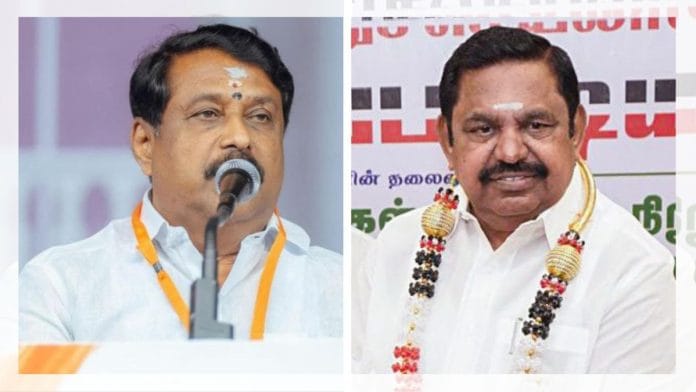


Chennai: The BJP’s near washout in Tamil Nadu, coupled with the diminished position of its major ally, All India Anna Dravida Munnetra Kazhagam (AIADMK), has cast a long shadow over the NDA’s future in the state.
The National Democratic Alliance (NDA) won just 53 of the 234 assembly constituencies it contested in this election, securing a vote share of slightly more than 24 percent. The BJP, alone, secured a vote share of just about 3 percent, and won only one seat.
Reflecting on these results, the Tamil Nadu BJP leaders who spoke to ThePrint acknowledged that the alliance failed to deliver the desired electoral outcomes. They blamed the void of a leader who could match actor Vijay’s charisma.
Vijay’s Tamilaga Vettri Kazhagam (TVK) has emerged as the single largest force in the state with 108 seats, falling just short of a majority.
“In a cult-driven political landscape like Tamil Nadu, the BJP should have won more seats than we did. We could not capitalise on the anti-incumbency sentiment created by K. Annamalai in the years leading up to his resignation and did little to sustain the momentum closer to the election,” Tamil Nadu BJP vice president Narayanan Thirupathy, told ThePrint.
“The people of Tamil Nadu wanted a strong presence, a star-like personality to match Vijay’s, even though we countered the narrative and opposed the DMK’s corruption and malgovernance,” added Thirupathy, who is also Tamil Nadu BJP’s chief spokesperson.
“We need to introspect and see why we failed to project that face as a party and as an alliance,” he said.
Recalling historical electoral trends in Tamil Nadu, Thirupathy explained how, since the 1970s, former chief ministers and cine stars from the AIADMK—M.G. Ramachandran and J. Jayalalithaa—had risen against the DMK each time there was anti-incumbency against the then top boss of DMK, former CM M. Karunanidhi.
Other BJP leaders noted parallels between their party’s jettisoning of Annamalai and replacing the popular Bandi Sanjay with Union Minister G. Kishan Reddy as Telangana BJP president before the 2023 assembly polls in that state. In Telangana, the BJP ended up ceding space to the Congress. Benefitting from the anti-incumbency wave against the Bharat Rashtra Samithi (BRS), Congress eventually formed the government.
Also Read: Vijay’s promises will now face politics. Defeating Tamil Nadu behemoths was easy
BJP-AIADMK: ‘A meaningless alliance’
The non-transfer of votes from the AIADMK to the BJP—and vice versa—was “worrisome”, senior state BJP leaders told ThePrint on the condition of anonymity.
The BJP was banking on its ally to win eight seats in the western part of Tamil Nadu, considered the AIADMK’s stronghold.
The AIADMK, similarly, hoped to capitalise on the BJP’s strength in the southern districts, such as Tuticorin, Kanyakumari, Tirunelveli, and Rameshwaram, which have a higher concentration of Christians. However, the AIADMK’s dismal performance in the southern districts showed that it did not gain anything from the BJP’s presence. And, this was the ground reality, despite Prime Minister Narendra Modi’s campaign from Nagercoil.
Moreover, E.P.S. addressed nearly 100 rallies, but the AIADMK still could not secure wins in roughly 50 percent of the constituencies it had previously won. The BJP is seeing this as a sign of E.P.S.’s shrinking political capital—and the AIADMK’s fading relevance.
Sitting BJP MLA Vanathi Srinivasan’s loss and Union Minister and former Tamil Nadu BJP president L. Murugan’s losses in Coimbatore North and Avanashi, respectively, have not gone down well with the BJP.
The lone victor from the BJP was M. Bhojarajan from Udhagamandalam (Ooty).
“It is a meaningless alliance now. Representing just 2.97 percent of the population, the BJP is a pariah in Tamil Nadu. The AIADMK’s performance has proved to be of no consequence to the NDA,” a senior BJP leader, who was earlier in charge of Tamil Nadu, told ThePrint.
“Our continued association will depend on the survival of the AIADMK,” he added.
With Tamil Nadu BJP president Nainar Nagendran failing to win from Sattur, the party itself needs to recalibrate its strategy. The NDA, across the 2019, 2021, and 2026 assembly and Lok Sabha elections, has lacked a uniform political messaging.
In the 2019 Lok Sabha elections, with Theni voting the AIADMK into power, the NDA won one seat in Tamil Nadu. Subsequently, the party secured only 75 seats in the 2021 state assembly elections.
While the AIADMK and the BJP parted ways in 2024, their coming together in September 2025—eight months before the elections—has proved fruitless.
The AIADMK and the BJP patched up in September 2025, just ahead of the 2024 parliamentary elections. Together, they trounced the Dravida Munnetra Kazhagam-led Secular Progressive Alliance (SPA), which includes the Congress.
Now, since the unexpected shake-up in state politics with Vijay’s Tamazhaga Vettri Kazhagam (TVK), whispers and questions over the sanctity and security of the BJP-AIADMK alliance are also emerging from the AIADMK camp.
“Having ruled for 10 years from 2011-2021, we hoped to re-establish our dominance across Tamil Nadu, banking on the BJP’s plank of development and welfare measures we proposed. But the outcome calls for us, as a party and an alliance, to go back to the drawing board and evaluate our priorities in the face of a transformed and dynamic political situation,” Kovai Sathyan, a senior leader and spokesperson who also helped draft the party’s manifesto, told ThePrint.
While AIADMK leaders are confident that their cadre would want to stay with the party, they expressed concerns over the party’s third position. Their principal opponent, the DMK, meanwhile, managed to retain its position as the Opposition in this election.
Sriram Seshadri, a political observer and strategist, said, “That O. Panneerselvam and Sengottaiyan—two senior leaders who had been estranged from the AIADMK—won would also be a thorn in E.P.S.’s side. With the smaller parties likely to go with the TVK, we, once Vijay consolidates his position, have to see if the AIADMK’s supremacy as a Dravidian party continues to hold considerable electoral sway.”
While both the AIADMK and BJP leaders refused to comment on the prospects of their alliance, they agreed on one thing. The NDA’s coming together in Tamil Nadu in 2026 was more an electoral compulsion than an ideological fit, they said.
“In the transformed landscape of politics in the Indian Peninsula region, alliances were formed. In the hopes of favourable electoral outcomes and to defeat a common enemy. But if this objective has not been met, we will have to find alternate ways of appealing to the people in the state,” Narayanan Thirupathy said.
(Edited by Madhurita Goswami)
Also Read: Election pledges risk wider fiscal deficits across states, economists warn