






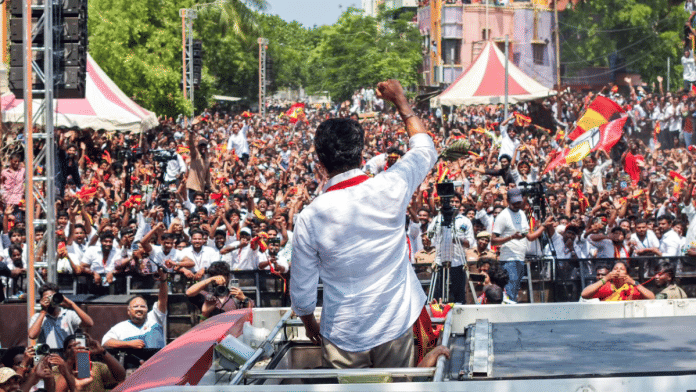


It was a wave that very few saw coming. One exit poll had predicted it but the sheer improbability of a newly formed party headed by a movie star with no prior political experience sweeping the Tamil Nadu election in its first attempt blindsided most pollsters and analysts. As counting day wore on, it became clear that history was being made in Tamil Nadu. Actor Vijay and his newly formed Tamizhaga Vetri Kazhagam emerged as the single-largest party, winning 108 out of 234 seats, just 10 short of a majority. The incumbent DMK was ousted, handed a decisive defeat and the opposition AIADMK was humbled even in its erstwhile bastions.
Just a week before polling, there was a buzz around the “whistle,” the TVK symbol, but few expected Vijay to win more than a handful of seats. Most local journalists and pollsters put the figure at fewer than 20 seats. The buzz grew stronger after polling day, with several reports of people saying they had voted for the “Whistle”. Most TVK candidates were unknowns—political novices, fan club members, or last-minute defectors from other parties. In fact, many voters likely had little idea who their candidate was. As Vijay himself said during the campaign, he was the candidate in all 234 seats; people only needed to vote for the “Whistle”.
In and around Chennai, the party seemed to be making some inroads. But it was in rural Tamil Nadu that most observers had doubts about its ability to attract voters. Yet, in a Gen Z-led wave driven largely by social media, Vijay bested the two Dravidian behemoths, and how.
Now comes the difficult part. With zero political experience and only one MLA who has previously been a minister, it will be an uphill task for Vijay to deliver. Several tall promises have been made, some of which could strain the state’s finances: Rs 2,500 per month to all women, free bus travel, Rs 20 lakh collateral-free loans for students, Rs 4,000 per month for unemployed graduates, Rs 10,000 per month for those undergoing skill training, and Rs 2,500 per month for unemployed diploma holders, among others.
For a state already grappling with high debt, these promises will be difficult to fulfil. Will Vijay be pragmatic in implementing them? He has also vowed to stop the Parandur airport project, a much-needed infrastructure boost for Chennai. Will that project now be shelved?
Many losers in Tamil Nadu election
Deciphering the verdict is challenging. The DMK government was not exactly popular, but why voters would back an actor with no political experience and no coherent plan beyond welfare schemes is confounding. For the DMK, the defeat of Chief Minister MK Stalin and several high-profile ministers will be a huge shock. For the AIADMK, the rout in its traditional Kongu (western Tamil Nadu) bastion and its inability to make gains elsewhere will raise serious questions about Edappadi Palaniswami’s leadership. A leadership change may come sooner rather than later.
The party that appears to have missed a golden opportunity is the Congress. Weeks before the election, it was offered 75 seats and a share of power if it broke with the DMK and allied with the TVK. It declined. In hindsight, that looks like a huge blunder.
For the BJP’s Tamil Nadu unit, this was an eminently forgettable election. From four seats in the previous Assembly, the party has been reduced to just one, with most of its prominent leaders losing, often to unknown TVK candidates. Union minister L Murugan lost to 28-year-old TVK rookie S Komali. Tamizhisai Soundararajan lost to TVK treasurer P Venkataramanan in Mylapore, while state president Nainar Nagendran lost in Sattur to A Kadarkarai Raj of the DMK.
The unexpected nature and scale of Vijay’s victory has left not just political observers but even sections within the TVK in a daze. There are still too many unanswered questions. Where will he find the 11 additional members required for a majority? If he seeks outside support, will he form a coalition government, as he had suggested during the campaign? Most importantly, will Vijay be able to deliver? The answers should begin to emerge in the coming weeks.
The author is a political analyst, doctor, and healthcare IT professional. He tweets @sumanthraman. Views are personal.
(Edited by Prashant Dixit)
Seriously I have kind of lost respect for these people who voted for this guy who has no vision unlike Stalin (I am not a fan of him at all and I hate Periyar ideology ) who atleast wants the state to do well (infra and economy)
Like who are these dumb people who voted just because he is an actor ? Is this a joke ? This guy has made such lofty promises that if he ends up fulfilling them then Tamil Nadu will become the next Karnataka where all the budget is spent on welfare schemes.
Seriously what a pathetic result. I don’t understand why people are even celebrating this. This state is going to ruin itself and the south is going down hill. Kerala is already done, Karnataka seems to be doing horrible and now Tamil Nadu is screwed.
Absolute morons. I feel sad for Tamilians who didn’t vote for this.