



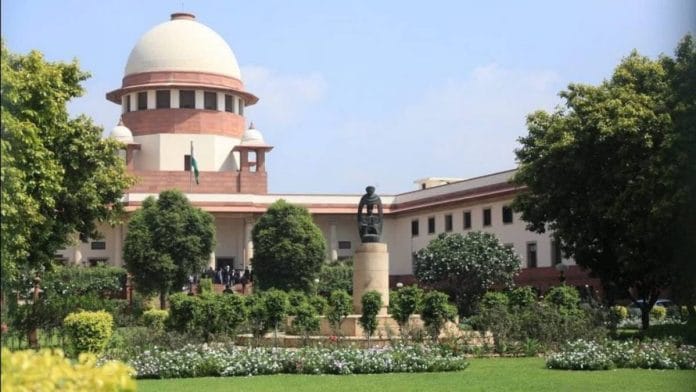
New Delhi: The Supreme Court has held that an accused is entitled to inspect documents seized during the investigation which were not relied upon by the prosecution, but must seek production of specific documents only at an appropriate stage of trial.
Doing so, the top court set aside orders of a special court in Ranchi directing the CBI to produce voluminous documents that were not relied upon during framing of charges.
In an order on 25 September, a bench of Justices JB Pardiwala and K. Vinod Chandran said an accused is entitled to documents available with the prosecuting agency to shape their defence. The stage at which a particular document can be sought would, however, depend on the nature of the document, the bench said.
The case, CBI v Anil Dixit, arose from a CBI investigation into alleged irregularities in the award of consultancy work for the permanent campus of the Central University of Jharkhand in Ranchi. Dixit’s agency allegedly hatched a conspiracy between 2010 and 2014 involving forged documents and payments that caused a public loss of about Rs 1.92 crore. Dixit is facing charges relating to criminal conspiracy, cheating and corruption.
The dispute before the Supreme Court, however, was not about the merits of those allegations. It concerned documents collected during the investigation which the CBI had not relied upon in its chargesheet.
Dixit had approached the Special CBI Court in Ranchi under Section 91 of the Code of Criminal Procedure, seeking several categories of documents. These included documents seized during investigation but not relied upon in the chargesheet.
The agency argued that some documents were confidential, some were not in its possession, and that the unrelied upon material was too voluminous to be supplied wholesale.
What the court said
The case brought two earlier Supreme Court decisions into focus. The CBI relied on State of Orissa v Debendra Nath Padhi, a 2005 judgment which held that an accused’s entitlement to seek an order under Section 91 would ordinarily arise at the stage of defence. Dixit relied on the 2025 judgment in Sarla Gupta v Directorate of Enforcement.
In this, the Supreme Court had held that an accused is entitled to a list of documents and other material not relied upon by the prosecution. It had, however, also said that the accused is ordinarily not entitled to copies of those documents at the stage of framing of charges.
The bench said it did not need to resolve the apparent tension between the two decisions. Instead, it proceeded on the premise that the accused is entitled to documents available with the prosecuting agency to shape his defence. The question was when those documents could be sought.
On the voluminous unrelied upon material, the court accepted the CBI’s proposal that Dixit could inspect the documents rather than require the agency to produce all of them before the trial court at the charge stage.
But inspection would not end the accused’s right to seek relevant material. The court said Dixit could identify a specific document required for his defence and seek its production at the appropriate stage, including when the relevant witness is being examined by the prosecution or the defence. The CBI would have to keep the files ready for this purpose during trial.
The court also laid down an alternative procedure. During inspection, Dixit or his authorised representative could identify particular documents needed by the defence. The details would be recorded in writing and signed by both sides, after which the identified documents would be produced before the trial court without delay.
Documents not with CBI
The court separately dealt with minutes of building committee meetings that Dixit claimed could help his defence. The CBI had said only the minutes of the 11th meeting, dated 27 January 2012, were relied upon in the chargesheet.
The Supreme Court said that if the other specified minutes were available in the records open for inspection, Dixit could seek their production at the appropriate stage. If they were not available with the CBI, the agency could not be directed to produce them.
In that situation, Dixit could procure the documents himself and seek to prove them during defence evidence, including through the Right to Information Act or by examining an appropriate witness. Whether such material has evidentiary value would be for the trial court to decide.
The order does not give an accused an unrestricted right to obtain copies of every document collected by an investigating agency. It provides a mechanism under which the accused can inspect voluminous unrelied material, identify documents relevant to the defence and seek their production when they become necessary during the trial.
The Supreme Court set aside the orders and directed the trial court to proceed in accordance with its directions to facilitate an expeditious trial.
Aditya Edara is a TPSJ alum, currently interning with ThePrint.
(Edited by Nardeep Singh Dahiya)