



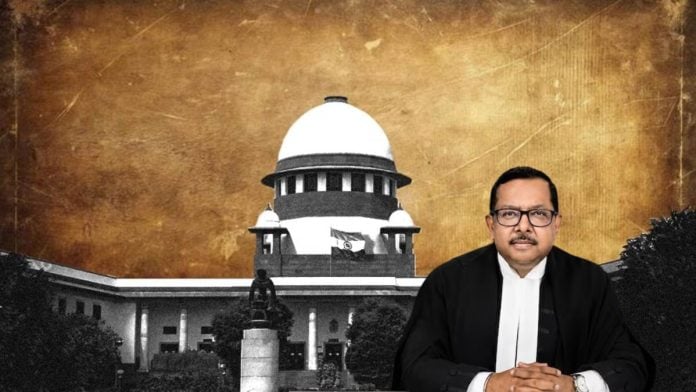
New Delhi: The Supreme Court witnessed a heated discussion on judicial propriety and the master-of-the-roster powers on Wednesday after contempt petitions concerning the deputation of 46 IPS officers to the Central Armed Police Forces (CAPF) were removed from the cause list of a regular bench and listed before a special bench without notice to the petitioners.
The matter was taken up by a special bench of Justices Manoj Misra and Ujjal Bhuyan after the petitions were abruptly deleted from the cause list of the bench comprising Justices Bhuyan and A.S. Chandurkar. Justice Bhuyan was made the puisne, or junior, judge of the special bench.
The petitions concern the deputation of 46 IPS officers to the CAPF, allegedly in violation of the Supreme Court’s May 2025 judgment directing the progressive reduction and eventual phasing out of IPS deputation posts in CAPF cadres. The contempt petitions were filed against Union Home Secretary Govind Mohan over the continued appointment of IPS officers despite the court’s judgment.
The May 2025 judgment was passed by Justices Abhay Oka, now retired, and Bhuyan, who authored the verdict. Since Bhuyan was part of the original bench, he should have ideally headed the bench hearing the contempt proceedings.
The Supreme Court is also hearing a separate writ petition challenging the 2026 CAPF Act before a bench of Justices Misra and V Bishnoi. The petitioners argue that the Act is contrary to the 2025 judgment.
Senior advocate Shyam Divan, appearing for the petitioners, objected to the manner in which the contempt petitions had been listed before the special bench, saying they had not been informed of any request to have the matter heard by another bench.
“We received no notice of an early hearing. It cannot come up before that hearing date… we do not want any erosion in the institution… (the petitioners) do not even have notice of this matter coming up,” he told the court. Divan said the situation raises questions about “institutional credibility”.
He also referred to Tuesday’s order by the earlier Bhuyan-led bench, which sought an explanation from the Supreme Court Registry on why the contempt matter had been struck off the cause list despite a judicial order directing that it be listed at 2 pm on Tuesday.
The Registry said counsel for the Centre in both matters had mentioned them before the CJI on 23 September, seeking that they be listed before one bench. This led to the matters being listed before the special bench, the Registry said. The bench read out the Registry’s note and directed that it be kept in a sealed cover.
Additional Solicitor General Aishwarya Bhati told the court that she had made the mention before the CJI on behalf of the Centre, submitting that the defence in both the contempt petitions and the challenge to the Act overlapped and should be heard together.
Justice Misra said, “Propriety demands it can be heard together but you should have informed, they feel the order has been violated and rightly so.”
Bhati then apologised to the court. Solicitor General Tushar Mehta also apologised.
Senior advocate Guru Krishna Kumar, also appearing for the petitioners, strongly objected to clubbing the two matters and urged that they be decided separately.
“On 22 September (the challenge to the Act hearing), no such request was made. They didn’t make any mention like this. Yesterday (the contempt petition hearing) also they didn’t say anything like this,” he said.
Divan emphasised that “this is an all India court” and that litigants and lawyers from across the country make arrangements to appear when a matter is listed.
“A matter needs to be taken up once it is listed,” he said, while also pressing for the Registrar to appear before the court and explain the reasons behind the decision.
Justice Misra noted that “we were also informed at 9 pm that this bench was constituted”.
He, however, said that now that the matters had been clubbed, they could be heard together on 18 November.
Divan maintained that the contempt case could not be linked to the challenge to the Act, arguing that the contempt proceedings involved specific, time-bound issues that could not be heard together with the writ petition.
Mehta opposed this, submitting that the challenge to the Act could be heard along with the contempt proceedings.
As Divan began explaining why the contempt proceedings should not be affected by the challenge to the Act, Mehta sought time to prepare and requested that the matter be listed next week.
Justice Misra then fixed the matter before the same bench on 13 October for the limited purpose of determining whether the directions in the two matters were independent and whether they had been complied with. “If they are able to satisfy, we will hear together,” he said while pronouncing the order.
“Sometimes too much heat is generated out of nothing,” Justice Misra said before rising from the bench.
Also Read: Jaymin Patel vs UPSC: The 2.06-mark fight that reached the Supreme Court
Earlier case
This is not the first instance in which questions of judicial propriety and the master-of-the-roster powers have arisen.
Similar questions were raised in the Vanashakti matter after Justice Bhuyan was excluded from the bench hearing miscellaneous applications arising from a judgment with significant environmental implications.
In May 2025, a Supreme Court bench of Justices Abhay S. Oka and Bhuyan struck down a 2017 central government notification and a 2021 Office Memorandum, ruling that retrospective or ex-post facto environmental clearances were “alien to environmental jurisprudence”. It also restrained the Centre from regularising illegal constructions through such clearances.
Justice Oka retired in May 2025.
In July, two companies filed miscellaneous applications (MAs) in the case, seeking directions in the already disposed of matter, which could also have led to reconsideration of the judgment.
Since Justice Bhuyan was part of the original bench and Justice Oka had retired, the applications could have been heard by a bench including Bhuyan. Instead, they were listed before a bench led by then CJI B.R. Gavai.
The MAs, which contained wide-ranging prayers relating to the Vanashakti judgment, were heard by a bench of CJI Gavai and Justices K Vinod Chandran and NV Anjaria, which issued a notice on July 28.
The bench did not include Bhuyan, who had authored the original judgment, raising questions about judicial propriety and the powers of the master of the roster.
When formal review petitions were later filed by groups including the Confederation of Real Estate Developers of India (CREDAI), a new three-judge bench was constituted. The bench comprised then CJI Gavai, Justice K Vinod Chandran and Justice Ujjal Bhuyan.
In November 2025, the new bench recalled the original Vanashakti judgment by a 2:1 majority, with Bhuyan dissenting and defending the original judgment.
However, another round of litigation followed. With the May 2025 judgment recalled, the original case returned to the starting point.
A bench led by CJI Surya Kant began hearing the Vanashakti case in 2026 and delivered the Vanashakti-III judgment on 29 July 2026. It ruled that while prior environmental clearance remained mandatory, the government could introduce tightly controlled statutory amnesty measures in exceptional public interest.
(Edited by Chingkheinganbi Mayengbam)
Also Read: When final judgement isn’t final: Inside Supreme Court’s course of self-correction & the concerns