



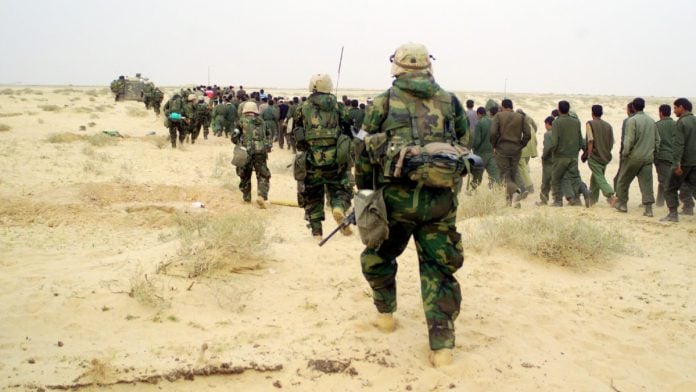
New Delhi: After two decades, the US formally announced an end to its military presence in Iraq Wednesday, leaving behind a country that continues to balance its security priorities between its powerful neighbour Iran, and America’s own positioning in the region.
The withdrawal comes in the backdrop of the ongoing US-Iran war. The US Department of Defence publicly named 14 military personnel as having died since 28 February. At least six of them died in Iraq.
From toppling the Saddam Hussein regime in 2003, to fighting the Islamic State of Iraq and the Levant (ISIL) between 2014 and 2017, and the war with Iran, the US military has been an almost consistent presence in Iraq.
Following its earlier withdrawal in 2011, Iraq witnessed the rise of ISIL, which soon captured territory spanning parts of the country including Mosul, and parts of neighbouring Syria. The US military returned to Iraq in June 2014, with the launch of Operation Inherent Resolve, taking the fight to ISIL.
The two combined military operations have led to over 4,500 American soldiers being killed in action in the two decades of presence in Iraq. Operation Iraqi Freedom, which signalled the US and its allies’ presence in Iraq in 2003, led to the death of 4,418 American personnel, according to data published by the Department of Defence, while Operation Inherent Resolve left 123 personnel dead.
The US withdrawal has been welcomed by Iran and its allied militia, which remain active within Iraq. For Baghdad, the situation remains on the precipice, as it seeks to defend its newly returned sovereignty, balancing US and Iranian interests, while reports indicate the potential of the remnants of ISIL regrouping.
The withdrawal of the US military aids Iraqi Prime Minister Ali al-Zaidi’s ambitious plans for the full demilitarisation of all armed militias in the country by June 2027. The new PM outlined his goals for the demilitarisation of the armed militia and the dates in an interview with The New York Times earlier this month.
ThePrint looks into the history of the US military operations in Iraq and what its withdrawal means for the future of the West Asian nation.
Also Read: The Mecca pact repeats America’s failed Cold War bet on Pakistan
Operation Iraqi Freedom
The march to war in March 2003 began almost a year earlier, when then US President George W. Bush declared Iraq, along with Iran and North Korea, as part of an “axis of evil” during his State of the Union address in January 2002.
The declaration came a few months after the 11 September 2001 terror attacks in the US, including the hijacking of planes and flying them through the twin towers of the World Trade Centre, leaving nearly 3,000 Americans dead had shocked Washington’s security architecture.
Bush sought Hussein’s ouster by the middle of 2002, with his advisers and administration lobbying countries on Iraq’s weapons of mass destruction programme (WMDs), according to the Council on Foreign Relations.
By September 2002, Bush warned the United Nations of potential action, if there are no steps undertaken to intensify inspections of Iraq’s alleged WMD programme. Eventually in March 2003, the US and some of its allies, including Australia, Poland and the United Kingdom, launched military strikes against Hussein’s regime, despite no authorisation from the United Nations Security Council (UNSC).
Hussein’s regime was toppled within five weeks, and Bush famously declared “Mission accomplished” on 1 May 2003. A couple of years later, a presidential commission informed Bush that the US’ intelligence on Hussein’s WMD programme was “dead wrong in almost all of its pre-war judgments”.
Nevertheless, the US was now mired in a country, which witnessed the complete breakdown of order. The US-led military operation in Iraq set off a cycle of sectarian violence between the Shi’ite majority of the country, long repressed by Hussein, and the Sunni minority that had run the country for over two decades.
The US’ own military presence led to anger in Iraq, as its forces were accused and later found complicit in torture of prisoners in Abu Gharib, while its extensive use of private military contractors and reports of extrajudicial killings added to its negative reputation.
Over 4,400 US military personnel were killed during the length of the US’ first military presence in Iraq. The violence continued to spread across the country, as al-Qaeda and other terror organisations began a guerilla war across Iraq.
A majority of the deaths occurred after Bush declared that the mission of toppling Hussein’s government was “accomplished” in May 2003. By 2006, studies indicated that the US was losing the war, which led to a troop surge in 2007, with over 170,000 American military personnel active in Iraq.
A year later, the Iraqi government negotiated the US withdrawal from the country, with most troops leaving cities by 2009 and entirely by 2011. On 15 December 2011, all US military personnel withdrew from the country, except around 700 personnel who remained for training purposes.
Operation Inherent Resolve
The US’ withdrawal lasted less than three years. The al-Qaeda in Iraq saw its presence reduced in the country following the American troop surge in 2007. However, following the US’ withdrawal in 2011, the remnants of the AQI grouped together to form ISIL.
Taking advantage of the Arab Spring and the civil war in Syria, ISIL launched its operations in both countries. By June 2014, the group, which had renamed itself as ISIS—Islamic State of Iraq and Syria—had captured Mosul, and was in control of around 40 percent of Iraq and a third of Syria. The then leader of the terror organisation—Abu Bakr al-Baghdadi—declared the “caliphate” in 2014.
In August 2014, the US-led coalition began airstrikes across Iraq, and Syria later in the year. In October 2014, the US launched Operation Inherent Resolve, beginning its second military phase in Iraq.
By the end of the following year, the Iraqi forces aided by the US’ airstrikes were able to recapture cities such as Ramadi, while in Syria, ISIL continued to expand its presence and hold its core territories surrounding Raqqa.
The US and its allies continued to strike at ISIL positions and by 2017, around 95 percent of its territory had returned to government control. US President Donald Trump in 2018 declared American victory over ISIL.
However, its military presence remained. In 2024 US President Joe Biden came to an agreement with the Iraqi government for the withdrawal of American troops from the country by 30 September 2026.
On Wednesday, the US military announced its formal withdrawal of its troops from its last major base—Erbil—drawing down two decades of activities in the region.
The armed militias, a number of which are backed by Iran, have sent out ominous warnings against al-Zaidi, especially if the Iraqi Prime Minister makes any moves to follow US sanctions against Tehran, leading to worries of the potential growth in power for Iran within the country.
Saudi Arabia just earlier this month accused militias based in Iraq of launching the attack that temporarily shut down its East-West pipeline, further hurting global oil supplies. Iranian militias have in the past struck at US positions in Iraq.
In 2020, Trump authorised the killing of Qaseem Soleimani, the head of the Islamic Revolutionary Guard Corps (IRGC) of Iran in Baghdad. In the last decade, Tehran has deepened its engagement with political parties within Iraq.
(Edited by Gitanjali Das)
Also Read: Iran can survive the war. But the cost of survival is changing