



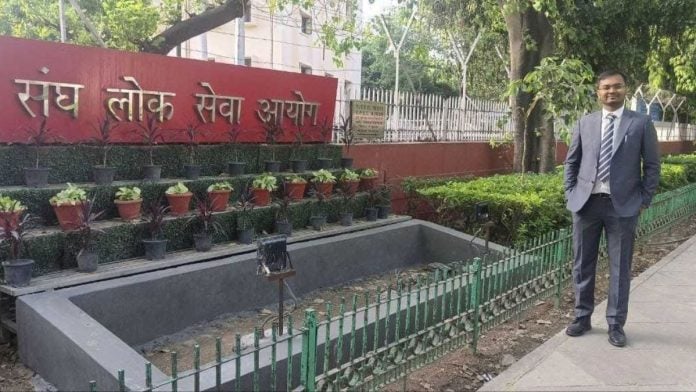
Ahmedabad: Jaymin Patel’s UPSC journey was supposed to end in 2024, when he missed the Indian Forest Service prelims by 2.06 marks. Instead, it followed him into the courtroom, from the Gujarat High Court to the Supreme Court.
His classroom days were over. His preparation was over. Even the exam was over. But Patel was not ready to accept that his UPSC dream had ended with a question whose answer, he believed, the commission had got wrong. For nearly a year, Patel had one question on his mind: which question had cost him the exam?
“I knew the matter was about only one question. I waited a whole year to find out that it was UPSC who was at fault, not me. It was very unfair to me because UPSC failed me for the 2024 prelims. I got the 2025; the cycle of that exam is already over,” said Jaymin Patel in a conversation with The Print.
Patel’s UPSC journey began in 2016, when he started preparing for the Civil Services Examination. Over the years, he appeared for three Mains examinations and two interviews. By 2021, he had exhausted all six CSE attempts. However, after being selected through the Gujarat Public Service Commission examination in 2018, he continued preparing for UPSC while working.
“After my CSE attempts, I started preparing for the Forest Service, and in 2023, I appeared for the interview. In 2024, it was my last attempt age-wise. I prepared well and gave the exam, and in my last attempt, my battle started,” said Patel.
The Print has reached out to UPSC for a response. The copy will be updated once a response is received.
Patel’s long fight for the right answer
In July 2025, Patel took leave from his post as a Deputy Collector in Gandhinagar and stayed in Delhi. He was doing two things at once: studying for the next examination and working with his lawyers on his case.
Everyone advised him to let it go — from IAS and IPS friends to lawyers and teachers. But Patel was not ready to accept the result as fate. He filed an RTI, obtained his OMR sheet, and went back to the question that had kept him awake for months. Then he did something few UPSC aspirants would contemplate after failing a prelim: he took the commission to court.
For decades, UPSC’s examination process has been built around the commission’s reputation for conducting one of India’s most important recruitment examinations with institutional credibility.
That process has faced scrutiny in recent years, including after the Pooja Khedkar case. But Patel’s case put a different question before the courts: what happens when a candidate challenges an answer key after the examination process has already moved on? Patel eventually secured a court order allowing him to appear in the subsequent year’s Mains, with the Gujarat High Court treating the relief as an interim measure.
For Patel, however, the question of examination reform came after his own battle had already begun. During the case, he had to return to court over his candidature, his Mains appearance and later stages of the examination, while UPSC opposed relief at several stages.
“It was against our terms and conditions. He couldn’t clear the exam on merit and dragged the UPSC to the court and demolished the name of a reputed commission. Many people clear UPSC studying under the street light; lakhs of people couldn’t clear the exam and accept and move on. He was at fault, and UPSC still believes that its answer was not wrong,” said Bhagyadoy Mishra, UPSC’s counsel who represented the commission in Gujarat High Court.
The disputed question
The question that changed Patel’s UPSC journey was about the Union Budget. It asked candidates to consider two statements:
- The Union Finance Minister, on behalf of the Prime Minister, lays the Annual Financial Statement before both Houses of Parliament.
- At the Union level, no demand for a grant can be made except on the recommendation of the President of India.
Candidates had to choose the correct option: (a) 1 only, (b) 2 only, (c) Both 1 and 2, or (d) Neither 1 nor 2.
Patel had chosen option B, 2 only.
“I chose answer B, and the court has also said that UPSC’s answer was not correct,” Patel said.
The Gujarat High Court’s reasoning centred on the Constitution’s wording itself. Referring to Articles 112 and 113, the court said the Annual Financial Statement is laid before Parliament on behalf of the President of India, not the Prime Minister. It therefore held that statement 1 was incorrect, while statement 2 was correct.
Also Read: 15 years of UPSC CSAT — protests, U-turns & now a new parliamentary panel
Himanshu Kumar’s case
During his research, Patel came across Himanshu Kumar’s case in the Supreme Court, a separate challenge filed by 17 aspirants against the Commission’s practice of withholding the preliminary answer key until after the entire examination process was over.
That case, and the Supreme Court’s October 2025 proceedings on it, is what eventually pushed UPSC to start releasing a provisional answer key soon after the prelims and inviting objections before finalising it — the change that came too late to help Patel himself.
That case led Patel to Rajeev Kumar Dubey, an advocate-on-record in the Supreme Court.
“I read about such cases and found there is one case of Himanshu Kumar in the Supreme Court. I met the AOR, Rajeev Dubey ji, and he told me that the issue regarding the wrong answer key and appearance in the next mains exam was directly added in the Amicus report,” said Patel.
Patel initially approached the Supreme Court under Article 32. On 25 August 2025, the Supreme Court allowed him to withdraw the petition and approach the High Court under Article 226. By the time the matter reached the Gujarat High Court, Patel was no longer simply asking UPSC to correct an answer. He was asking for a chance to appear for the Mains.
The case also raises questions about when a candidate can challenge an answer key. UPSC released the final answer key for the 2024 preliminary examination only after the declaration of the final result. The Gujarat High Court observed that, by then, the Mains and interviews were already over, leaving a candidate who believed an answer was wrong with little practical remedy.
To this Court,” Justice Nikhil S. Kariel wrote, such a system could render candidates like Patel “almost remediless”. The court said the situation could not simply be accepted on the ground that the examination process had already ended, particularly when the wrong evaluation of one question had, prima facie, resulted in Patel’s exclusion from the Mains.
“We were very clear that I failed because of UPSC’s wrong answer and that I deserved a chance to appear in the Mains. But UPSC kept opposing it, saying that the examination process had already been completed and that the court should not interfere at that stage,” said Patel.
After hearing both sides, the Gujarat High Court directed UPSC to allow Patel to appear in the 2025 Mains as an interim measure and also ordered that his result be kept in a sealed cover until further directions, while directing the Commission to complete the necessary formalities as soon as possible.
The fight for a roll number
For Patel, it felt like a breakthrough. But the order did not immediately end the uncertainty over whether be able to give the exam.
Patel immediately wrote to UPSC, attaching a copy of the court order and asking for his roll number. But, he said, he received no response.
“I had attached the judgment in my email and asked UPSC to give me my roll number, but didn’t get any response. Till 30 October, UPSC kept me hanging, and on 1 November. I included the chairman in my emails too,” said Patel.
Then, on 10 November, with less than a week to go before the Mains, he learnt that UPSC had approached the Supreme Court against the Gujarat High Court’s order.
“There was barely a week left for the exam,” Patel recalled.
With the examination scheduled to begin on 16 November, Patel approached the Gujarat High Court again, this time with a contempt petition, alleging non-compliance with its earlier order.
The court recorded that Patel had not been allowed to complete the examination formalities and had not been given a roll number or examination centre. It issued notice to UPSC, returnable on 14 November, and allowed the order to be served by email.
UPSC had another argument
“The UPSC said that if they allowed me to appear for the Mains, it would open the floodgates for other aspirants to do the same,” said Patel.
He added, “While all the other aspirants were preparing for the exam, I was in the middle of another court battle. I was not even sure whether I would be able to write the exam or not.”
UPSC then challenged the Gujarat High Court’s order in the Supreme Court. On 14 November, two days before the Mains, the Supreme Court declined to interfere.
The Supreme Court noted that such directions could impact the conduct and integrity of an examination, but said it would not exercise its discretion because the High Court’s order had been passed on 15 October and the Mains examination was imminent.
Patel’s own battle, meanwhile, continued even after he sat in the Mains. After appearing for the IFS 2025 Mains exam, Patel cleared the written stage and sought to appear for the interview; However, UPSC opposed his candidature on age-limit grounds. The Gujarat High Court rejected that objection and allowed him to appear.
But when the result was later placed before the court, Patel found he had not been recommended for selection. He said he did not lose hope and continued his fight. The UPSC has also not given him his final marksheet, he said.
The battle continues
Thirty-one-year-old Somesh Pandey is now fighting a similar battle. He is one of 63 candidates who appeared in the 2026 prelims and have approached the CAT over alleged errors in 27 questions in the provisional GS and CSAT answer keys, according to a Jagran report. The Delhi High Court has also recorded similar challenges and directed petitioners to the CAT as the forum of first instance.
For Pandey and the others, Patel’s case offered a possible route: a candidate had challenged a disputed answer in court and, through an interim order, secured a chance to appear in the subsequent Mains. But Pandey says there was a catch — UPSC never accepted that its answer to the disputed question was wrong.
“This is another reason why, now that other students are going ahead, taking Patel’s case as an example, UPSC is saying that we never accepted our answer was wrong. But he got interim relief from the court,” Pandey told The Print.
Pandey said he had tried several ways to find others who had faced the same problem. He created a group and approached a coaching institute to identify candidates whose scores may have been affected by the disputed questions. But, he said, the advice he received was mostly to let the matter go and focus on preparing for the next stage.
“Faculty members advised us to go back to studying. Even students who had given three or four attempts told us not to pursue it because nobody has fought UPSC on this scale. Everyone is scared, but this time we are well prepared and won’t stop,” said Pandey, who started his preparation in 2016.
Pandey has given six UPSC CSE attempts and one Mains examination. He is a Hindi-medium aspirant from Chhattisgarh who completed Mechanical Engineering from Raipur. When Pandey heard about Jaymin Patel’s case, he also decided to file a case against UPSC.
“I got to know about his fight through a video, and it gave me real hope. If he could appear for the Mains, then we also deserve a chance, because UPSC got the answers wrong. That is what we are going to fight in court,” said Pandey.
By the time he sat the Mains in November 2025, the case had consumed four months of Patel’s leave, a stay in Delhi and about Rs 7 lakh in expenses. He spent his days reading court orders and UPSC rules, meeting lawyers and preparing for an examination whose place in his career was still being decided in court.
Patel eventually appeared in the Mains and interview, but was not recommended for selection. His fight with UPSC, however, did not end there. He is now seeking access to his marks and answer sheets from the Mains exam and interview, saying he wants to understand where he fell short.
His case has also begun appearing in other candidates’ legal battles. Sankalp Deep Singh cited Patel’s case before the Lucknow High Court while seeking an opportunity to appear in the Mains, arguing that the answer he had marked was correct. UPSC, however, told the court that it had not made any changes to the 2024 preliminary answer key.
For aspirants like Somesh Pandey, Patel, and Sankalp, the goal was simply to clear the exam. Now, some of them want to change the way the exam itself is conducted.
“Everyone told me not to fight against UPSC. It is too big, and people said it would never accept its mistakes. But this shows how people sitting in positions of power can control everything. I will give them a tough fight. Even if I have to fight alone, even if I have to go to the Supreme Court, I will fight till the end. I want UPSC to know that it cannot play with the future of the youth like this,” said Pandey.
Edited by Maryam Hassan