





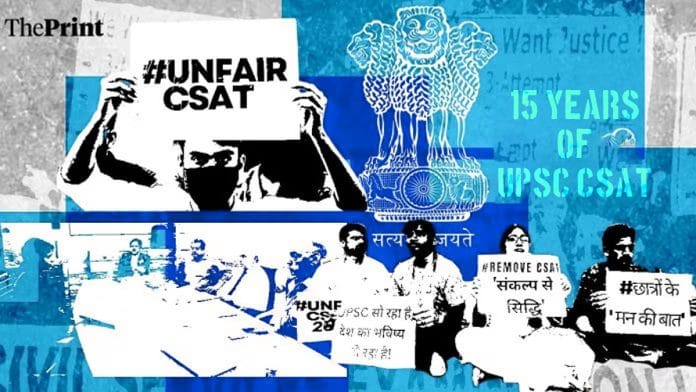


New Delhi: Last year, Neeraj Choudhary reached the UPSC civil services interview. This year, he fears he may not even clear the preliminary exam.
The roadblock is the Civil Services Aptitude Test, or CSAT, which has haunted lakhs of aspirants since it was introduced 15 years ago. Fail this qualifying test, and a candidate’s General Studies score is not even considered. Based on his calculations, the 24-year-old may have fallen short of the qualifying mark by a single point.
“I made some stupid mistakes. The exam gives an advantage to students with a science background. So, Hindi medium aspirants have to put in more effort. I prepared for it in previous attempts and scored well. But this year I couldn’t do better,” said Choudhary, who lives in Delhi’s Mukherjee Nagar and is waiting for the prelims result.
CSAT remains the most contested paper of the UPSC civil services exam. For 15 years, fierce protests and debates have raged around it, from the coaching lanes of Mukherjee Nagar to Parliament to courts. Supporters call it a necessary filter for future bureaucrats. Critics call it a roadblock that keeps out humanities, Hindi-medium and rural candidates, while spawning a whole new expensive coaching market.
Now, a new parliamentary recommendation has revived the fight, with a committee headed by BJP Rajya Sabha MP and former Uttar Pradesh DGP Brij Lal asking UPSC to review the paper for a level playing field. In Parliament this April, Brij Lal went a step further. He called CSAT the “biggest barrier to diversity” and said it should either be abolished or rationalised.
His remarks come more than a decade after resentment over CSAT erupted into the biggest protest in UPSC’s history, with student leaders lobbying political heavyweights such as Ram Vilas Paswan, Lalu Prasad Yadav, Murli Manohar Joshi and Mulayam Singh Yadav. Though CSAT changed shape twice under this pressure, the old grievances haven’t gone away.
CSAT was designed to make the examination more exclusionary. The system is working exactly the way it was designed to work. Over the last 15 years, you can see fewer candidates from Hindi-medium and regional-language backgrounds reaching even the mains or interview stage.
-Vijendra Chauhan, associate professor and UPSC mock interview mentor
The bigger battle is over the baseline identity of India’s bureaucracy. What began in 2011 as a reform to weed out rote learning has, critics say, changed the social and academic mix of those who make it through. Where preliminary candidates earlier relied on their strengths through General Studies (GS) and a chosen optional subject, CSAT introduced a mandatory screen of logic, reading comprehension, and quantitative aptitude.
Since then, the civil services have seen a rising share of selections from engineering and other technical backgrounds, while many others argue they have been left out in the cold. In 2009, humanities graduates made up 44 per cent of selections. In 2011, their share dropped to 27 per cent, and has not touched even 30 per cent since then.
“CSAT was designed to make the examination more exclusionary. The system is working exactly the way it was designed to work. Over the last 15 years, you can see fewer candidates from Hindi-medium and regional-language backgrounds reaching even the mains or interview stage,” said Vijendra Chauhan, who has been conducting mock interviews for several years and is also an associate professor of Hindi at Zakir Husain Delhi College, University of Delhi.
Defenders of CSAT, meanwhile, contend that if a future IAS officer can’t clear a 33 per cent aptitude paper, then they may not be up for the analytical demands of the work.
“CSAT is a qualifying paper and its purpose is to ensure a minimum standard of quality and analytical competence. The level of questions corresponds to the matriculation level,” said Union minister Jitendra Singh in a written Rajya Sabha reply this March.
Four years ago, Choudhary came to Delhi from Jaipur chasing the dream of becoming an IAS officer. A BSc graduate from a private college, he chose Political Science and International Relations as his optional subject and made his first attempt in 2023.
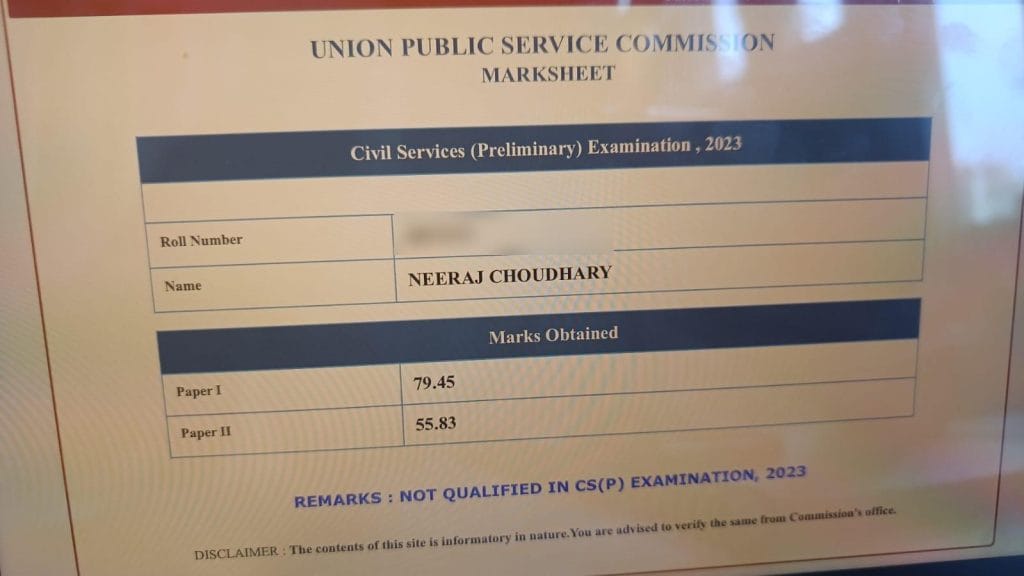
That year, CSAT was his undoing. He cleared the General Studies paper with 79.45 marks, but scored only 55.83 in CSAT, below the qualifying mark of 66.
Subsequently, he turned his performance around, scoring 118 in General Studies and 108.33 in CSAT. Now he fears he’s back at square one. Like many other students, he also claims the CSAT was more difficult this year.
“They reduced the comprehension section, which has traditionally helped humanities students. The mathematics portion was lengthy and far beyond what can be called a Class 10-level paper. My friends from engineering backgrounds did not have to prepare much for it, but I had to devote a significant amount of time solely to CSAT,” said Choudhary.
Also Read: The cult of Khan Sir and Patna’s coaching war
Evolution of CSAT
Few reforms in the UPSC have generated as much anger among aspirants as the Civil Services Aptitude Test.
The germ for the test came in 2001, when economist and Union minister YK Alagh recommended testing candidates in a common subject in his Civil Services Review Committee report.
“Re-examining the candidates in their own subjects appears to be of doubtful utility. The universities have already done the work…. What is important is the relevance of a subject to the job requirements of a civil servant, especially in the changing scenario,” the report said.
It took nearly a decade for the idea to crystallise. In 2010, then Prime Minister Manmohan Singh approved a proposal to introduce CSAT in the preliminary examination, after a one-member committee headed by SK Khanna, former Vice-Chairman of the University Grants Commission, submitted its report. The idea was to test conceptual understanding and analytical ability rather than the memorisation and regurgitation of facts.
Until then, the UPSC preliminary examination had two papers: General Studies and an optional subject chosen by the candidate, such as History, Sociology, Geography or Public Administration. Both counted towards merit. In 2011, the optional paper—which gave candidates the advantage of familiarity with their own disciplines— was replaced with CSAT, and its marks were counted toward merit.
The move was endorsed by officials and coaching institute chiefs as a step in the right direction. AK Mishra, founder of the Chanakya IAS Academy, said it enabled candidates to “think like administrators” and VK Gupta of Raus Study Circle argued it would make the system of selection “more objective, humane and transparent”.
CSAT has become controversial largely because many aspirants do not take it seriously enough during their preparation… The essence of any competitive examination is selection through elimination, and CSAT serves that purpose
-Suboor Sharma, IIT Roorkee graduate and UPSC aspirant
Students, however, were divided. Some welcomed the reduced rote learning, but rural aspirants and Hindi-medium candidates slammed “vague” English-heavy questions and a format that favoured STEM candidates.
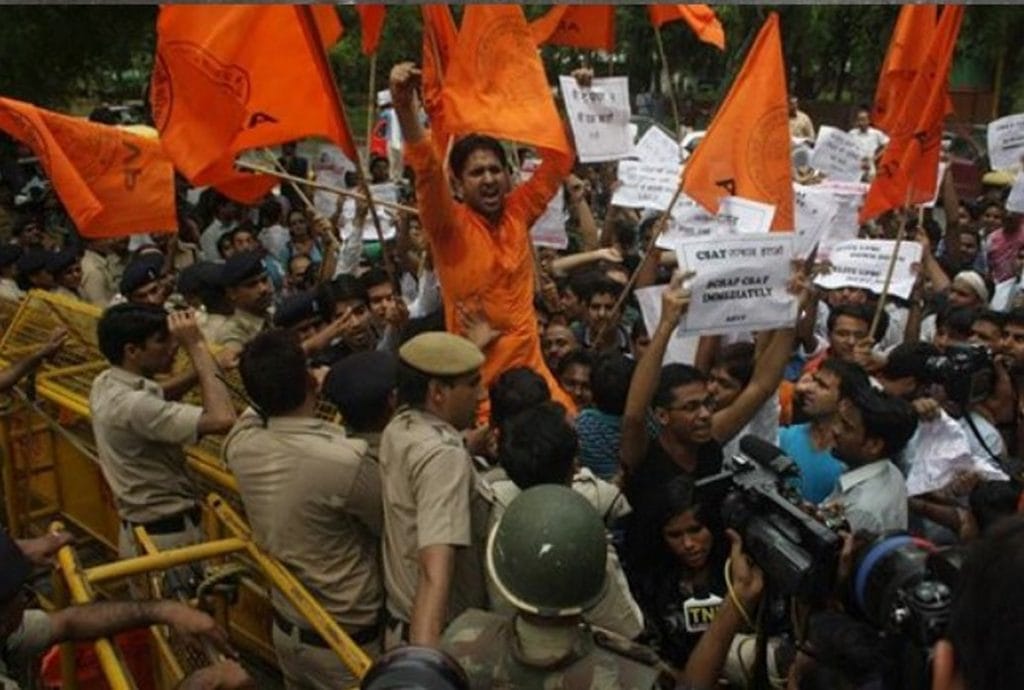
That frustration peaked in 2013-14, with massive protests outside Parliament and UPSC, including ABVP announcing a ‘Black Day’ sit-in. Inside Parliament, too, the issue caused an uproar, with the opposition staging a walkout in the Rajya Sabha on 1 August 2014. Aspirants also filed PILs in the Delhi High Court and Supreme Court.
Amid this groundswell of opposition, the government partially caved in 2014. It announced that English comprehension marks would no longer count for merit, though CSAT itself stayed. The following year, the paper was made strictly qualifying in nature. It no longer counted towards final merit, but an aspirant still had to score 33 per cent—66 out of 200—for the General Studies paper to be evaluated.
But it’s been an uneasy truce at best. It has become something of an annual ritual for UPSC aspirants to fulminate against CSAT. “Why is CSAT so evil? Scoring well in GS but not enough to pass CSAT,” read one Reddit post a couple of weeks ago. Another, from last year, called it a “silent eliminator” that can “quietly crush your UPSC dream”.
What CSAT changed in UPSC selections
What is particularly galling to many aspirants is the changing profile of civil services selections. Engineers, in particular, began dominating the merit list after CSAT.
The share of successful candidates from engineering backgrounds rose from 46 per cent in 2011 to 65 per cent in 2020, according to data cited by a Parliamentary Standing Committee in 2023. Over the same period, the share of humanities graduates declined from 27 per cent to 23 per cent.
The most recent UPSC Annual Report, for 2023-24, shows the engineering share has since dipped to 53.1 per cent. But science graduates made up another 11.2 per cent and medical graduates 6.7 per cent. Together, these accounted for 71 per cent of selections—seven in ten—against 29 per cent from the humanities.
Language is another contentious issue. Data from the Lal Bahadur Shastri National Academy of Administration shows candidates who wrote the examination in Hindi accounted for nearly 17 per cent of civil services recruits in 2013. Their share dropped to 2.11 per cent in 2014 and remained below 5 per cent in the following five years.
Now, the debate over CSAT’s allegedly exclusionary nature has returned to Parliament. In March 2026, a department-related standing committee chaired by MP Brij Lal asked UPSC to revisit the paper.
“UPSC should undertake a comprehensive review to rationalize the CSAT component, including its syllabus and level of difficulty,” said the report. It also flagged the alleged misuse of disability and Economically Weaker Section (EWS) certificates, and recommended stronger verification mechanisms.
The panel added that any review should be supported by empirical analysis of candidate performance patterns to ensure fairness, inclusivity, and equal opportunity.
There has been no official response from UPSC to the recommendation so far. ThePrint reached out to UPSC by email and phone; this report will be updated if a response is received.
A new coaching machine
Apart from causing despair among a section of aspirants, CSAT created a whole new side industry, financed largely by students from Hindi-medium and non-engineering backgrounds.
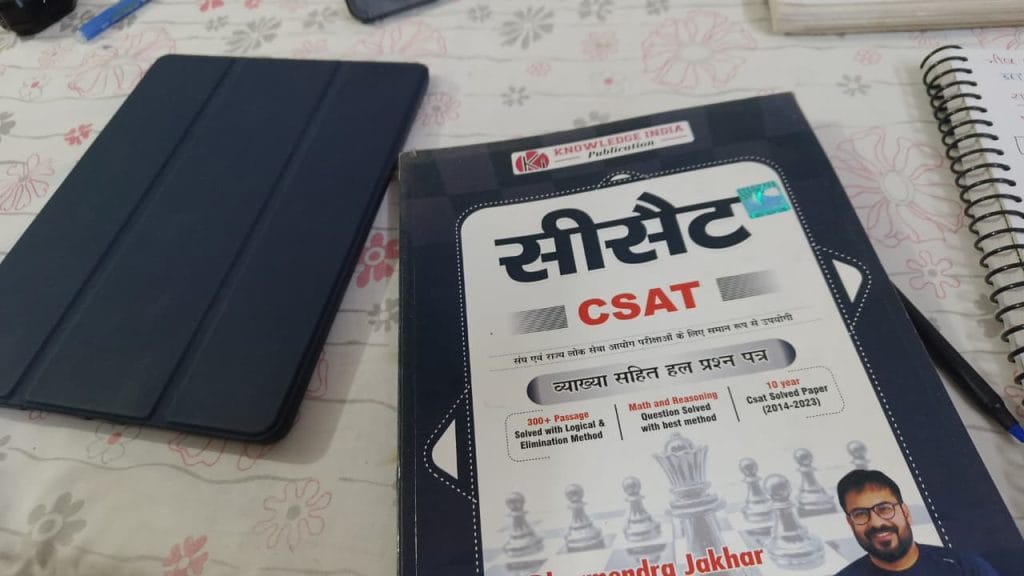
Until the mid-2010s, UPSC institutes in Mukherjee Nagar and other hubs taught General Studies and optional subjects, and left aspirants to prepare for the aptitude paper on their own. But as complaints about its difficulty grew, especially after the 2023 prelims, standalone CSAT batches became commonplace.
“Our basics aren’t that clear and majorly we focus on General Studies, so coaching does help. But it’s another pressure on our pocket, especially for those who come from a rural background. Those aspirants who studied from IITs and big institutions don’t require that,” said Sachin Pandey, a UPSC aspirant from a farming family in Bihar, who now lives in Mukherjee Nagar.
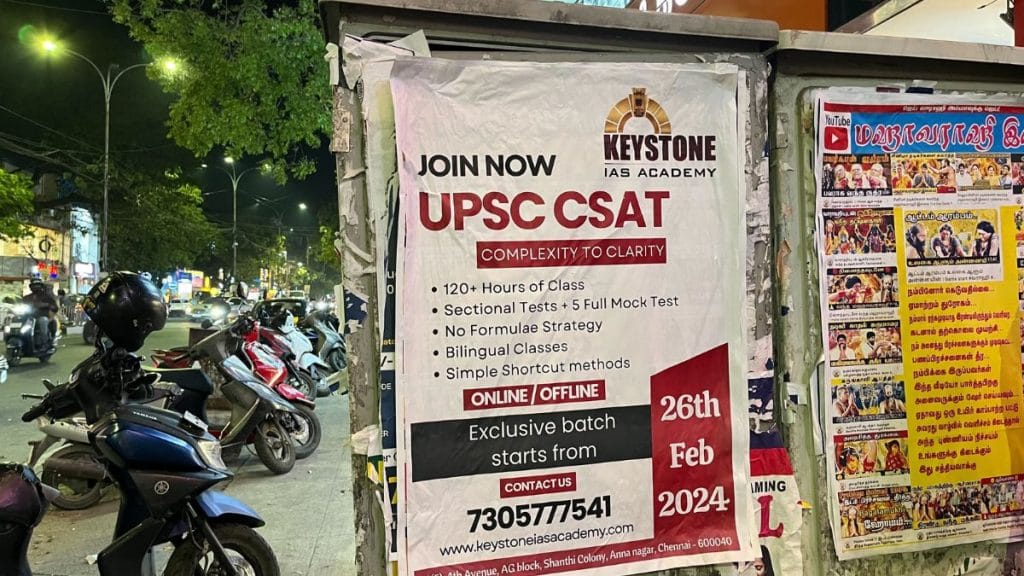
Coaching centres, for their part, call the classes essential for candidates whose grounding in maths and reasoning is weak.
These courses cost Rs 8,000 to Rs 25,000, depending on the institute, the duration, and whether mock-test series are included, with month-long crash courses timed just before the prelims. Most cover quantitative aptitude, logical reasoning, reading comprehension, previous-year questions, and full-length mocks.
Our basics aren’t that clear and majorly we focus on General Studies, so coaching does help. But it’s another pressure on our pocket, especially for those who come from a rural background. Those aspirants who studied from IITs and big institutions don’t require that.”
– Sachin Pandey, UPSC aspirant
For Lakshmi Yogi, 26, a humanities graduate from a private college in Haryana, that cost became unavoidable after two failed attempts at CSAT.
“I couldn’t clear CSAT two times in a row, and then I decided that I should join coaching. Finally, I joined classes for Rs 25,000,” said Yogi, who now lives with her husband in Delhi’s Najafgarh and travels an hour for coaching while managing household work and UPSC preparation.
While UPSC has not changed the CSAT syllabus since 2014, many aspirants and coaching experts argue that the paper has become more quantitative in practice.
An analysis by Testbook, an edtech platform that offers UPSC preparation courses, found that the composition of the 80-question CSAT paper has clearly tilted toward mathematics. Numerical questions rose from 15 in 2015 to 37 in 2024, after peaking at 40 in 2020. Reasoning questions fell from 35 in 2015 to 16 in 2024, while comprehension remained relatively stable, moving from 30 to 27.
For aspirants who depend more on comprehension than quantitative aptitude, this has fed the complaint that CSAT has become harder without any formal change in syllabus.
Students divided
The Brij Lal recommendation has reopened an old divide in Mukherjee Nagar. For Hindi-medium and small-town aspirants, it is a sign that Parliament has finally heard them. But many science and engineering students contend that any serious aspirant should be able to clear CSAT.
Sachin Pandey, 29, has made five attempts at the civil services examination. Twice, he failed to clear CSAT. Twice, he fell short in General Studies. But it is CSAT that he deems most “unfair”.
“The mathematics questions are often at an engineering level. The paper is extremely difficult. It is obvious that candidates from engineering backgrounds have an advantage in attempting such questions. CSAT was like this in 2023, and it was the same this year. We don’t get a fair chance,” said Pandey, who wrote the mains examination last year and has a BA in political science from Delhi’s Hindu College.
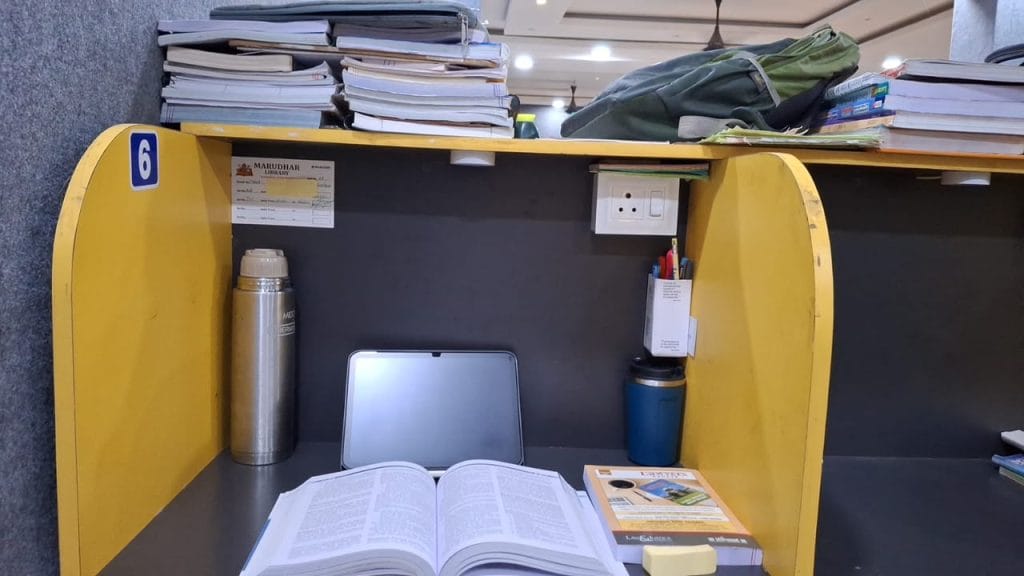
Aspirants from small towns and rural backgrounds argue that because the test spans English comprehension and tough mathematical questions, it penalises those who lacked access to elite schooling or technical education.
“It shouldn’t have been like this. The level of the exams is very high. There is no fixed system. What will they ask? They reduced it from merit to qualifying, but humanities and Hindi-medium students are still at a loss,” said Avinash Singh, a former UPSC aspirant who participated in the 2014 CSAT protests and now works in the UP government.
However, some candidates counter that a year of systematic preparation is more than enough to pass.
“CSAT has become controversial largely because many aspirants do not take it seriously enough during their preparation,” said Suboor Sharma, a UPSC aspirant and IIT Roorkee graduate. “The paper can certainly be reviewed and the quantitative aptitude section recalibrated, but scrapping it would be a mistake. The essence of any competitive examination is selection through elimination, and CSAT serves that purpose.”
Someone who can’t solve CSAT questions can’t even properly understand the data in reports they’ll have to read as bureaucrats. The percentage required to clear CSAT is pretty low, and none of the questions are that hard.
— IAS officer who cleared the CSE in 2015
An IAS officer who cleared the civil services examination in 2015 also defended the paper, saying the 33 per cent qualifying mark is not such a tough ask.
“Someone who can’t solve CSAT questions can’t even properly understand the data in reports they’ll have to read as bureaucrats,” he said, speaking on condition of anonymity. “The percentage required to clear CSAT is pretty low, and none of the questions are that hard. Go at a relaxed pace and make sure you solve things correctly and skip questions that look long from the beginning.”
Fifteen years, he added, is long enough for a candidate pool to make peace with the exam.
“We have seen the protests in Mukherjee Nagar. It was the biggest protest in the history of the UPSC exam. It did bring changes as well. But it’s been 15 years, and this much time is enough for any exam to get adapted to by the aspirants,” the IAS officer said.
Also Read: Super 100 is fueling Haryana’s IIT, AIIMS dream. Helping govt school students crack JEE, NEET
An unfinished protest?
One of the students at the forefront of the original 2014 protests was Nilotpal Mrinal, now an author and activist.
He had begun preparing for the UPSC in 2008, and CSAT upended everything when it was introduced three years later. In 2012, Mrinal cleared the prelims but not the mains, and the fight with the standardised test began again. It took a couple more years for anger to build.
“It was a new reform, so we took our time to understand it. We didn’t oppose it immediately. But then I saw aspirants who had reached the interview stage earlier fail to clear the exam. Many meritorious students were struggling, and that is why, after three years, students came on the roads,” he said.

From 2011 to 2013, according to Mrinal, fewer Hindi-medium aspirants cleared the prelims. Yet among those who made it to the mains, the majority had Hindi as their Indian language paper. To him, this was a signal that the problem was not a lack of merit, but the new screening stage. He also pointed out that engineers usually choose humanities subjects like sociology or political science as optionals in the mains because these are considered scoring.
“Frustration turned into anger and then into protests,” he said. Back then, aspirants marched from Mukherjee Nagar to Jantar Mantar, shaved their heads, sat on a nine-day hunger strike and spent nights under tarpaulin sheets demanding changes to CSAT. The agitation eventually pushed the government to dilute the paper’s role in the examination.
The protests are now part of UPSC folklore. But in the classrooms and hostels of Mukherjee Nagar, the conversation around CSAT is as heated as it was a decade ago.
“Students have accepted that CSAT is part of the dream they are chasing. But they still haven’t accepted it as fair,” said Sachin Pandey.
(Edited by Asavari Singh)
All services who need generalist type background not specifically science/engineering background should not take more than 25% of engineers/science background students. The students just enroll in engineering and later change the line and go for MBA and various government and banking jobs. In this wayless no of students will go for engineering. 75% students for MBA and Civil services should come from commerce but not CAs and humanities background. Most of the technically trained students should remain in their field of training.