



Eminent German economist Rudiger Dornbusch, former professor of economics at Massachusetts Institute of Technology, famously said, “In economics, things take longer to happen than you think they will, and then they happen faster than you thought they could.”
The pattern reflects distinctly in India’s manufacturing export story.
For half a century, India struggled to export manufactured goods. That is now changing. Merchandise exports in the first four months of FY27 are up 17 percent on last year, with July alone setting a record at $44.2 billion.
There are four things that have swung in India’s favour: the rupee is at its cheapest in real trade-weighted terms since February 2014; the UK trade deal is live and the EU deal is signed in all but name; global buyers are actively de-risking China; and Western rearmament and grid spending have run into capacity constraints which is creating spillovers into India.
None of this needed world trade to accelerate, it only needed world trade to hold up, while India’s share of it rose, which is exactly what is happening.
50 years of getting it wrong
For decades, India took a large, young, cheap workforce, and repeatedly failed to turn it into an export machine, while South Korea, then China, then Vietnam did precisely that. The data backs this up:
● Manufacturing value added was 12.5 percent of Indian GDP in 2024, against roughly 17 percent in 2010.
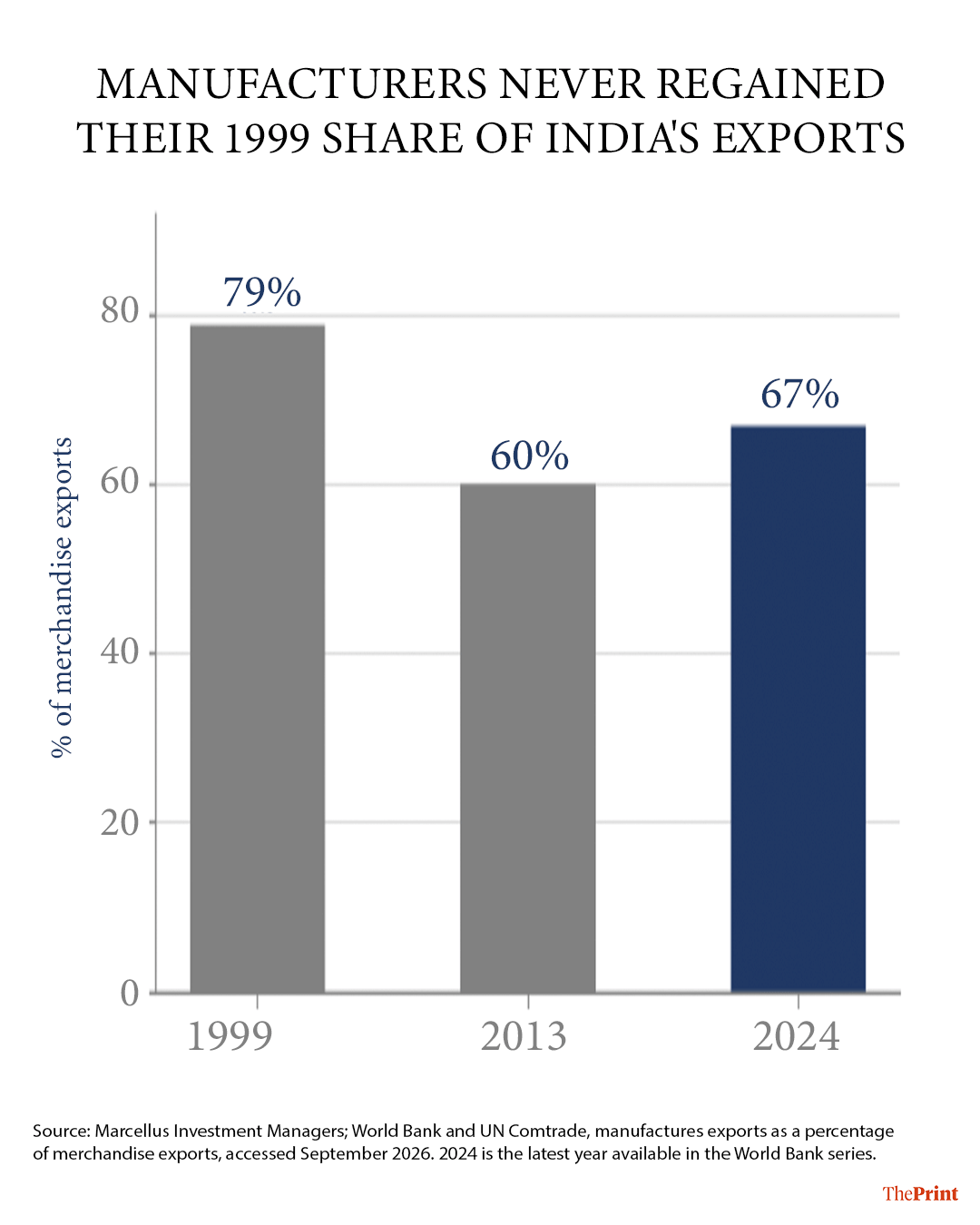
● Manufactures were 79 percent of India’s merchandise exports in 1999. They fell to 60 percent by 2013, and have clawed back only to 67 percent in 2024.
● On the new national accounts series, goods exports have slipped from 14.1 percent of GDP in FY23 to 12.1 percent in FY25.
● India’s share of world merchandise trade is still under 2 percent.
● FY26 was flat. Merchandise exports grew 0.93 percent to $441.8 billion, and in March 2026, exports actually shrank 7.4 percent when the Strait of Hormuz closed.
Layered on top of that history is what happened last year in Washington. India was hit with a 25 percent reciprocal tariff in 2025, doubled to 50 percent over Russian oil, and for half a year, Indian goods were among the most expensive ones an American importer could buy.
That regime is gone, but not in the tidy way most people thought in February. The US Supreme Court struck down the IEEPA (International Emergency Economic Powers Act) tariffs on 20 February this year, which invalidated the 18 percent reciprocal rate India had negotiated. A temporary Section 122 surcharge filled the gap until it hit its 150-day statutory ceiling on 24 July, and a new Section 301 forced-labour duty of 10 to 12.5 percent covering roughly 60 economies took effect the same day.
A separate Section 301 investigation into manufacturing overcapacity, opened on 11 March and covering 16 economies including India, is still working through. The comprehensive bilateral agreement with the United States remains unsigned. Earlier this month, Union Commerce Minister Piyush Goyal reiterated that India will not sign until the terms give Indian exporters an edge over competitors.
The level of US tariffs on India is now far below the 50 percent peak, with certainty still awaited on the final bilateral trade agreement between the two large democracies.
Also Read: Indian consumption is being rebuilt on 3 pillars—the new elite, household debt, govt cash transfers
Data stopped agreeing with pessimists in April
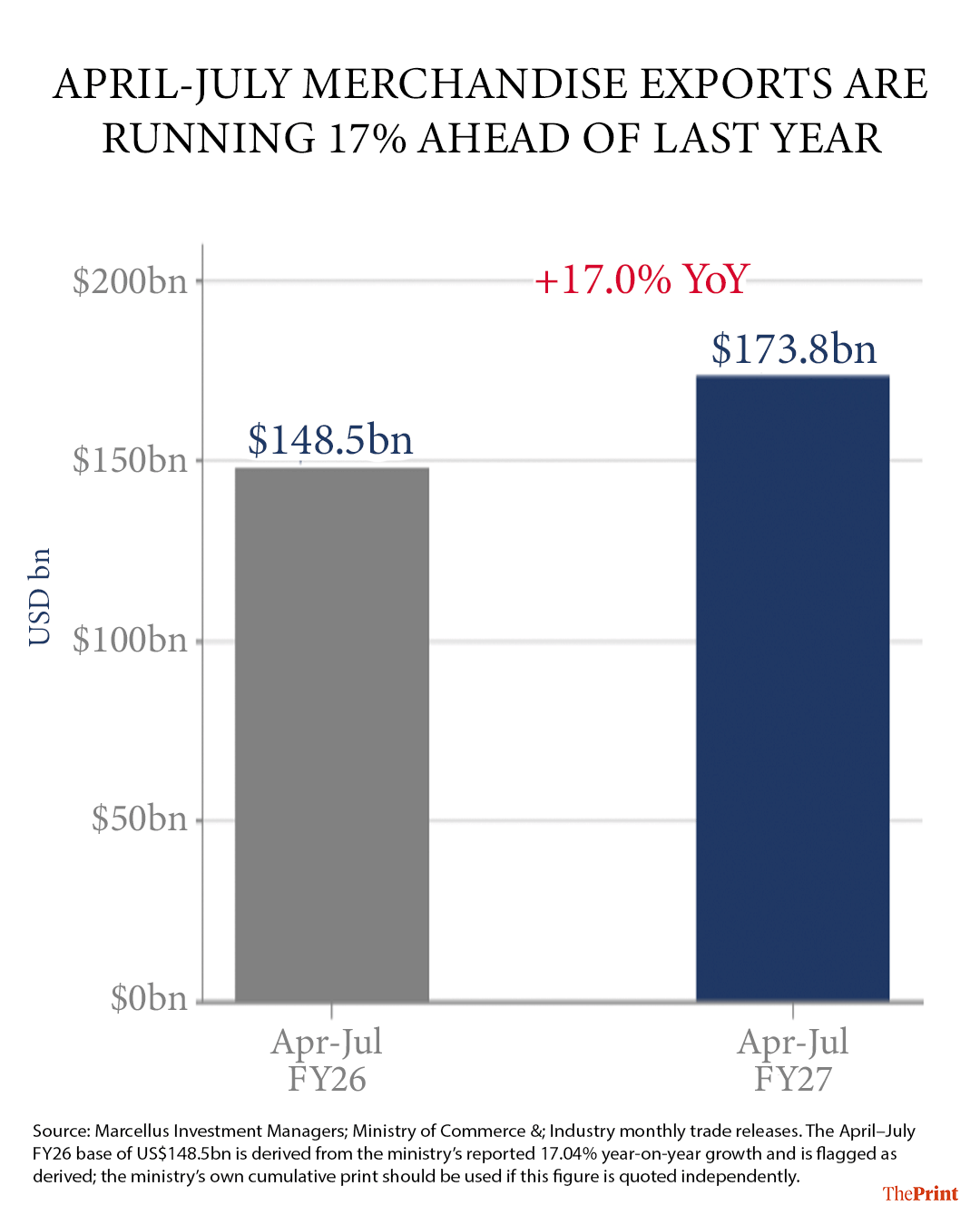
Whatever FY26 was, FY27 is not. Merchandise exports in the April-July period this year came in at $173.8 billion, up 17 percent on the same four months last year. The June quarter alone was $129.3 billion, up 16 percent. July’s $44.2 billion was the highest July figure on record and beat the previous July peak of $38.3 billion from 2022 by a wide margin, and did so while Gulf shipping was disrupted and freight rates elevated.
However, the composition is more interesting than that. Engineering goods, now 28 percent of merchandise exports, grew five percent in FY26 when the aggregate grew one percent, and were up 18 percent year-on-year in July 2026. Electronics have gone from Rs 38,000 crore of exports a decade ago to Rs 4.24 lakh crore in FY26, and are now India’s third-largest export category.
And look at where the growth is coming from: shipments to China in April to July rose to $7.78 billion from $5.72 billion, while exports to the US barely moved, from $33.48 billion to $34.49 billion. India is growing exports without leaning on the market that has spent a year threatening it.
Globalisation did not die, it changed its address
The other point in trade pessimism is that there is no world trade left to win.
James Crabtree, reviewing Ed Conway’s new 2026 book—Trade World: The Ties that Bound Our Past and Could Unravel Our Future—on the history of trade, makes the opposite point rather well: globalisation peaked during the financial crisis, but since then it has barely declined, and we still live in the most economically interconnected period in human history.
Trade as a share of world GDP climbed for decades into the early 2010s, stalled, and has drifted only slightly lower since. Meanwhile, the absolute numbers keep setting records:
● World merchandise trade volumes grew 4.6 percent in 2025, nearly double the World Trade Organisation’s own October forecast of 2.4 percent, on the back of demand for AI-related goods. The value of world goods exports reached $26.26 trillion, up 7 percent.
● Tariffs did not spiral. US tariffs are the highest in a generation, but almost nobody followed America’s example. So, average global tariffs rose only modestly from around 2.5 percent. Crabtree’s phrase for it is that this is hardly a chaotic unravelling of the global order.
● Companies adapted, instead of retreating. They re-routed shipments through third countries, mapped their vulnerabilities, shortened chains and moved some production closer to home. Rerouting is precisely the mechanism that hands volume to a country like India.
● WTO’s 2026 baseline is slower, at 1.9 percent volume growth recovering to 2.6 percent in 2027, with the Middle East conflict as the swing factor. That is deceleration from a record base, not contraction.
We would not go as far as saying global trade is booming. The more accurate version is that global trade refused to break, and is being redirected. India does not need world trade to accelerate. It needs world trade to hold up, while India’s share of it rises. One caveat worth considering though is that restrictions, interventions and chokepoint politics are all increasing, and today’s stability may simply be the lag before deeper fractures bite.
Four things have changed at once
Any one of the following factors in isolation would be good to know. But together, they look less like a good year, and more like a change of regime.
Rupee has stopped punishing exporters
For a decade, India ran a mild case of Dutch disease—a term used to explain economic issues that arise when a country’s currency strengthens sharply, often due to a boom in one sector, making other export sectors less weak or less competitive.
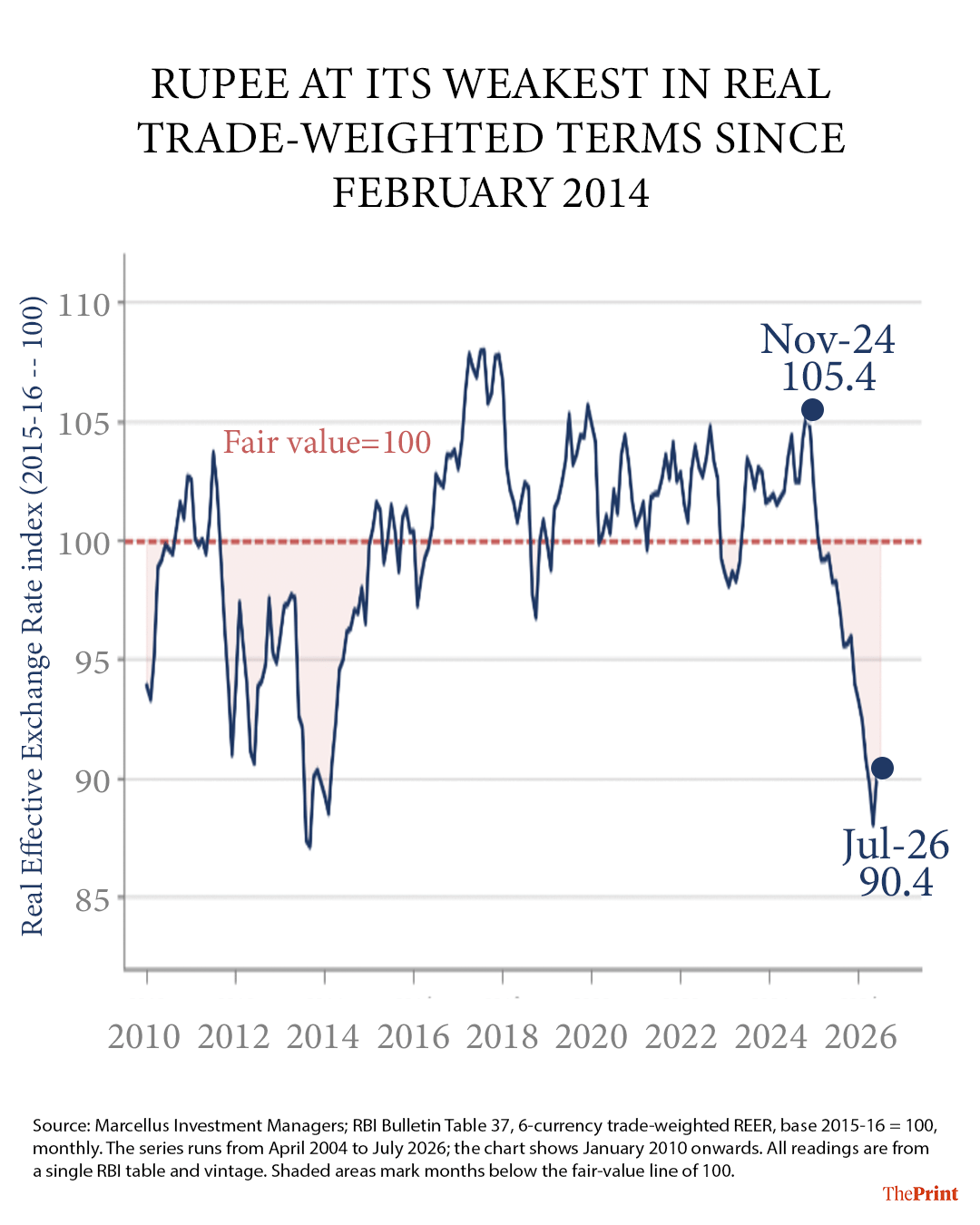
A large, high-margin IT services surplus and steady capital inflows kept the rupee expensive in real terms, and manufacturers paid for it. On the Reserve Bank of India’s 6-currency trade-weighted Real Effective Exchange Rate (REER), the rupee sat above the fair-value line of 100 in 91 of the last 121 months—three-quarters of the decade—and the cycle peaked at 105.4 in November 2024.
It has fallen every leg since. It broke below 100 in March 2025, touched 88.1 in May 2026, and stood at 90.4 in July 2026, 14.3 percent below the November 2024 peak and 11 percent below its 10-year average of 101.5. The last month the rupee was this cheap in real terms was February 2014, in the wake of the taper tantrum. Spot USD/INR is around 94.4, some 7 percent weaker than a year ago.
The engine behind the old strength is losing power. IT services growth is decelerating from the double digits of 2010s to mid-single digits, with expected net IT services export growth to slow on account of H-1B fee risk, and Tata Consultancy Services alone removing some 12,200 roles in FY26 as AI reshapes delivery. Services exports still grew 8.71 percent to $421.3 billion in FY26, so this is a slow structural shift and not a cliff. But the direction is unambiguous, and a currency that is no longer being propped up by a services windfall builds for a situation most export manufacturers have been waiting for.
This is the least discussed input into Indian export competitiveness, and possibly the most powerful. It compounds quietly through every quarter it persists, and does not need a single policy decision to keep working.
Two of the three big tariff walls are coming down
The India-UK Comprehensive Economic and Trade Agreement (CETA), India’s only comprehensive agreement with a G7 economy, came into force on 15 July this year. The UK removed duties on 99 percent of Indian tariff lines on Day 1. More than 50 consignments worth over $140 million shipped under the agreement on the first day of operation, averaging roughly $2.8 million each.
The India-EU FTA, concluded on 27 January 2026 after nearly two decades of talking, is the bigger prize. The European Union has offered preferential access on 97 percent of tariff lines covering 99.5 percent of India’s export value, with immediate elimination on 70.4 percent of lines representing 90.7 percent of India’s exports to the bloc. Bilateral goods trade was $136.5 billion in FY25, of which India exported $75.9 billion. Signature is expected by 2026-end and implementation targeted for early 2027, so this is something that is rather certain than just expected.
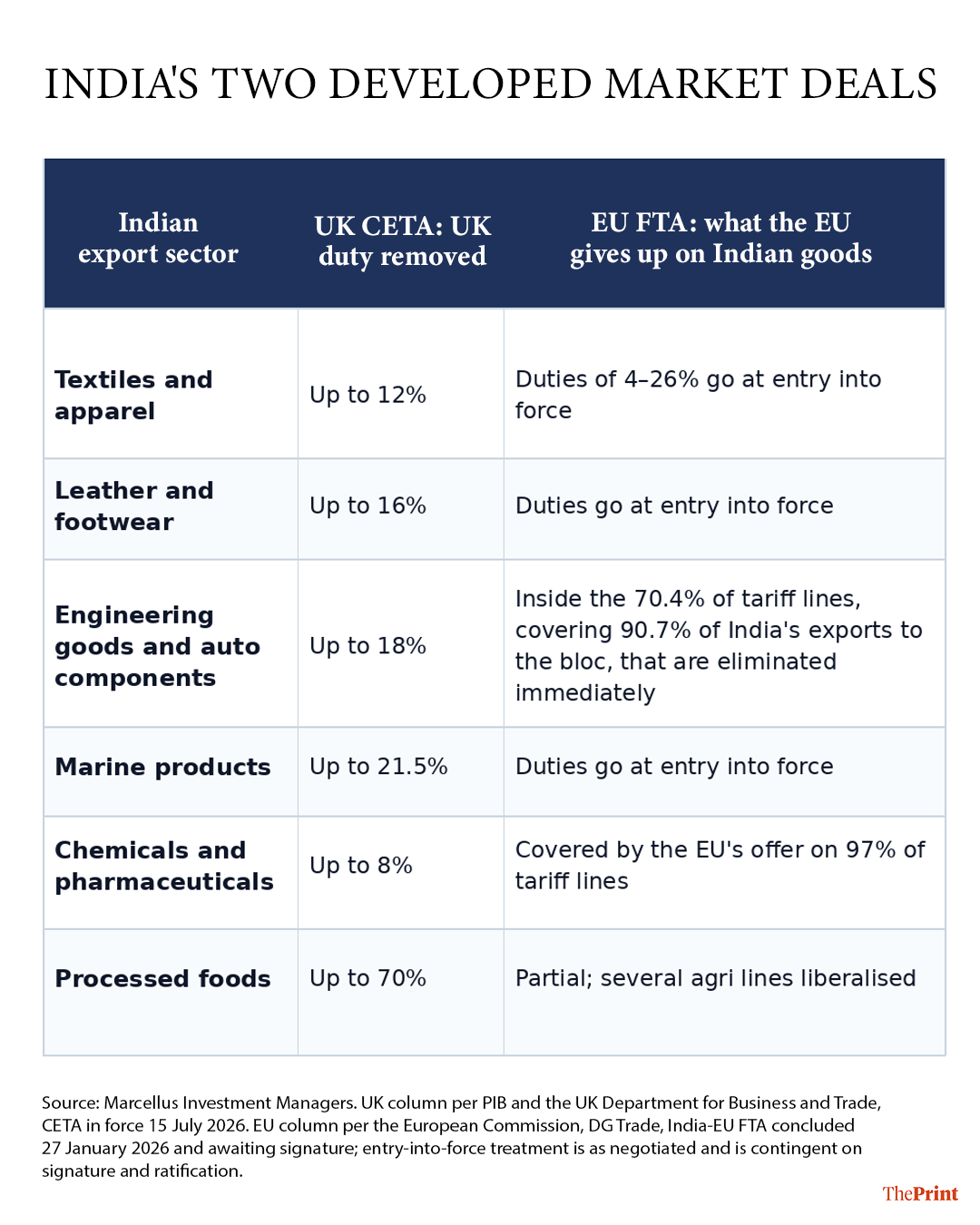
One reason for caution is utilisation. The Global Trade Research Initiative estimates Indian exporters claim preferential tariffs on only 20-30 percent of exports that already qualify under existing deals, against 60-70 percent claimed by exporters selling into India. Whether CETA and the EU deals break that pattern will decide how much of this reaches earnings, which is a company-level question, not a macro one.
A second factor for caution, on textiles specifically, is widely misunderstood. These deals do not immediately leapfrog India past its competitors. Bangladesh keeps duty-free EU access under ‘Everything But Arms’ through a transition that runs to November 2029, and Vietnam has had an EU agreement since 2020. What India is doing is closing a gap it should never have allowed to open. The step ahead comes in 2029, when Bangladeshi garments move to roughly 9.6 percent standard GSP (Generalised System of Preferences) duty, and Indian garments are at zero. Sourcing decisions for that date are being made now.
China+1 has moved from the deck to the dock
The evidence has finally shifted from documents to shipment data. India’s share of global iPhone production has gone from under 10 percent a few years ago to roughly a quarter, across five assembly facilities and a network of around 45 local component vendors. Electronics exports were up about 35 percent year-on-year as of April this year, taking India to roughly eight percent of the global electronic manufacturing services (EMS) market.
But India is one of several winners rather than the sole winner. Vietnam and Mexico have taken large slices, and ASEAN pulled a record $225 billion of Foreign Direct Investment in 2025. And domestic value addition in Indian electronics is still only 18-20 percent against roughly 40 percent in China, so a good deal of what India books as exports is assembly on imported components.
Moving up that curve is a decade of work. What has already happened, and what does not reverse, is that a generation of Indian operators and engineers has been trained in modern electronics manufacturing, and that capability is now spilling into other buyers.
The West is rearming, cannot build all of it at home
European allies and Canada raised defence spending by nearly 20 percent in real terms in 2025, the fastest annual increase since 1953, taking their combined outlay above $574 billion. For the first time, every NATO member is above two percent of GDP, and the alliance has committed to five percent by 2035.
The binding constraint here is industrial capacity: shell production, machining, skilled labour, raw materials. Demand of that size hitting a supply base that cannot expand fast enough has to find qualified capacity somewhere.
Enter India. Defence exports hit a record Rs 38,424 crore in FY26, up 62.7 percent, with the private sector contributing 45 percent, and the United States the single largest destination. American defence & aerospace OEMs (Original Equipment Manufacturers) are buying sub-systems and fuselages from Indian suppliers. The number of registered defence exporters rose to 145 from 128, and Indian defence goods now reach more than 80 countries.
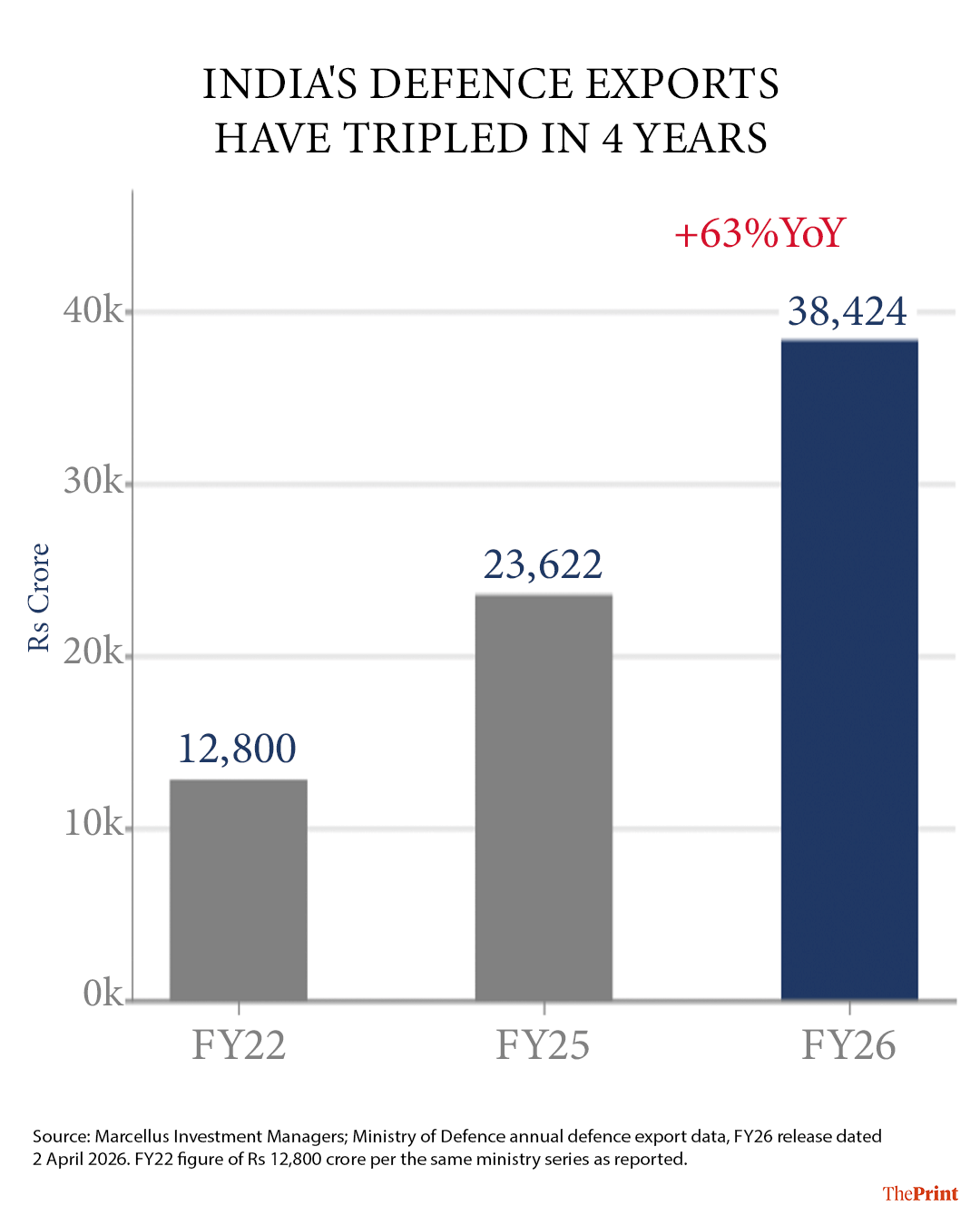
The winner here is precision component supplier that has already cleared a Western aerospace or defence qualification cycle, two to four years of audits, and now sits inside a supply chain that is desperate for capacity and structurally slow to re-qualify anybody else.
Also Read: Indians are marrying later, having fewer kids. It’s signalling the end of the demographic dividend
Who is set to benefit?
The five sectors that are the clearest beneficiaries of the EU and UK agreements and of the demand shifts: textiles, auto ancillaries, precision engineering, pharma and pharma ancillaries.
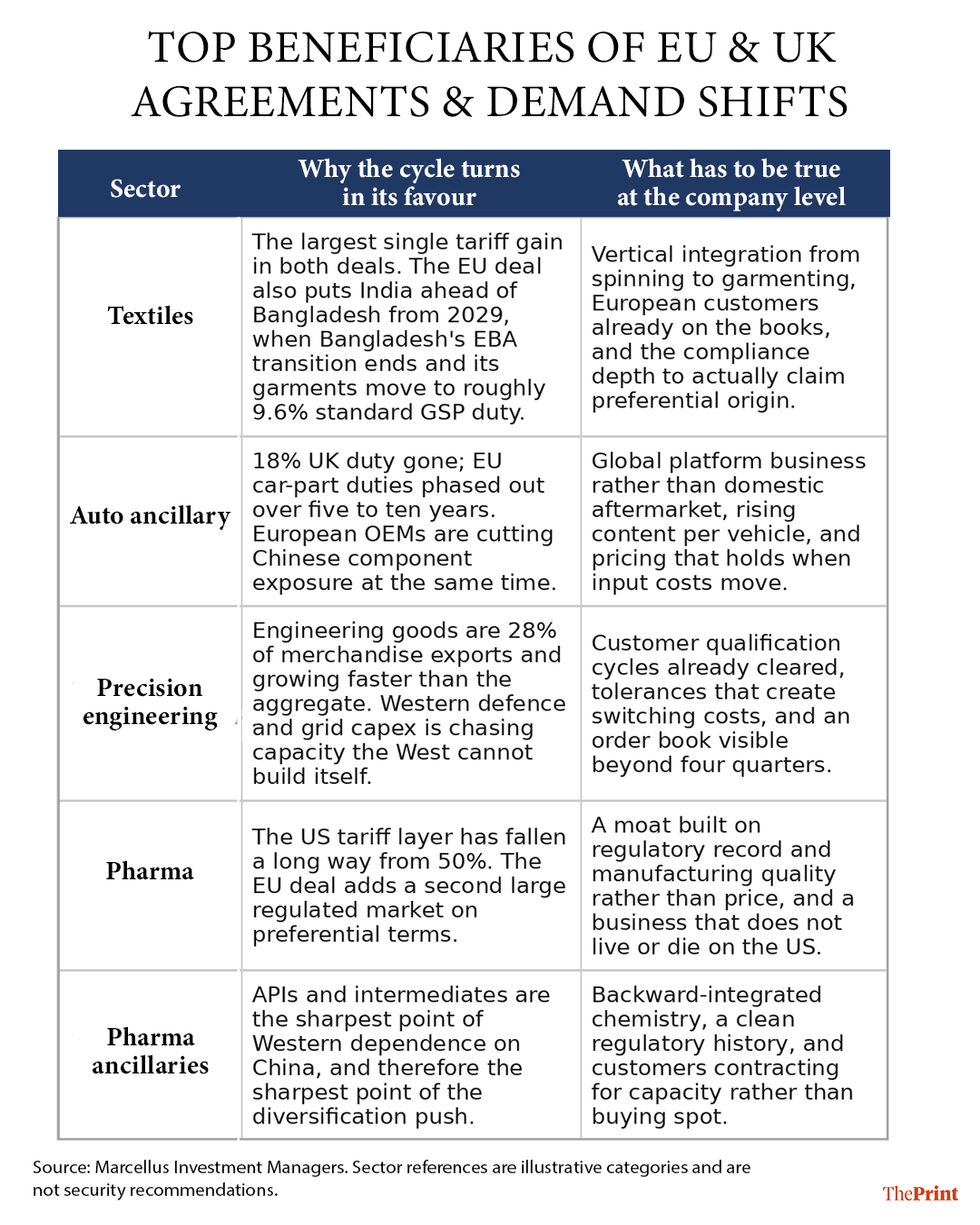
A tariff line falling to zero is available to every exporter in that line, including the ones with no pricing power and no balance sheet. Franchises where this tailwind lands on top of an advantage that already exists—clean accounts, capital allocation that can be defended, and a reason the customer cannot easily walk away—are the best investment bets.
What could go wrong?
● The American arrangement never settles. The bilateral agreement is unsigned, the overcapacity investigation is live, and the legal basis for US tariffs has already been rebuilt twice this year. The US is still India’s largest single export market.
● Utilisation stays where it has always been. If exporters claim preference on only a fifth of eligible shipments, the FTAs deliver a fraction of the headline.
● The rupee turns. A real exchange rate 11 percent below its own 10-year average is not a permanent condition, and the rupee has already ticked up from May’s low.
● Chokepoints. Crabtree’s warning about sea lanes is not academic for India. The Hormuz closure alone took 7.4 percent off March 2026 exports, and freight and insurance can erase a 12 percent tariff saving in a fortnight.
● Non-tariff barriers replace tariff barriers. The UK’s carbon border tax starts in January 2027 on steel, aluminium and cement, alongside a tightened steel safeguard regime from July 2026. The EU has its own Carbon Border Adjustment Mechanism (CBAM) and deforestation rules. Compliance can easily undo the benefit from access in a volatile world trade scenario.
Investment-wise, these are not the reasons to sit this out. They are reasons to look at companies that can absorb it, which is the same discipline one would apply with or without a trade cycle. The difference is that for the first time in 50 years, the exchange rate, market access and global demand are pointing the same way at the same time.
Nandita Rajhansa and Saurabh Mukherjea work for Marcellus Investment Managers (www.marcellus.in).
(Edited by Mannat Chugh)
Also Read: Winner-takes-all Wimbledon-style payoffs await India’s white-collar workers