



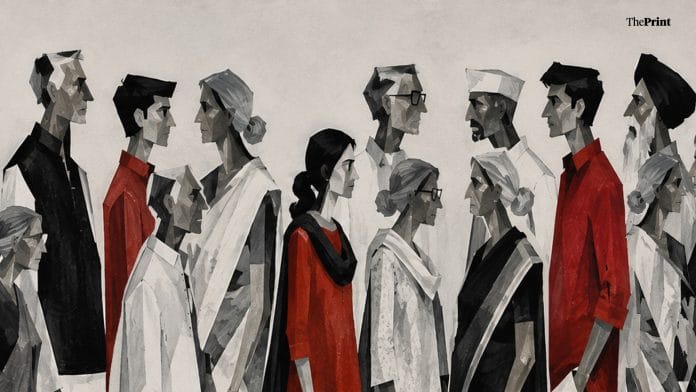
New Delhi: At a very early stage in its development, India is tracing the same path the richer economies did: Indians are marrying later in life and having fewer children.
Specifically, these shifts are taking place far more rapidly in the better educated, more employable parts of the Indian economy.
As a result, data points to shrinkage in India’s overall population and rapid population shrinkage in the most developed, better educated segments of the economy.
This, in turn, implies the end of the “demographic dividend”—the generation or so of higher economic growth that India enjoyed due to a surplus of young, employable workers. The investment implications of this are profound, including slower consumption growth.
Economic theory on marriage is well-established
Gary Becker’s economics of the family, for which he received the Nobel Prize, treated the household as a small firm. The gain from marriage came from specialisation: one spouse specialising in market work, the other in domestic production, with the division of labour producing more than either could alone.
Becker called these production complementarities, and they generate a specific prediction — that people will sort into couples on the basis of difference rather than similarity, because complementary skills are worth more than duplicated ones. Opposites should attract.
Betsey Stevenson and Justin Wolfers argued in a 2007 (National Bureau of Economic Research (NBER) paper that this model has been overtaken. Household technology reduced the time cost of domestic production; the service economy made it purchasable; women’s education raised the opportunity cost of staying home.
What remains, in their account, is consumption complementarities—activities that are simply more enjoyable when shared. They call the result hedonic marriage, and it inverts Becker’s prediction: if the gain comes from shared enjoyment rather than divided labour, similarity beats difference, and sorting should become positively assortative on education, age and outlook. That is what the data shows for the developed economies.
Stevenson-Wolfers’ work also implies that the specialised, production-based marriage is genuinely obsolete in rich countries. Specifically, what is doomed is the marriage in which one person specialises in the home.
The two papers highlighted above effectively provided the underlying theory to explain what the developed world has seen over the past half century. Across the OECD (Organisation for Economic Co-operation and Development) countries, marriage rates have fallen by roughly half since 1970: in 1970 most member countries recorded crude marriage rates between 7 and 10 per 1,000 people; by 1995 most were between 5 and 7; most are now between 3 and 5.
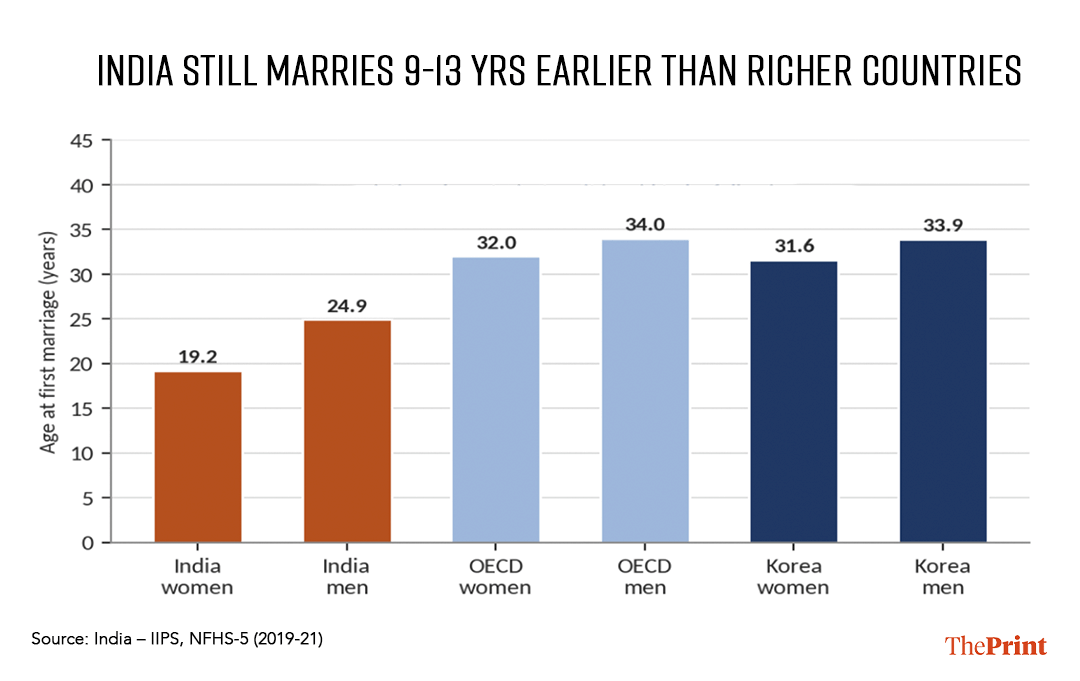
The OECD Family Database records the mean age at first marriage rising by almost six years between 1990 and 2017, reaching close to 32 for women and 34 for men by 2021.
Following path laid out by richer countries
Although based on overall per capita incomes, India remains one of the poorest 40 nations in the world, the marriage and fertility behaviour in India is following the pattern laid out above.
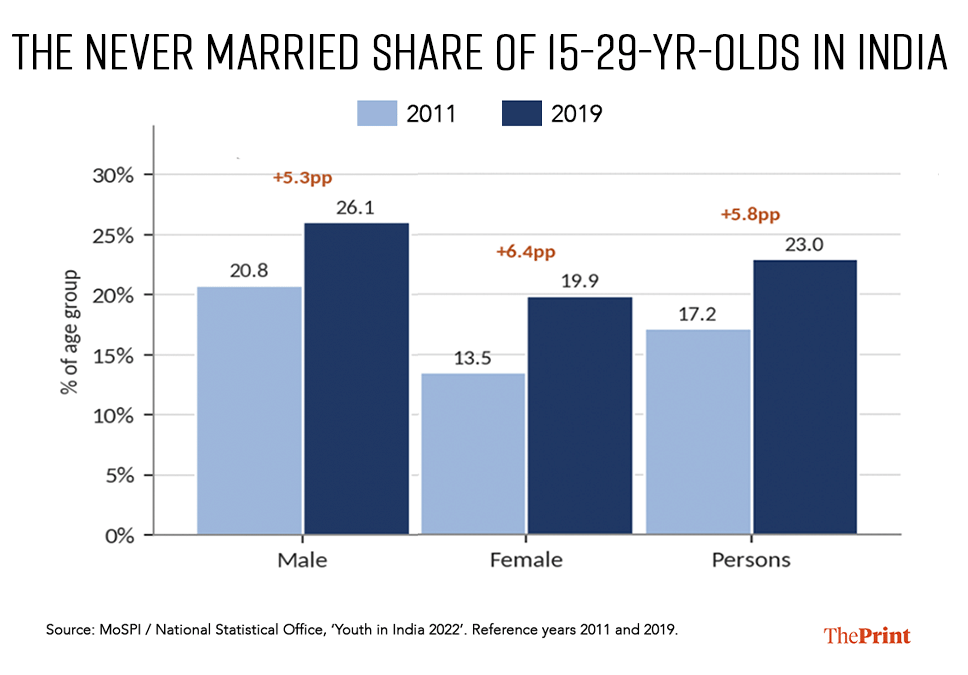
The National Statistical Office’s ‘Youth in India 2022’ compendium records the never-married share of the 15–29 population rising from 17.2 percent in 2011 to 23.0 percent in 2019, with the male share moving from 20.8 percent to 26.1 percent and the female share from 13.5 percent to 19.9 percent.
Both moved roughly six percentage points in eight years, which for a nuptiality series is a fast shift.
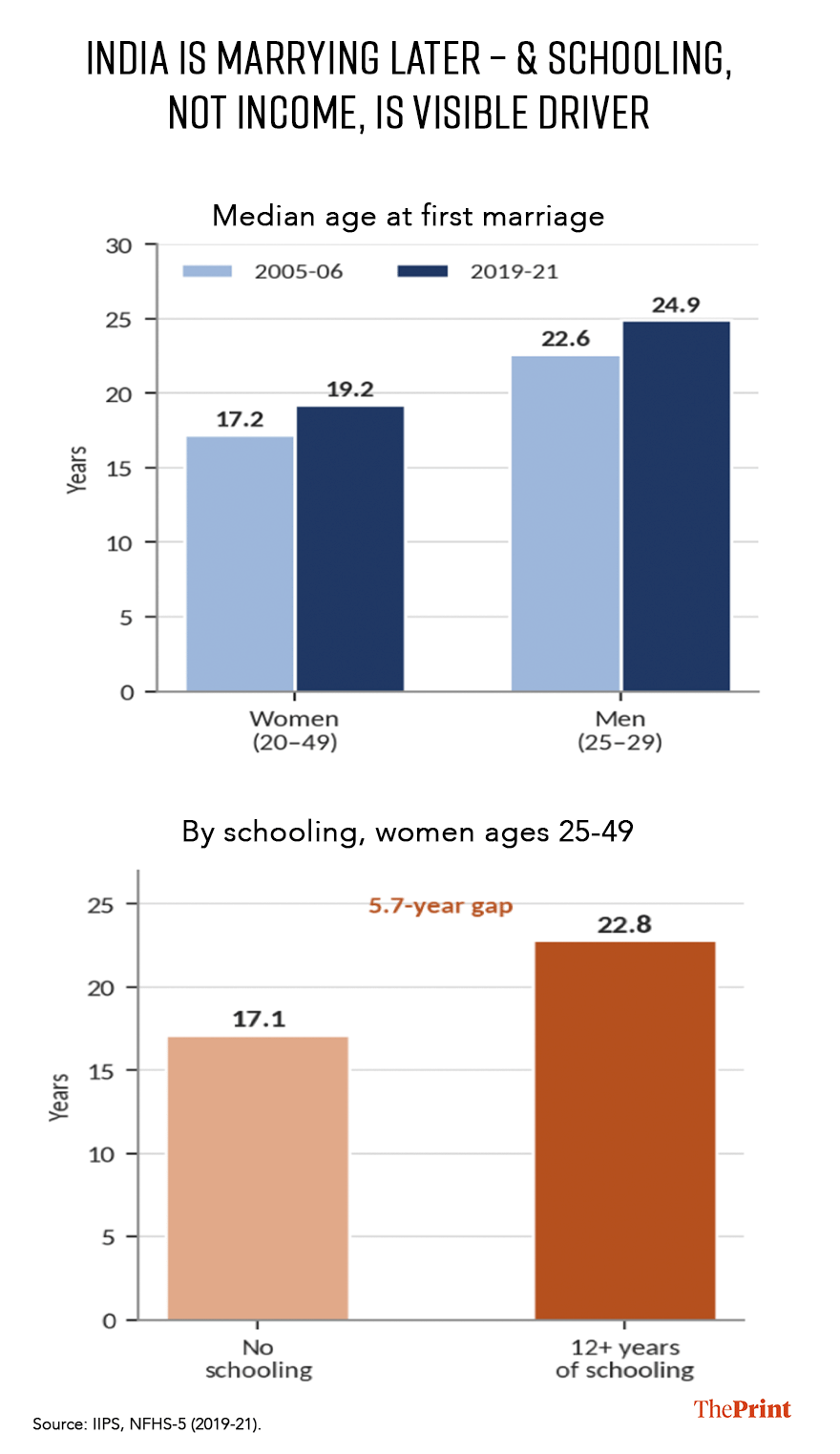
On timing, the National Family Health Survey 5 records the median age at first marriage for women aged 20–49 rising from 17.2 years in 2005-06 to 19.2 in 2019-21, and for men aged 25–29 from 22.6 to 24.9.
The Ministry of Statistics and Programme Implementation (MoSPI) Women and Men in India 2025 reports the mean age at effective marriage for women reaching 24.3 in 2023.
The share of women aged 25–29 first married by age 20 fell from 72.4 percent to 52.8 percent over the same 15 years, and the share of women aged 20–24 married before 18 halved, from about 47 percent to 23 percent.
Marrying later—schooling, not income, is visible driver
The education gradient is the sharpest observable dividing line.
The median age at first marriage among women aged 25–49 runs from 17.1 years for those with no schooling to 22.8 years for those with 12 or more years of schooling— a gap of 5.7 years. Each additional year of a girl’s education raises age at marriage by 0.36 years after controlling for wealth and residence.
India’s median age at first marriage for women is 19.2. The OECD mean is about 32, and Korea’s 31.6.
Marrying late, having fewer children
According to the Sample Registration System (SRS) Statistical Report — India’s largest demographic survey—India’s fertility rate has for the first time fallen below the level needed to stop the population from shrinking, raising concerns about future labour shortages and an ageing society.
The latest SRS report released in May 2026 said that India’s Total Fertility Rate (TFR) had dropped to 1.9 children per woman—lower than the benchmark replacement level of 2.1 needed to keep the population stable in the long run.
The TFR is the average number of children that a woman is expected to have in her reproductive years. In the 2000s, India’s TFR was around 3.3.
More specifically, fertility rates are falling the fastest in the best educated, most affluent parts of the country. Bihar in northern India with the lowest levels of education and high infant mortality rates, also recorded the highest fertility rate in the country at 2.9, followed by 2.6 in Uttar Pradesh.
By contrast, India’s capital New Delhi—with among the highest levels of education and lowest infant mortality rates—registered the lowest fertility rate, with an average of 1.2 births per woman.
Southern states such as Tamil Nadu and Kerala, with among the best health and education systems in India, recorded a rate of 1.3. In these better developed parts of the Indian economy, it is highly likely that for the middle class Indian, fertility rates are now well below 1 i.e. far below the replacement rate of 2.1.
So, not only is India’s overall population already shrinking (with the fertility rate now below replacement rate), it is shrinking the fastest in the most prosperous parts of the economy, thus implying that the demographic dividend that India is supposed to have enjoyed over the past generation is now likely coming to an end.
Profound implications
These shifts are going to impact Indian society and economy deeply.
- The fact that fertility rates are falling far more rapidly in the better educated, better developed southern states is bound to create a high voltage political flashpoint as India approaches “Delimitation”. India’s politicians are unlikely to find a neat solution to south India’s rising economic importance alongside its rapidly shrinking population.
- As India’s population shrinks, consumption growth—which has tanked steadily over the past 15 years (see chapter 7 of the authors’ book, “Breakpoint: The Crisis of the Middle Class & The Future of Work”) – is likely to decline further even if the household debt bubble sustains in India for a few more quarters.
- As well-educated affluent Indian families move towards retirement with few or no children, savings rates are likely to rise. Furthermore, as is increasingly being seen, Indian professionals having no kids, their spending on aspirational and luxury items is likely to rise.
- Social scientists have found that lack of children seems to impact mental health adversely in India. “Childlessness is associated with higher depressive symptoms among both men and women in mid- and later adulthood, and with greater life dissatisfaction among women.”
Investment implications are significant
Multiple forces—tech in the form of AI, demographics in the form of a shrinking population, economics in the form of high household indebtedness, geopolitics in the form of China+1—are working together to rapidly change the structure of the Indian economy—away from consumption and towards higher saving as India enters Sankat Kaal, away from IT services exports and towards manufacturing exports, and away from reliance on the government for public services towards relying on the private sector for health, education and security.
Saurabh Mukherjea & Nandita Rajhansa work for Marcellus Investment Managers.