



Delhi: In their bestseller Breakpoint: The Crisis of the Middle Class & The Future of Work, the authors argued that India’s middle class has been pulverised —white-collar job creation has stopped, real wages have gone backwards for nearly a decade, and the gap has been plugged with debt.
That damage is now visible in the numbers that used to define Indian consumption. FMCG (Fast-Moving Consumer Goods) volume growth has fallen from 12 percent in FY11 to 3 percent in FY26; and consumer durable volume growth has slipped from double digits to mid-single digits.
Consumption in India now is being rebuilt around three new pillars: 1) elite consumption is booming as a new class of owner-operators prospers, 2) middle-class consumption is now financed by credit rather than by income, and 3) the state is withdrawing from providing public services to doling out large cash transfers each year to low-income voters.
Also read: Winner-takes-all Wimbledon-style payoffs await India’s white-collar workers
The old consumption engine has stalled
For 20 years, Indian consumption was easy to understand. A widening middle class bought its first packaged shampoo, then its first two-wheeler, then its first air conditioner, and the companies selling those things compounded earnings without having to think very hard about it. That reality is now largely over.
FMCG volume growth has collapsed from 11 percent in FY11 to 3 percent in FY26. Consumer durable volume growth has followed a similar pattern, and even smartphone volumes — a category with easy financing and near-universal desire— are struggling to grow.
Nestlé India’s Managing Director put it plainly when he observed in October 2024 that the middle class seems to be shrinking.
The authors have written extensively about the drivers of this middle-class consumption slowdown in the Breakpoint. IT job listings have shrunk at a 12 percent CAGR (Compound Annual Growth Rate) over FY23-25 and BPO listings at 28 percent, while white-collar listings overall are down about 20 percent since generative AI arrived at scale in 2022.
Eight million new graduates enter the job market every year. Azim Premji University’s research shows that only 4 percent of them get full-time white collar work.
Real wages for Nifty 50 employees have been shrinking at 4 percent a year since FY16. Meanwhile, the true cost of a middle-class life— school fees, hospital bills, transport costs, a decent thali—compounds at roughly 9 percent a year.
Annual income growing at 0.4 percent (as per Income Tax department data) a year cannot fund the cost of living growing at 9 percent a year. Naturally therefore, there has been an explosion in household debt.
However, private final consumption—all the spending by households/individuals on goods and services for their own consumption—is about 60 percent of GDP. Therefore, this sector is too important for it to slow down abruptly. A combination of free market forces and state intervention has given consumption growth in India three brand new drivers.
The top is pulling away
India now has roughly 3,50,000 ‘octopus’ families — about a million individuals—whose wealth has risen more than 16-fold in 20 years, according to BCG Global Wealth Report, 2020.
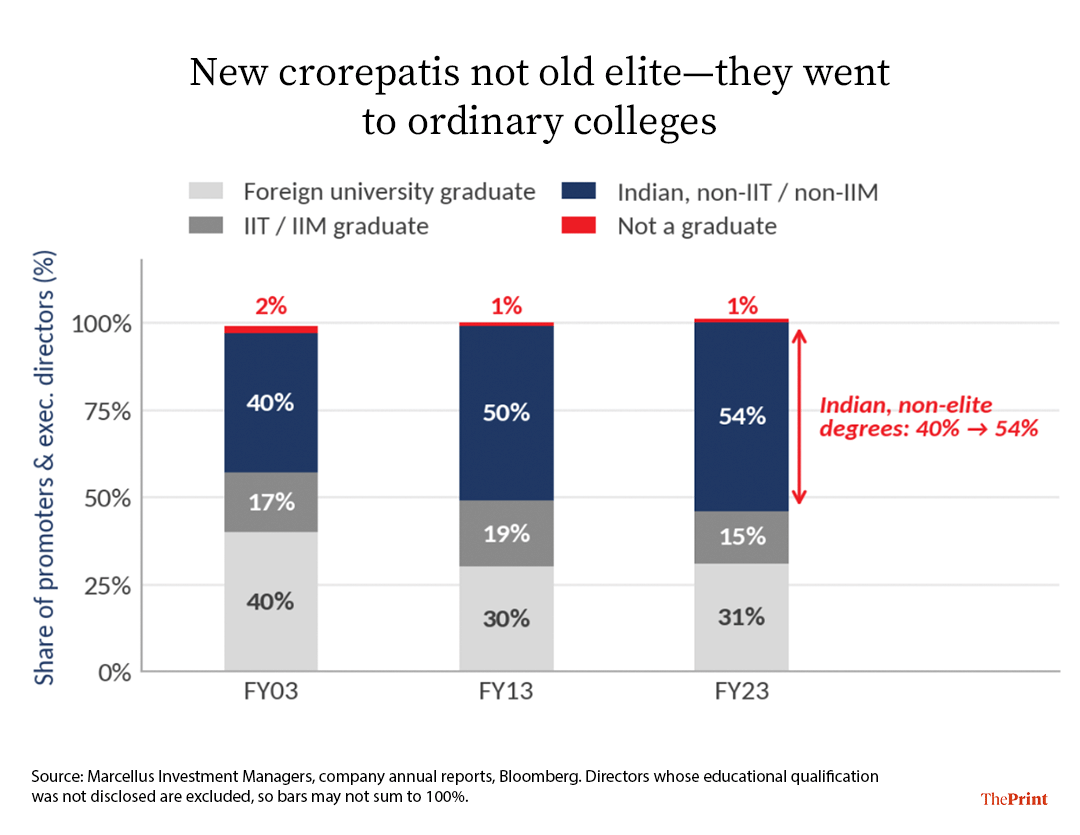
The number of Indians filing Income Tax returns above Rs 1 crore is up seven times in 12 years. This is not the old elite. For the first time, a majority of the directors of Nifty 50 companies hold ordinary Indian degrees—not IIT, not IIM, not educated abroad.
The old-style conglomerates are fading, and a new type of owner-operator is rising, often from India’s smaller cities, using technology and political access to grow revenue at 15 percent-plus, with very little headcount addition and very little debt.
New crorepatis not old elite—they went to ordinary colleges
There is a second, less obvious engine behind this. Indian IT services were the country’s forex machine; the dollars they earned kept the rupee firmer than the trade account alone would justify. As AI compresses the IT services model, those dollars thin out, the rupee weakens, and Indian manufacturing exporters become structurally more competitive.
Pune is a prime example of both the changes: Hinjewadi is where the IT export model is unwinding, and Pimpri-Chinchwad and the MIDC belt—industrial areas developed by the Maharashtra Industrial Development Corporation—are where the currency and Free-Trade Agreements benefit accrues.
The India-European Union trade deal opens an addressable market of about US$5 trillion at post-deal tariffs of roughly 0-5 percent, against FY25 exports to the EU of only US$50bn. The wealth being created in the second Pune is what funds the consumption boom sees at the top end.
The decline of the white collar middle class and the rise of the new elite can be most visibly seen in the real estate market. In the housing market, homes below Rs 1.5 crore have fallen from 85 percent of new launches in Q1 2022 to 47 percent in Q1 2026, while the Rs 1.5-4 crore band has gone from 14 percent to 44 percent. Developers are not being sentimental; they are building for the buyer who exists and has the ability to pay.
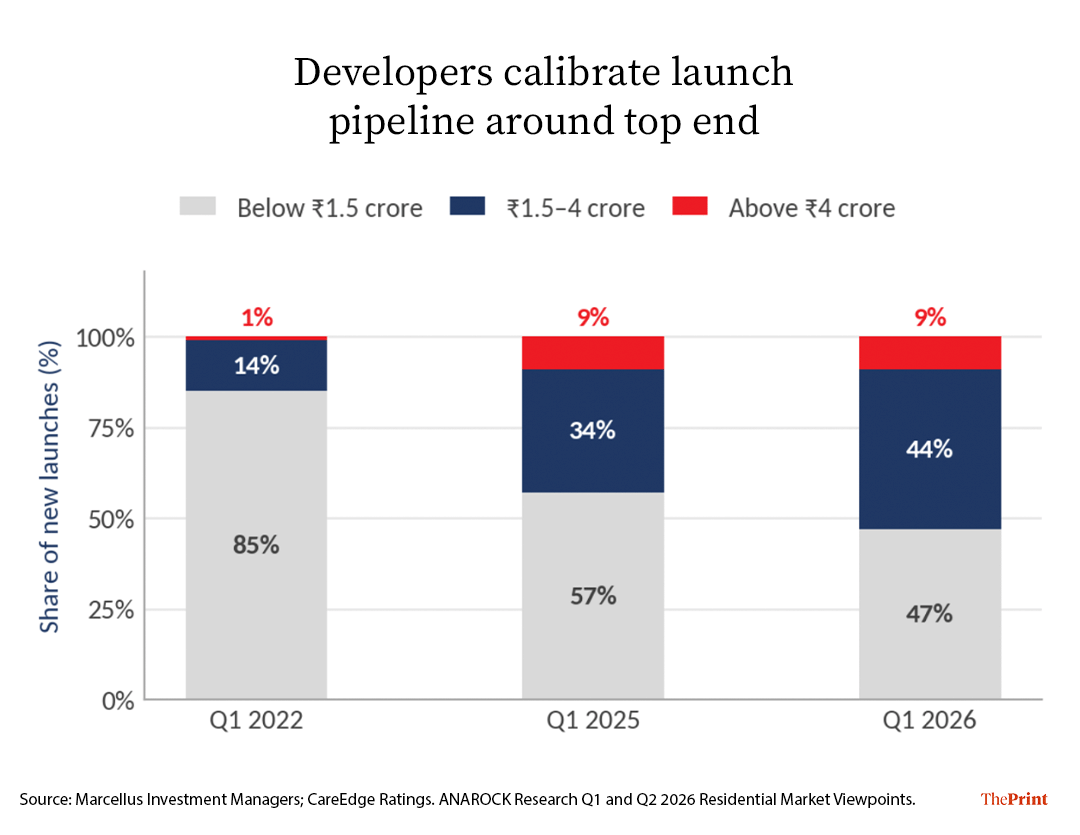
Middle class now consumes on credit, not on income
Aspiration does not fall just because income does. A middle-class household that watches the octopus class on its phone all day still wants the holiday, the phone and the car.
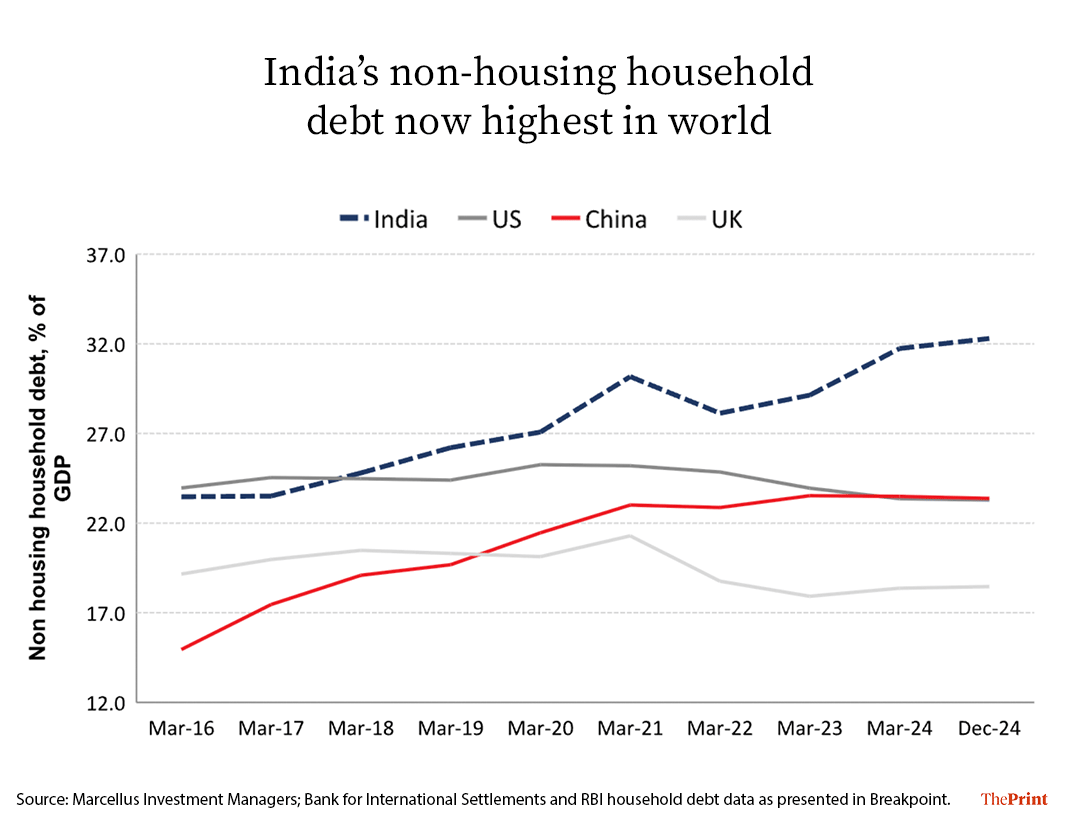
With wages flat, there is only one way to fund that gap, and Indian households have found it. India’s non-housing household debt is now the highest in the world as a share of GDP — above the US, above China.
About 40 percent of annual income goes to servicing debt. 67 percent of personal loan borrowers took their first loan before the age of 30, and 5-10 percent of retail borrowers are, on any reasonable definition, in a debt trap.
India’s non-housing household debt now highest in world
What makes this a live issue rather than a background worry is that the consumption recovery India has just reported is a financed recovery. Private final consumption expenditure grew 7.7 percent in FY26 against 5.8 percent in FY25, and 7.1 percent in Q1 FY27.
That rests on two legs: the GST 2.0 rate cuts from September 2025, and a credit impulse. Non-food bank credit accelerated from 9.9 percent to 19.1 percent in the year to July 2026, and retail credit from 11.9 percent to 16.2 percent. Neither leg is income.
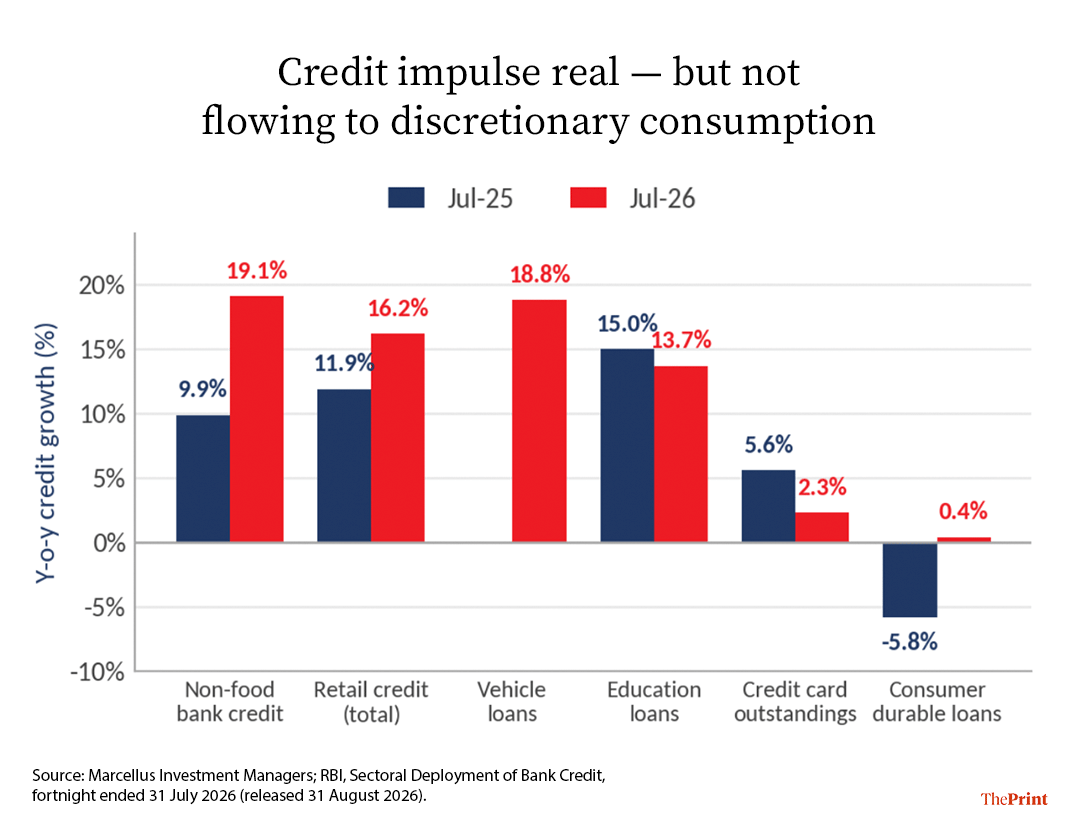
Look closely where the money is and is not going. Vehicle loans are growing at 18.8 percent and gold loans at 88.1 percent. But credit card outstandings have decelerated to 2.3 percent from 5.6 percent, and consumer durable loans are effectively flat at 0.4 percent, while the system runs at 19 percent.
Lenders are extending secured, collateralised credit and pulling back from the unsecured, discretionary kind. That is exactly the behaviour you see when underwriters have started to worry about the borrower’s repayment capacity. The overall consumption print looks healthy but the underlying detail points to a weakening household sector.
State pivoting from providing public service to handing out cash
The authors have argued in their work on the fading nation state that as capital becomes mobile and formal employment shrinks, governments lose the ability to collect taxes at the rate their commitments require.
India is a textbook case. Interests alone consumed 38 percent of the Centre’s revenue receipts in FY26 Revised Estimates. (the highest ratio among any large economy).
Interest payment at Rs 12.74 lakh crore is the single largest head of expenditure for the central government, larger than defence. At the state level, 62 percent of revenue receipts go to pay pensions, interest and subsidies before a single new school or hospital is built.
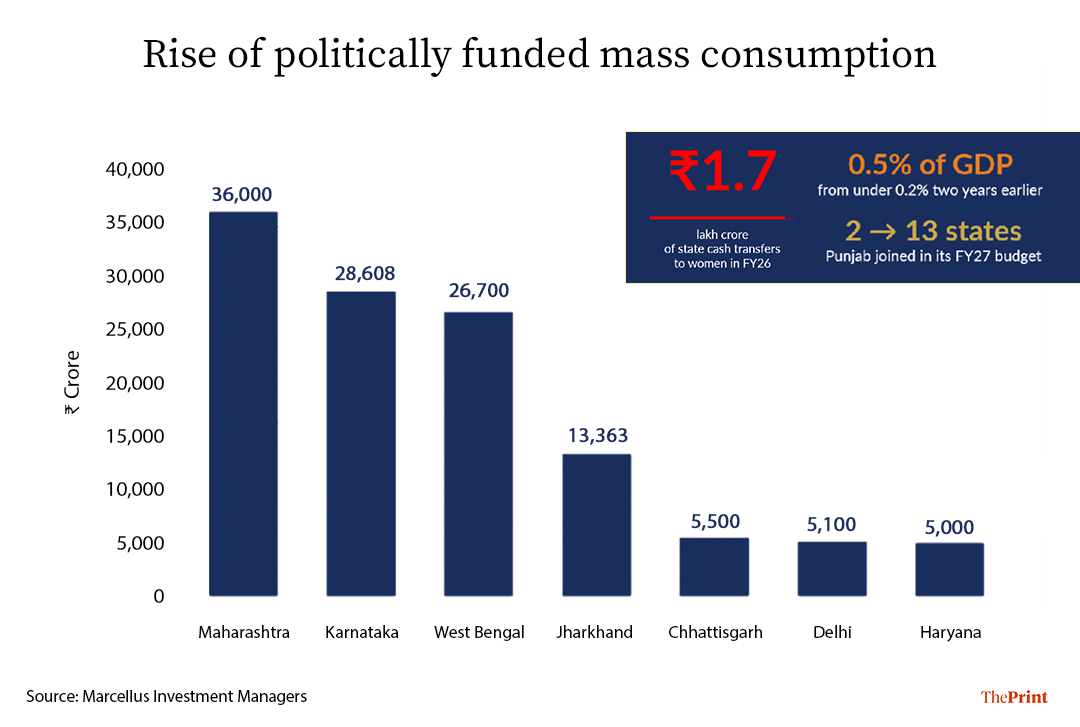
What is left over is not going into services. It is going into cash transfers. State cash transfers to women reached Rs 1.7 lakh crore in FY26, about 0.5 percent of GDP, up from under 0.2 percent two years earlier, and the number of states running such schemes has gone from two to 13.
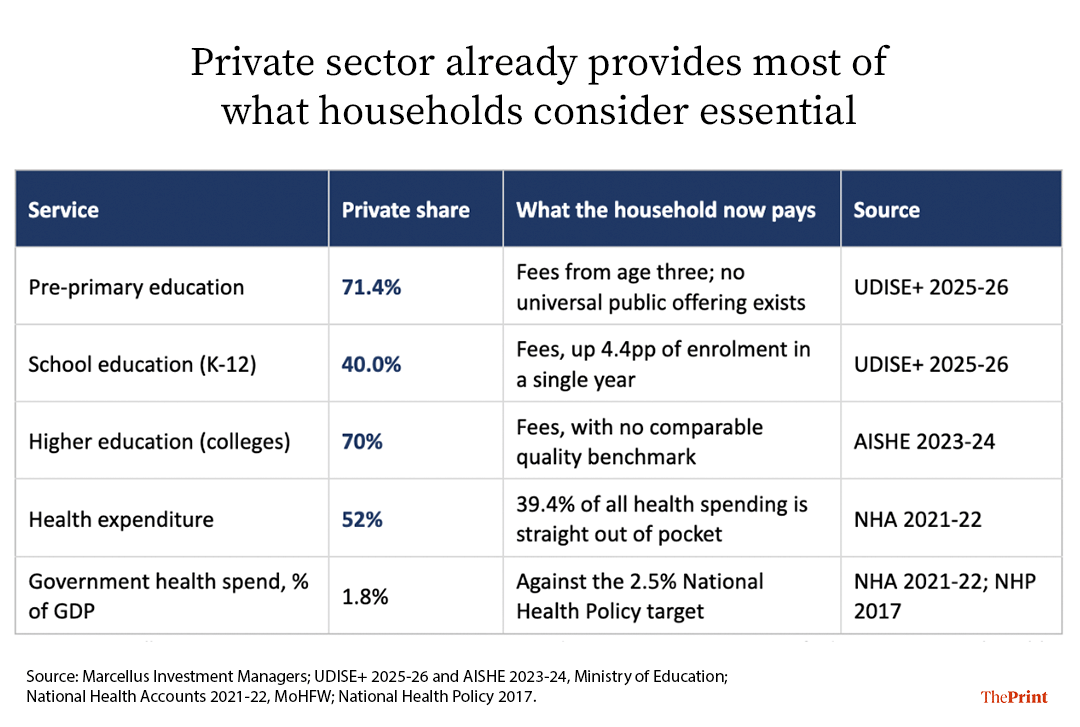
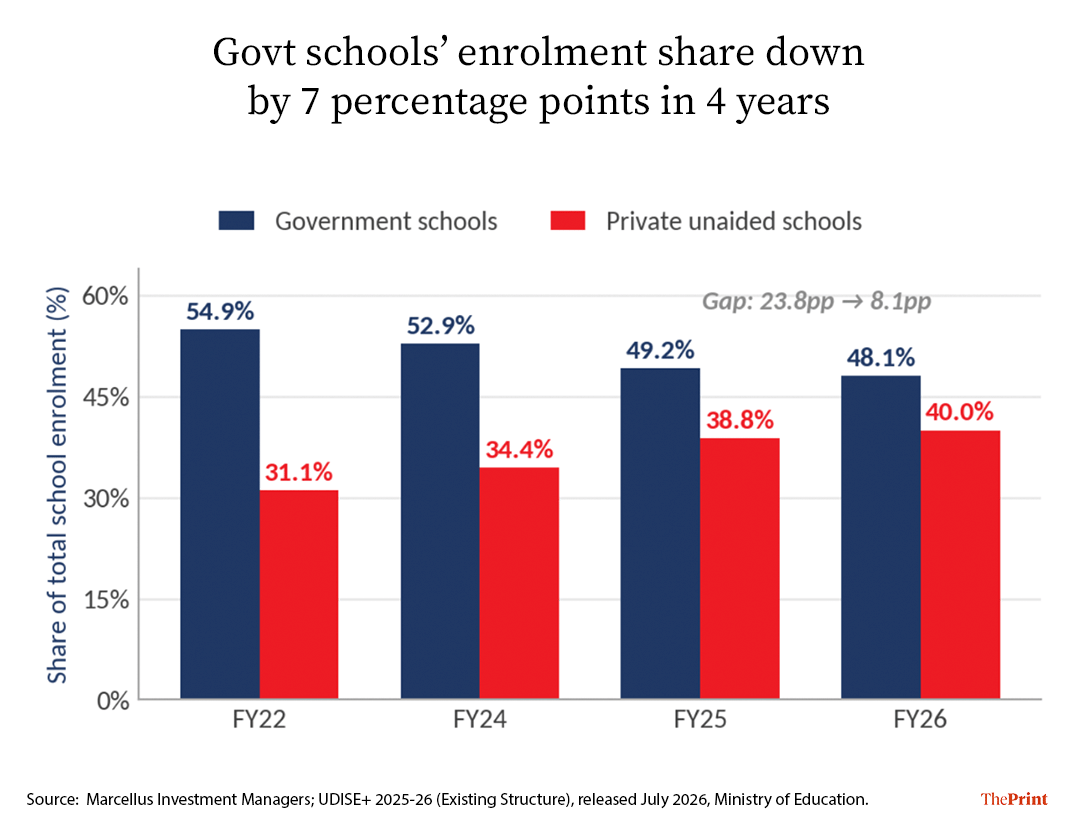
The state has swapped the provision of services for the transfer of cash. Cash transfers win elections; schools and hospitals don’t. The consequence for households is that they now buy privately, at a price, what the government used to provide for free.
Investment implications
In this new, rewired India, three things follow for those seeking to grow their wealth via the stock market.
Own boring franchises that compound. As a large chunk of IT services manpower is laid off because of AI, the hit lands directly on the domestic consumption that is 60% of GDP. In that environment, the wisest strategy is to own quality franchises that are unexciting but steadily compound earnings year after year.
The Consistent Compounders Portfolio (CCP) has already started benefiting from this in the current financial year. Public services provided by the private sector will be a lucrative source of compounding for long-term investors. The authors have invested in several such franchises spanning hospitals, medical devices, medical insurance and pharmaceuticals.
As IT Services throttles off as a source of forex generation, as the INR weakens
at a more rapid rate to the 5% p.a. it used to fall at, manufacturing exports are also becoming a source of long-term compounding. The authrors have invested in several such franchises spanning textiles, auto, auto ancillaries, engineering exports and pharma ancillary exports.
The results of this rewiring of portfolios around India’s new realities have begun showing up in FY27.
(Edited by Ajeet Tiwari)
Also read: Indians are marrying later, having fewer kids. It’s signalling the end of the demographic dividend