








At Wimbledon this July the singles champion took home £3.6 million. The 64 players who lost their first match took £80,000 each i.e. the winner earns 45x the losers.
That gap is what economists call the ‘Theory of Tournaments’, and two celebrated papers explain why the gap must be that wide.
This payoff structure will become familiar to Indian white-collar workers as jobs give way to gigs.
Three things follow: Payoffs polarise, money arrives in lumps rather than in fixed monthly figures, and everybody can see where they rank.

These three factors will make it imperative for every single white-collar worker to have a robust financial plan.
“Hearing a succession of mediocre singers does not add up to a single outstanding performance.”
— Sherwin Rosen, The Economics of Superstars (1981)
Also Read: Agentic AI is the real threat to white collar jobs. It’ll spell more trouble for Indian middle class
Some jobs pay you for your rank, not your work
In October 1981 Edward Lazear and Sherwin Rosen published a paper in the Journal of Political Economy asking why organisations pay people on where they finish against colleagues rather than on what they produce. Their answer: measuring one person’s output is slow and unreliable, while ranking two people is cheap and almost always possible. So, firms rank, then pay the ranking.
The uncomfortable part is what this does to the pay gap.
How hard people try depends on the gap between the prizes, not on how big they are. Double every cheque and nobody works harder. Widen the gap between first and second and everybody does. So, the top prize has to be far larger than the winner is actually worth. That prize is paying for the effort of the whole field, not just for what happened in the final.
Rosen published a second paper two months later, The Economics of Superstars. He explained that when work can be copied and delivered at almost no extra cost, the best person in the field is no longer limited by the hours they have. Buyers also do not treat suppliers as interchangeable. A surgeon who is 10 percent better gets paid far more than 10 percent extra. Put rank-based pay and unlimited reach together and you do not get a bell curve. You get a cliff.
Wimbledon is the clearest case study of this effect
Most tournaments keep their prize list private. Wimbledon publishes it. The 2026 fund was £64 million, of which £24 million went to each singles draw of 128 players.
The champion got £3.6 million, roughly ₹46 crore. Each first-round loser got £80,000, roughly ₹1 crore. That is 45 to one. From the other end, the weaker half of the field, 64 players good enough to get in and then beaten once, split 22 percent between them.
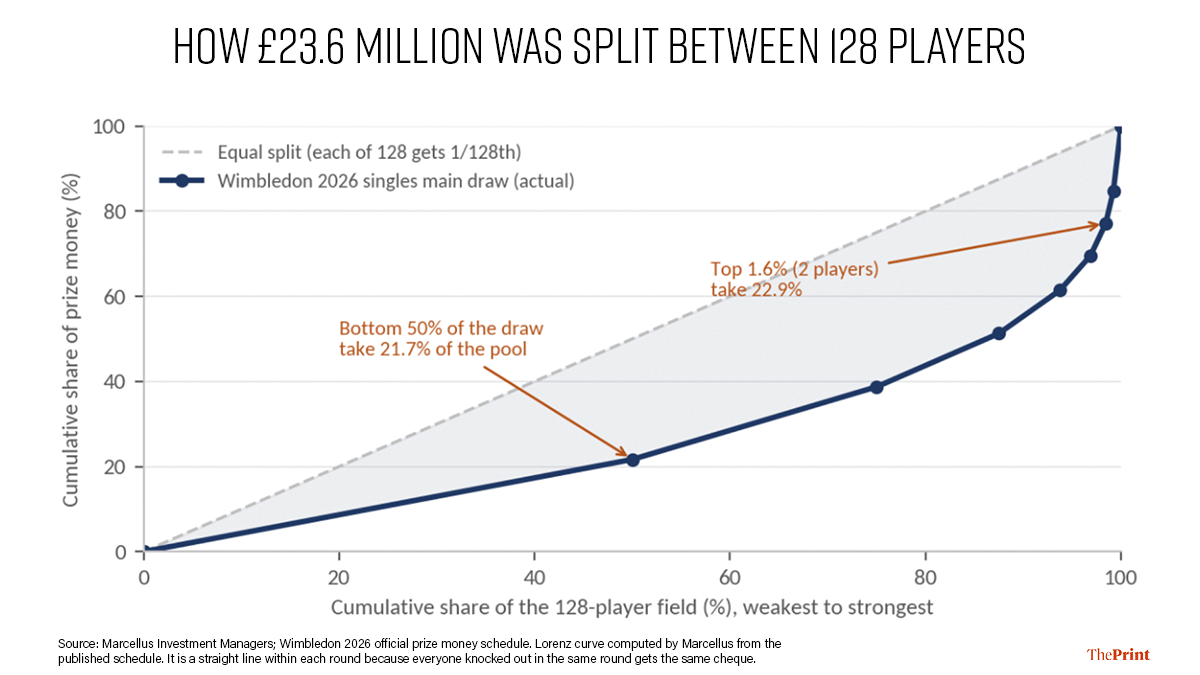
Was the champion forty-five times better? Rafael Nadal won 1,080 matches and lost 228 across his career, a strike rate of 82.6 percent. Nobody outside the very top wins one match in 45. The pay gap is about ten times wider than the skill gap. That is the design working, not unfairness creeping in. Nadal earned around US$ 135 million in prize money and, per Forbes, over US$ 415 million from endorsements. That second number was not paid for his tennis. It was paid for being ranked first.
Same structure now awaits Indian white collar workers
In “Breakpoint: The Crisis of the Middle Class & The Future of Work” we argued that the old middle-class deal, a degree then a salaried job then a slow climb, is coming apart. We then explained why gig work (i.e. assignment-based work) will soon replace office work. Once work is bought as a transaction, the buyer can rank the sellers, move volume to the highest rated, and pay for the result rather than the hours. India is further down this road than most assume.
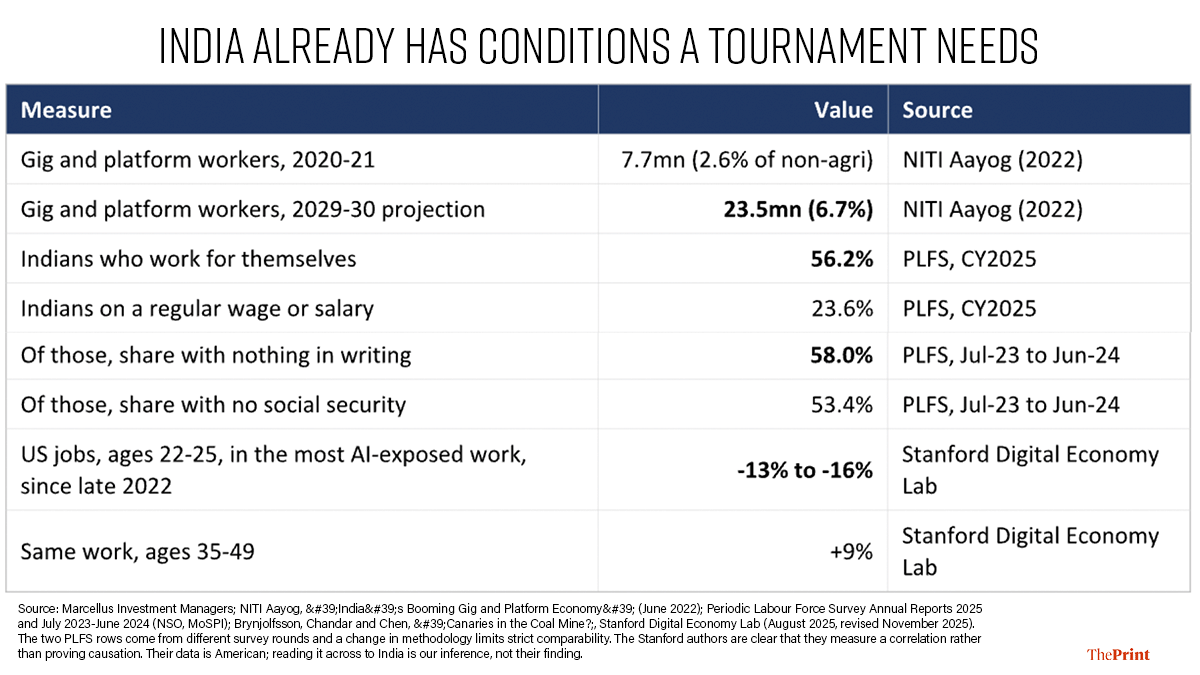
More than half of India already works without an employer. What is new is that this is reaching graduate careers, from the bottom up with the IT sector being the first to fully realise the impact of AI substituting human workers.
Three things follow when such a structure becomes dominant
One: payoffs are polarising in the Indian economy
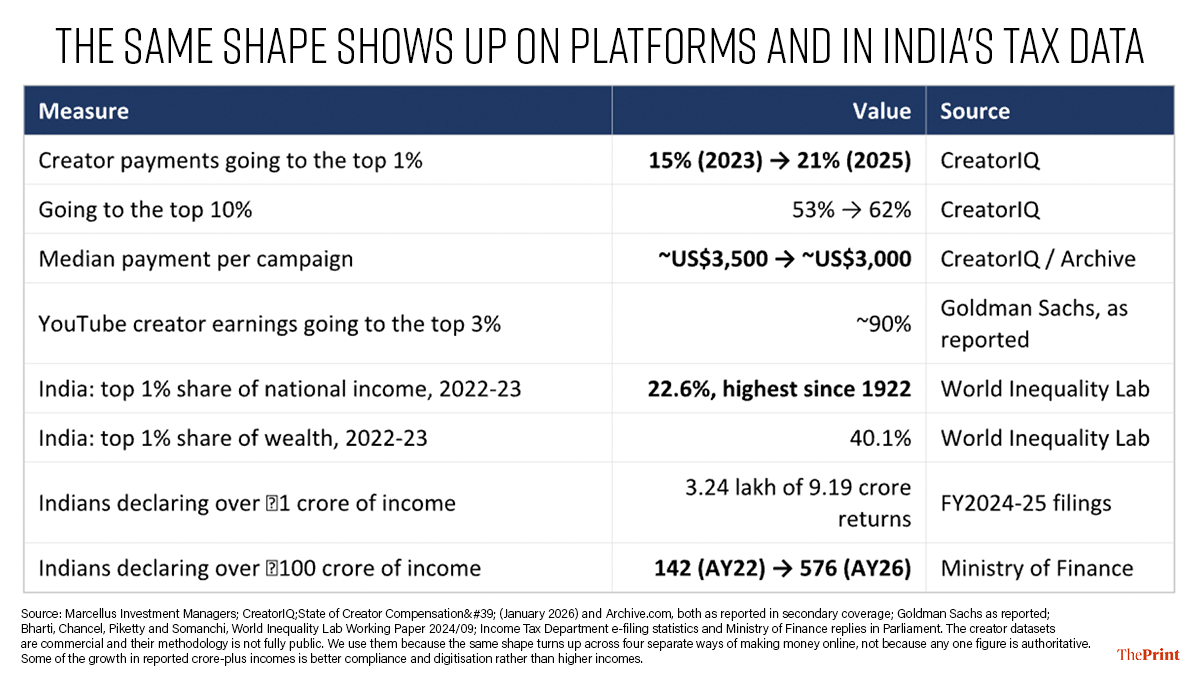
Globally, the digital creator economy runs entirely on platforms where rewards are doled out “tournament-style”. Payments to creators grew 59 percent in 2025. The median payment per campaign fell. The average payment per campaign in 2025 was US$11,400 whereas median payment per campaign was just US$3,000, meaning there are a few campaigns that comprehensively out-earn a long tail globally. As Rosen explained 45 years ago, in a tournament those two facts sit together: a bigger prize pulls in more entrants, they pile up at the bottom, and the extra money goes to the top. Indians’ Income Tax data shows that rewards in the broader Indian economy (see table below) are now increasingly “tournament-style”.
Two: earnings are going to become more volatile for Indian families
Inequality is a gap between people. Lumpiness is a gap inside one career, and we think it is harder to live with. Two extra wins at Wimbledon moved a player from £480,000 to £3.6 million in a fortnight. The JPMorgan Chase Institute looked at six million US families and found the typical family’s income moves 36 percent month to month, with swings above a quarter in five months of the year, and the young and the well-paid were the most volatile of the lot.
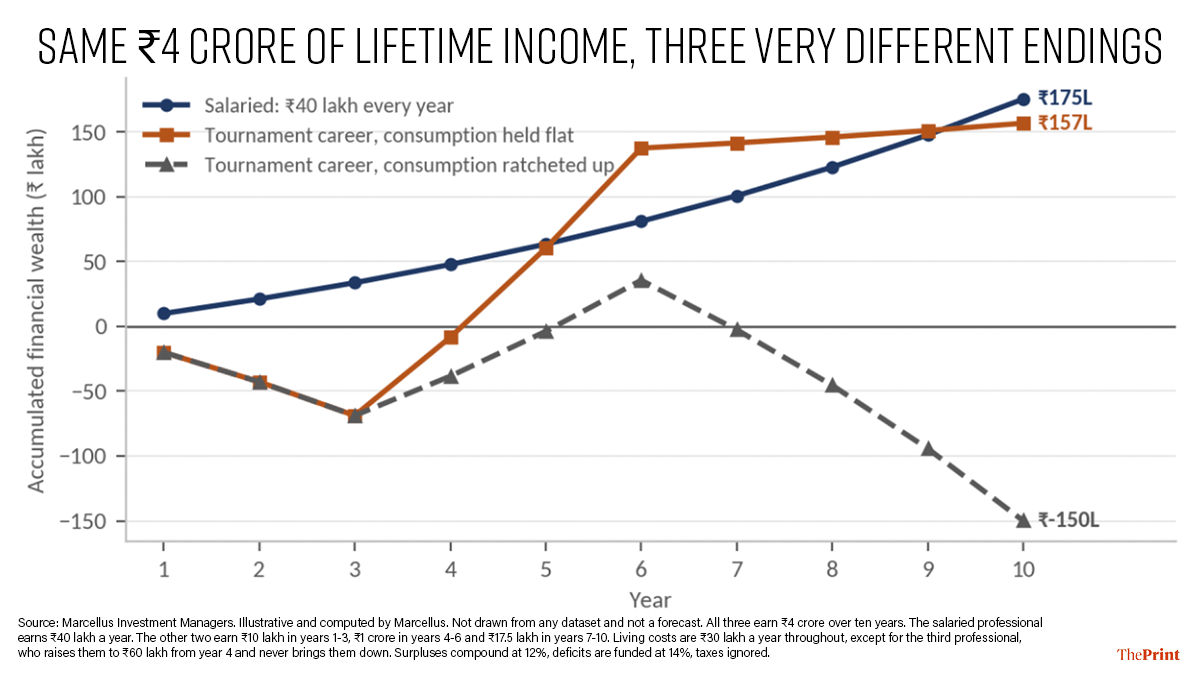
Most salaried Indians assume that they will earn the same amount every month for the rest of their careers. However, as gig jobs replace office jobs, earnings are likely to become more volatile. Let’s take the example of three professionals each of whom earns Rs 4 crore over 10 years. If you assume that their annual earnings follow three different trajectories over 10 years. As shown in the chart above, their financial position at the end of the decade will vary dramatically.
The salaried professional ends with ₹1.75 crore. The one with lumpy income who holds spending flat ends with ₹1.57 crore, 11 percent behind, only because the money arrived in the wrong order and the thin years had to be funded. The third let spending rise in the big years and never brought it down. He ends ₹1.5 crore in debt even though he has the same income as the two other salaried pros.
Three: everybody can see where they rank relative to others
In 2012 David Card, Alexandre Mas, Enrico Moretti and Emmanuel Saez studied what happened when every University of California salary went onto a public website. People who found they earned below their department’s median reported lower satisfaction and started looking elsewhere. People who found they earned above it reported no improvement at all. In an office you could only guess what colleagues earned (see more here: NBER Digest, 2011). On a platform the ranking is published and permanent. We would expect this to bite hardest inside households, where one person is in their earning years and the other is not. That is the structure at work, not a fault in the people.
Investment implications
As white-collar workers get set for a life of gig jobs, they need a financial plan which helps them deal with:
- Years of feast interspersed with periods of famine;
- Years in which they win their profession’s equivalent of Wimbledon interspersed with many years in which they are knocked out in the early rounds; and
- Perpetually seeing their professional rank fluctuate in full view of their entire professional community.
As we wave goodbye to the era of steady office jobs, the need for robust financial planning grows.
Nandita Rajhansa and Saurabh Mukherjea work for Marcellus Investment Managers (www.marcellus.in). The views and opinions expressed in this material are those of the authors and do not necessarily reflect official policy. This material is for informational and educational purposes only and should not be considered financial, investment, or other professional advice.
Note: the above material is neither investment research, nor investment advice. Marcellus does not seek payment for or business from this material/email in any shape or form. Marcellus Investment Managers Private Limited (“Marcellus”) is regulated by the Securities and Exchange Board of India (“SEBI”) as a provider of Portfolio Management Services. Marcellus is also a US Securities & Exchange Commission (“US SEC”) registered Investment Advisor and is regulated by the International Financial Services Centres Authority (IFSCA) as a Fund Management Entity. No content of this publication including the performance related information is verified by SEBI, IFSCA or US SEC. If any recipient or reader of this material is based outside India and USA, please note that Marcellus may not be regulated in such jurisdiction and this material is not a solicitation to use Marcellus’s services. All recipients of this material must, before dealing and or transacting in any of the products and services referred to in this material, make their own investigation and seek appropriate professional advice. Past performance is not indicative of future results. Marcellus and/or its associates, the authors of this material (including their relatives) may have financial interest by way of investments in the companies covered in this material. Marcellus does not receive compensation from the companies for their coverage in this material. This material may contain confidential or proprietary information and user shall take prior written consent from Marcellus before any reproduction in any form.
Also Read: Graduate and unemployed: India’s middle-class rulebook for career & success no longer works