








New Delhi: The 150-year-old concept of the nation-State is steadily being altered by: a) the growing complexity for such states to tax economic activity; b) the fact that barring USA & China, every State has little or no control of the critical technologies which underpin modern economies; and c) the migration of gainful employment away from salaried jobs (which are easier to tax) towards global gig work (which is harder to tax).
National investing was, in large part, a one-time bet on a closed market re-rating as it opened—a trade that has now largely played out.
As the nation-State weakens, the case for diversifying into US and global equities over a home-biased, “buy-the-national-index” strategy is stronger than at any point in the liberalisation era.
Corporate tax rates have halved since 1980 across the world.
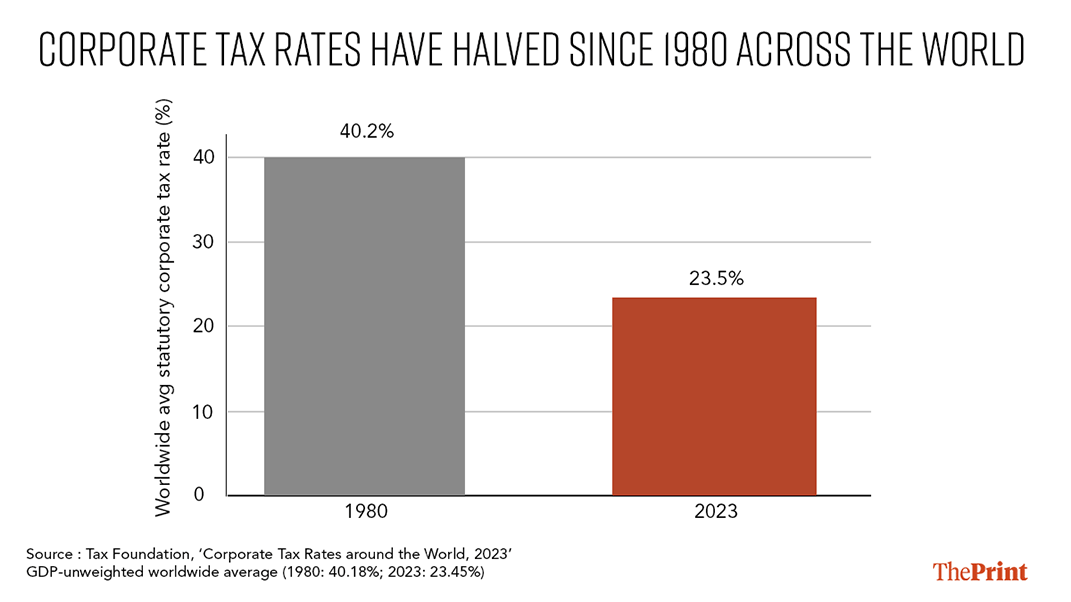
Source: Tax Foundation, ‘Corporate Tax Rates around the World, 2023’ – GDP-unweighted worldwide average (1980: 40.18%; 2023: 23.45%)
The nation-State was born in 19th century Europe…
The idea of a nation-State was and is associated with the rise of the modern system of states, often called the “Westphalian system”, following the Treaty of Westphalia (1648). The balance of power, which characterised that system, depended for its effectiveness upon clearly defined, centrally controlled, independent entities, whether empires or nation states, which recognise each other’s sovereignty and territory.
The first high profile implementation of the construct of the nation-State was in Germany in the second half of the 19th century under Otto von Bismarck. The unification of Germany was a process of building the first nation-State for Germans with federal features, with a common army, a customs union and a tax union.
It commenced on 18 August 1866 with the adoption of the North German Confederation Treaty establishing the North German Confederation, initially a military alliance de facto dominated by the Kingdom of Prussia, which was subsequently deepened through adoption of the North German Constitution.

Subsequently, other European countries followed the German model and the modern idea of the nation-State as we know it today was on its way to becoming the default model of economic and political union the world over.
…but is fading away across world in 21st century
In the 21st century, however, the idea of nation-State is under severe pressure. Across the world, three sets of powerful economic forces are steadily eroding the construct of the nation-State.
The State’s ability to tax shrinking
Joseph Schumpeter called the modern polity a ‘tax state’: its capacity to do anything rests on its capacity to raise revenue. With capital—both investments in financial markets and investments in plant and productive capacity—now mobile across borders, it is increasingly challenging for the nation-State to tax the returns arising from capital.
Since 40 percent of India’s GDP is accounted for returns to capital, as the years go by, the Indian State will find it increasingly complex to tax this part of national income. Any attempt to tax this will result in capital seeking optimisation and leaving the country.
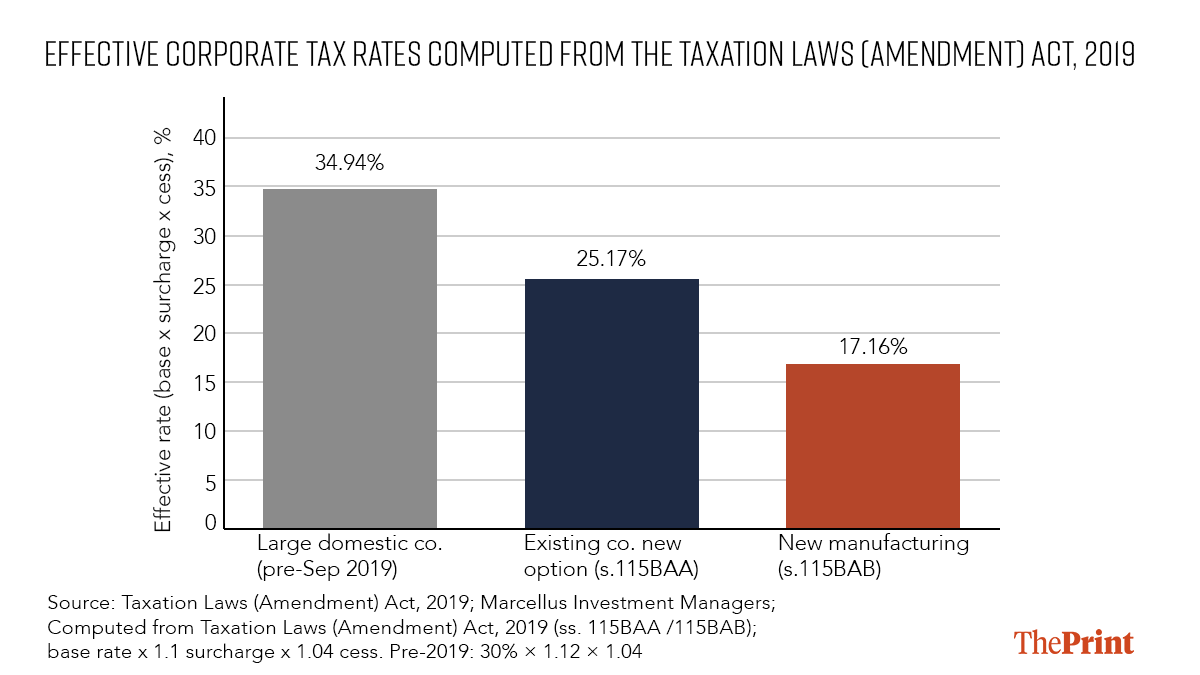
It is not just Foreign Institutional Investors (FIIs) who are reluctant to pay tax. Corporates the world over are just as reluctant. India’s Taxation Laws (Amendment) Act, 2019 cut the base rate for existing domestic companies to 22 percent and introduced a 15 percent rate for new manufacturing companies.
The effective tax rates shown in the chart below highlight the remarkable extent of the 2019 corporate tax cut.
Exhibit 3: Effective corporate tax rates computed from the Taxation Laws (Amendment) Act, 2019
To be clear, the growing shifts in how the State taxes capital are not confined to India. This is a global phenomenon—see the opening exhibit of this blog. Capital is mobile; a booked profit can move across borders far more easily than a worker. If one government raises corporate tax, capital can relocate. Anticipating this, governments compete competitively on rates—a pattern the tax-competition literature has tracked for three decades, and which is visible in the worldwide average rate.
Tech outside national control for every nation barring US, China
Sovereignty increasingly means control over compute, data, energy and the hardware beneath them. Farrell & Newman show how states that sit at the hub of critical networks—financial messaging, cloud, chokepoint supply chains—can leverage those networks structurally, restricting access (the ‘chokepoint effect’) or tracking information (the ‘panopticon effect’).
On each key network, the hub is the US or China, and India is a technology taker.
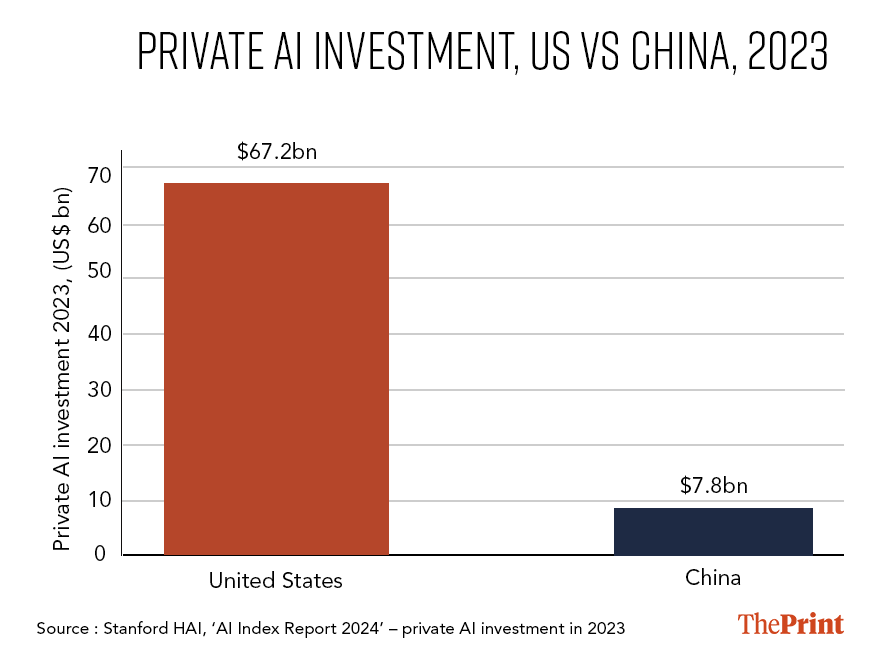
The frontier of AI—the largest models, leading-edge accelerators, and hyperscale clouds—is overwhelmingly American (with chip fabrication concentrated in Taiwan). Private capital tells the story – see chart below.
India’s responses—RBI’s 2018 payments-data-localisation mandate, the Digital Personal Data Protection Act (2023), and the India AI Mission approved by the Union Cabinet in 2024 with an outlay of roughly Rs 10,000 crore—are real attempts to claw back control, but modest relative to the gap.
A jurisdiction problem compounds it: data on US-headquartered clouds can be reachable under the US CLOUD Act regardless of physical location—the panopticon effect in practice.
If AI is American, the energy transition is Chinese. The International Energy Agency reports that China’s share exceeds 80 percent at every major manufacturing stage of solar PV, rising above 95 percent for polysilicon and wafers, and it dominates battery-cell manufacturing and the processing of rare earths and other critical minerals.
The dependency is weaponisable—as is widely known, China has restricted exports of rare earths and, more recently, gallium and germanium—a textbook chokepoint. India’s answer (Production-Linked Incentives for solar, advanced-chemistry-cell batteries and electronics, plus a Critical Minerals Mission) addresses this. But upstream capacity takes a decade to build.
Global gig work and cryptocurrencies
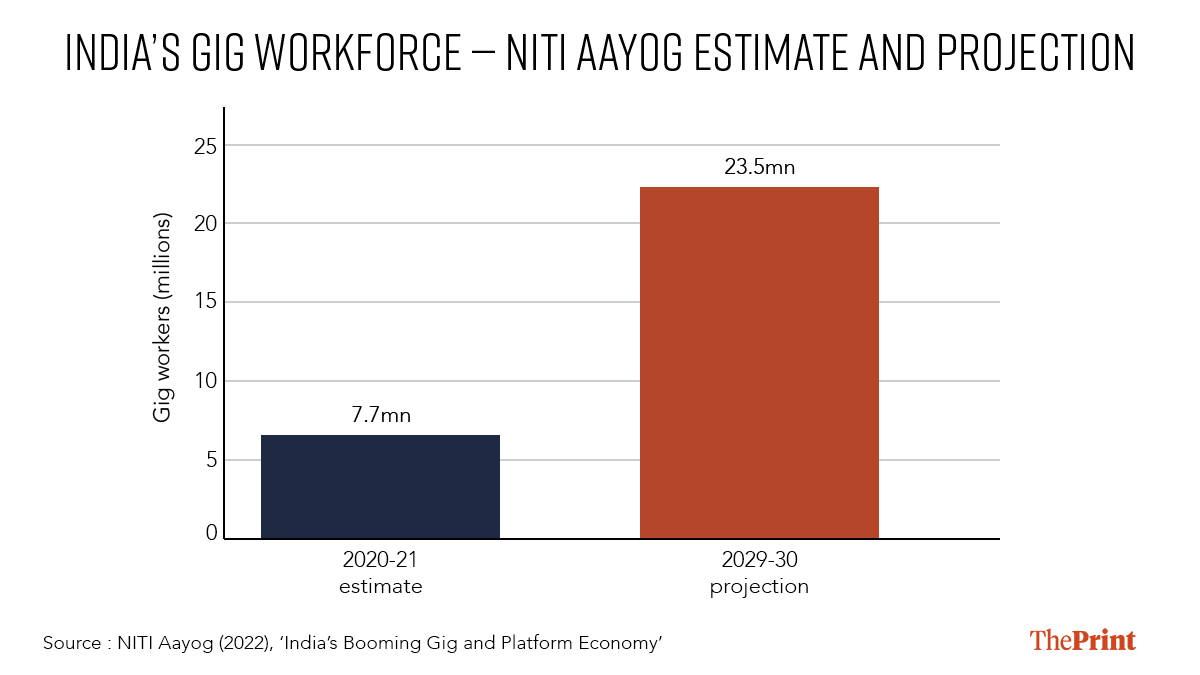
The third squeeze is on labour income. The salaried employee is the tax authority’s ideal subject: income is third party-reported and withheld at source. The self-employed and gig workers are harder to observe. The NITI Aayog projects India’s gig workforce to roughly triple this decade – see chart below.
The more fundamental point is that India’s income-tax net was never wide: the workforce is overwhelmingly informal and the share of the population paying material income tax is small.
In fact, as highlighted in our bestselling book, “Breakpoint: The Crisis of the Middle Class & The Future of Work,” less than 40 million of India’s 1.5 billion strong population pays substantial Income Tax.
India therefore leans on indirect (GST) and corporate taxes to generate tax revenues. However, as explained above, it is increasingly untenable for the nation-State to tax corporates heavily. That, in turn, underscores the growing challenge the modern nation-State faces in collecting taxes.
The State’s ability to collect taxes is undergoing a shift due to the changing environment of its most captive source of Income Tax: white-collar office workers. As has been explained in Breakpoint and in several podcasts, the rise of automation and AI in the workplace means that white collar office workers the world over are being replaced by technology.
As detailed in “Breakpoint” in India, this has meant the job creation for graduates has come to a halt over the past three years.
For white-collar workers, as options for salaried employment dwindle, the most attractive source of income now is global gig work sourced from platforms such as Upwork. Increasingly, however, the mode of payment for such work is likely to be in the form of cryptocurrency. Effectively, labour income itself seems likely to migrate out of the observable financial system — paid in crypto or, more plausibly, dollar stablecoins.
Modern income taxation does not rely on taxpayer honesty; it relies on third-party information and withholding. The employer reports and withholds (TDS/PAYE); the bank reports interest and large flows; the exchange or broker reports gains. Compliance is high wherever a regulated intermediary sits between the taxpayer and their money, and collapses where one does not. Which is why self-employment and cash income are chronically under-reported everywhere.
Crypto is, in effect, a technology for removing those intermediaries. The IMF’s analysis of taxing crypto-assets makes the point directly: pseudonymity and disintermediation mean the binding constraint is enforcement, not the statute — a government can declare crypto income taxable (most now do) and still be unable to see it.
The fading State points to the twilight of national investing
The erosion of the nation-State has several implications. For example, if the nation-State was the default provider of public goods such as law & order, education, and public sanitation, as the nation-State fades, it is not obvious who will provide these services.
In our subsequent blogs, we will delve deeper into these subjects. We believe that the erosion of the nation-State opens up several attractive investment opportunities alongside key investment risks.
National investing was, in large part, a one-time bet on a closed market re-rating as it opened — a trade that has now largely played out. As the nation state weakens, the case for diversifying into US and global equities over a home-biased, buy-the-national-index strategy is stronger than at any point in the liberalisation era: owning the hub — and the foreign-owned commanding heights themselves — is how an investor captures the value that is, by this very thesis, leaking away from the periphery.
Saurabh Mukherjea & Nandita Rajhansa work for Marcellus Investment Managers.
Your global compounder fund has worked so you peddling it to whole India the same story on all platforms. Please tell how your consistent compounders and rising giant funds have delivered? One out of three is not a very convincing narrative because you lucked out on global investing theme. Hell even an ETF would given better return than you other two funds. It would be better if you work to improve the performance of those funds rather than peddling the global narrative everywhere.