





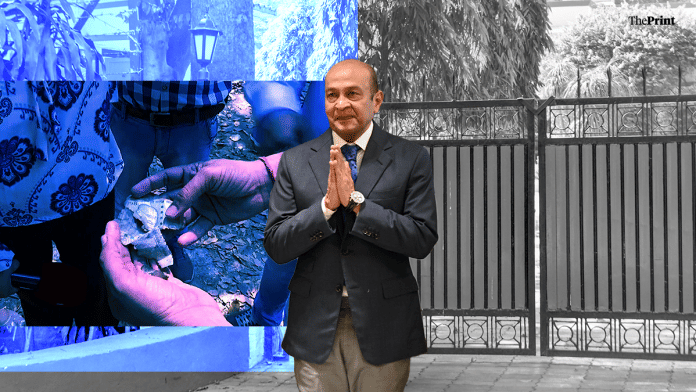


New Delhi: From the finding that Allahabad High Court judge Justice Yashwant Varma’s staff members interfered with key evidence on his instructions, to observing that the judge’s “whole defence is false and adds to grave suspicion against him,” the report of the judicial Inquiry Committee tabled in the Lok Sabha Wednesday makes damning observations against the judge.
The committee found that the judge “caused interference with material evidence” and did not take any steps to preserve the evidence while the premises were under his control. This, it said, amounted to “dereliction of duty”, while clarifying that it was not recording that the judge directed removal of any material.
Examining the record before it, the committee drew the inference that Justice Varma’s private secretary Rajinder Singh Karki and household staff member Mohammed Rahil, on the judge’s instructions, “caused interference with the material evidence”.
Currency notes was found at Justice Varma’s official residence on the intervening night of 14 and 15 March last year following a fire incident. The Supreme Court Collegium had recommended his repatriation from Delhi High Court back to the Allahabad High Court. Meanwhile, then Chief Justice of India (CJI) Sanjiv Khanna constituted a three-member in-house inquiry panel and later forwarded the report to the President for further action.
During the Monsoon Session of Parliament last year, more than 200 MPs submitted notices of motion on 21 July for initiating proceedings for removal of the judge. The notice was admitted by the Speaker of the Lok Sabha on 12 August, 2025. The Speaker then constituted a three-member committee for the probe in August under the Judges (Inquiry) Act, 1968. This high-level committee was headed by Supreme Court judge Justice Aravind Kumar.
The 1968 law envisages the constitution of an inquiry committee on the admission of a motion, the framing of definite charges and the conduct of an investigation—all culminating into findings on each charge.
The charges framed against the judge were three-fold: discovery and possession of unexplained Indian currency notes within official premises, failure to preserve and cause interference with material evidence, and furnishing of evasive and misleading explanations.
Justice Varma had submitted his resignation to the President in April this year, a month before the inquiry committee submitted its report to the Lok Sabha Speaker. With his resignation, this inquiry against him under the Judges (Inquiry) Act was rendered infructuous.
Also Read: ‘History will record unfairness’—what Justice Yashwant Varma wrote in letter to judges inquiry panel
Charge 1
The first charge against Justice Varma was that in March 2025, substantial undeclared Indian currency notes were found in the storeroom of his official residence, and that he failed to disclose or explain the lawful source or ownership of the currency notes. The allegation was that such possession and non-disclosure was “inconsistent with the standards of probity, integrity and rectitude expected of a judge of the higher judiciary”.
The committee found that the presence of the currency notes in the storeroom was substantiated through electronic and photographic records, and that several official witnesses from the Delhi Fire Service (DFS) and Delhi Police attested to presence of burnt, half-burnt, wet or scattered notes.
The committee noted that because of the failure to seize the currency notes or preparation of an inventory, it wasn’t possible to determine the exact amount of currency found inside the storeroom. But this didn’t dilute the core finding that currency notes were “huge and substantial”, it said.
For instance, it referred to the testimony of one of the witnesses, who was quoted as saying, “…the money found at the place of fire was un-imaginable and an ordinary person like me could not have thought of it in dreams also. The amount of five lakhs is too small. When the fire was doused and being cleared, the bundles of five hundred currency notes were found all over.”
Several witnesses had similarly corroborated the presence of burnt and half-burnt notes in the premises, with one telling the committee that he “had never seen so much money in his life”.
While the judge had also said that he was never aware of any money lying in his storeroom, the committee noted that he failed to enter the witness box and did not face cross-examination. Therefore, it said that adverse inference has to be drawn against him. Justice Varma had withdrawn from the proceedings on 9 April this year, and therefore, the committee said that he had “failed to cooperate” in the proceedings. The committee also asserted that where substantial currency notes are found within the official premises, a bare denial is not enough.
In his defence, the judge had also submitted that the storeroom was detached from the main living area, that it was near the staff/security quarters, and that it was accessible to the staff. However, the committee opined that it was not required to find that the money was found in the bedroom of the judge, and asserted that the storeroom was a part of his official residence, under his control and possession.
For the committee, the judge’s defence was weakened when he submitted that a liquor cabinet was kept in the storeroom and that the cabinet used to remain locked. “A locked cabinet containing personal articles is not ordinarily maintained in a space which is wholly unregulated, wholly outside the knowledge of the occupant or wholly beyond his effective control,” the committee noted.
The committee clarified that it does not infer from this point that the currency notes belonged to the judge, but only answers the judge’s defence that the room was outside his knowledge, use and effective control.
“When substantial unexplained currency notes are found in a room situated within such premises, the constitutional functionary in occupation of the premises cannot answer the matter merely by stating that the room was not part of his living quarters or that others could also access it,” it said.
The committee clarified that it was not recording a finding that the judge had direct personal ownership of the currency notes. “What stands established is that substantial unexplained currency notes were found within the official premises occupied by the judge; that the storeroom formed part of those premises; and that the judge failed to furnish a satisfactory explanation regarding its presence,” it noted.
Charge 2
The second charge pertained to the allegation that after the fire was extinguished and before the site was inspected and sealed, material objects and surroundings were altered or removed while the storeroom was still in the judge’s control.
The committee noted that it was not necessary to prove that the judge had personally removed the currency notes from the storeroom, but that the charge was wide enough to include his failure to preserve, or his acquiescence in the removal of the money and other material evidence from the site.
While the committee noted that the first responders—fire and police officials— failed to seize or preserve or inventorise the cash, it pointed out that the judge did not claim to have taken any step for seizure or preparation of inventory of the cash.
The committee noted that after the fire had been extinguished and the first responders had left, a security official, C.G. Rawat, said he saw Justice Varma’s private secretary Rajinder Singh Karki and household staff member Mohammed Rahil near the storeroom and offered his help in cleaning work at around 3 am. By the morning, he said that the “cleaning work” was finished and the burnt household articles had been moved out of the storeroom.
While the judge in his defence had submitted that cleaning after a fire was not suspicious, the committee felt that where substantial cash was seen in the debris of the burnt storeroom, “any cleaning or alteration of the scene assumes a different character”.
The committee also noted that the judge was in touch with his daughter, Karki and Rahil, and that “the inference is that they have acted at the instance of the judge under his instructions”.
The committee, therefore, said that what stands proved is the “failure to secure and preserve material evidence, disturbance and alteration of the evidentiary condition of the storeroom before lawful sealing and inspection, and unexplained non-availability of the material (currency notes)”.
It clarified that the committee did not rest its finding of any direct proof that the judge had personally removed the money from the premises.
Also Read: Can there be an FIR against Justice Yashwant Varma? A 1991 SC verdict holds the answer
Charge 3
The third charge pertained to explanations and statements furnished by the judge.
It said that when asked to explain the discovery of cash, Justice Varma denied it “by an evasive explanation”, that the denial was contradicted by the statements of independent officials and photographic/video records, and that he failed to exhibit candour, transparency and a sense of responsibility that is incumbent on a constitutional functionary.
The committee clarified that it did not intend to impose a criminal liability on the judge for a false statement.
It then referred to communication dated 21 March, 2025, which sought a response to three direct questions: how the judge accounted for presence of currency notes in the room located in his premises; what was the source of the notes; and who removed the burnt currency notes from the room on the morning of 15 March, 2025.
In his six-page written response to Delhi High Court Chief Justice D.K. Upadhyaya dated 22 March, 2025, Justice Varma denied ownership and personal knowledge of the currency notes. He also submitted that neither he nor any member of his family had knowledge of it, and that no such cash or currency notes were shown to his family members or staff. He also claimed that after the fire was doused no cash or currency notes were seen by members of the household or staff.
According to the report, in a subsequent report dated 30 April, 2025, the judge treated the subsequent cleaning activity as routine cleaning of a fire-ravaged site.
Then, in the petition filed by him in the Supreme Court last year, the judge alleged the failure of the authorities to seize, preserve or lawfully document the cash, instead of challenging the presence of cash.
The committee felt that this progression in his defence was “material”.
“The earliest reply was not merely ‘I do not know’. It also asserted that no cash was seen by family or staff after the fire and that no staff member had removed any article, currency notes or cash. Later, the defence shifted to non-seizure, absence of quantification, electronic deficiencies, first responder handling, conspiracy, planting, and possible staff involvement. Such expansion of defence may be permissible as a matter of legal strategy, but it cannot substitute a candid factual explanation,” the committee observed.
It emphasised on the alleged cleaning by Rahil and Karki once again, saying that while this itself does not prove physical removal of cash by them, the contents of his interaction with the duo as well as other members of his household, personal office and staff became material.
It highlighted that in his ‘Statement of Defence’ dated 12 January, the judge had said that he had spoken to both of them at around 2 am.
“…then what was stated to him, what inquiries were made, what he asked them, what answers were received, and why the site was not secured thereafter were matters peculiarly within the knowledge of the judge or of persons associated with his establishment. These questions are not answered by the judge, nor he examined Shri Karki and Mohd Rahil in defence,” the committee said, asserting that an adverse inference is therefore drawn against the judge.
‘Defence evasive, misleading, incomplete’
In its report, the committee highlighted the “changing character of the defence” furnished by Justice Varma over a period of time. It noted that several factual pleas were initially raised by him.
This included conspiracy, planting of cash, staff involvement, foul play, fake currency notes or removal of evidence by public officials. “…the Committee could not be expected to accept such pleas without material,” it then said, noting that the judge withdrew from the proceedings before presenting his evidence.
“The omission to substantiate these matters is not a mere procedural omission. No member of the household, personal office, staff or security establishment was examined in defence. No application was moved to summon Shri Karki, Mohd Rahil or any other person on behalf of the judge. No material was placed to show that any complaint or FIR, including a complaint alleging planting, theft, removal, tampering or foul play, had been lodged after the judge had himself expressed suspicion of conspiracy. The plea of conspiracy, staff involvement or first-responder removal therefore remained an assertion, not an explanation,” it then observed.
The committee, therefore, found that the explanation given by the judge was “incomplete and misleading in effect”.
Explaining its reasoning, the committee said the judge’s defence “was evasive because it did not engage with the central circumstance of substantial currency notes seen by independent officials inside the storeroom”.
“It was incomplete because it did not disclose the factual steps allegedly taken by him, the details of inquiries made, the answers received from staff or household members, or any action taken to preserve the site or complain of foul play. It was misleading in effect because the earliest broad denial gave way to successive alternative hypotheses, none of which was substantiated when opportunity to lead defence evidence was available,” the committee went on to say.
(Edited by Amrtansh Arora)
Also Read: Amid Yashwant Varma controversy, Supreme Court judges resolve to make their assets public