





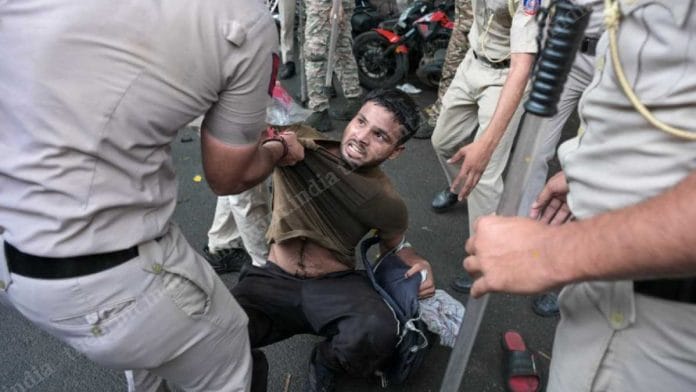

New Delhi: Former Supreme Court judge Justice R. Subhash Reddy will head the five-member high-powered enquiry committee (HPEC) constituted to conduct an “independent” and “impartial” probe into alleged police excesses during the ‘Sansad Chalo’ protest march called by Cockroach Janta Party (CJP) on 20 July.
Justice Reddy (Retd) served in the top court for a little over three years. He was appointed on 2 November, 2018 and retired on 4 January, 2022. In a career spanning over 20 years, Justice Reddy served as a judge of the Andhra Pradesh High Court before he was elevated as the Chief Justice of Gujarat High Court in February 2016.
In its official order released Thursday, a bench led by Chief Justice of India Surya Kant also framed the terms of reference for the HPEC that will examine issues ranging from allegations of excessive use of police force to targeted violence and surveillance of protesters.
The bench, however, clarified that HPEC’s constitution shall not bar the police or other security forces from taking administrative or disciplinary action against their officers, if they are found to have contravened the rules governing their conduct.
At the same time, the bench, also comprising justices Joymalya Bagchi and V. Mohana, expressly reserved the broader constitutional questions for consideration at a later stage. It said those questions would be heard and decided after a careful consideration of their submissions.
Importantly, the bench empowered the HPEC to study the establishment of strict constitutional thresholds and safeguards to prevent section BNS section 152—replacement to IPC section 124 IPC (sedition)—from being invoked as an instrument to stifle political dissent and peaceful protest.
This is to ensure the provision is confined to its intended purpose and not invoked as a chilling restraint.
Also, the committee will examine if authorities can issue blanket prohibitory orders and use them as a routine or pre-emptive measure that forecloses the exercise of right to peaceful assembly rather than as a genuine, proportionate response to a real and imminent threat to public order.
The other members of the HPEC are Justice Ravi Shankar Jha, former Chief Justice of Punjab and Haryana High Court, former Delhi High Court judge Justice Shalinder Kaur, former CBI director Rishi Kumar Shukla and retired IPS officer L.R. Bishnoi, former DGP of Meghalaya.
“The HPEC has been constituted bearing in mind a wide variety of considerations, including the individual expertise and experience of each of its members, as well as the diversity of the committee, among other factors. We are confident that the recommendation of the HPEC will be of invaluable assistance to this court, and the committee will be able to undertake a comprehensive assessment of all such issues as merit due contemplation,” the order stated.
Injuries to police, SOPs also under examination
The order came on a set of writ petitions demanding an impartial probe against the alleged disproportionate use of police force against peaceful protesters, particularly students, assembled at Jantar Mantar and at other locations across the country.
The petitions highlighted several serious issues, including use of pellet guns that cause grievous and irreversible injuries; violence by police personnel in plain clothes; use of electric batons; indiscriminate use of lathi and tear gas without issuing adequate warning; threats to fabricate evidence and violence against women and children at the protests.
The court is also hearing petitions that seek a detailed probe into the background of those who were present at the protest site on that day.
Delhi Police has claimed that more than 2,000 persons with criminal antecedents had visited the Jantar Mantar protest site and violence by protesters had resulted in grievous injuries to police personnel. They also raised concerns about damage to public property.
In the backdrop of allegations and counter-allegations, the court acknowledged the need for an independent, continuing fact-finding mechanism to examine allegations of excessive force and related violations during protests. It also said that allegations of violence by protesters and injuries to police should also be examined.
The HPEC will look into a host of issues and submit an interim report, specifically on issues concerning alleged grievous injuries to protesters and alleged targeted violence, harassment and molestation of women protesters, as soon as possible. The committee has been asked to suggest whether victims require medical assistance and compensation.
Besides examining the allegations of excessive police force, including pellets, electric batons, lathi charges and tear gas, the committee has to determine whether the police response was disproportionate and how it can remain proportionate while maintaining public order. The committee shall also hear the parties on the use or ban of metallic pellets and will undertake the exercise to identify the erring police personnel, while fixing accountability, if any, of those who defied existing rules on crowd-control measures.
Allegations of surveillance and monitoring of protesters through facial-recognition technology would also be studied, with the court asking the committee to also ascertain whether this is compatible with privacy and freedom of assembly.
Further, the HPEC will also hear out those who have raised concerns over alleged violence against police and security personnel, damage to public property, and injuries and mental trauma suffered by police personnel and their families. “In our opinion, all of the issues enumerated hereinabove merit analysis by the HPEC, upon due consideration of the material and submissions placed before it by the parties. The HPEC is also at liberty to consider any other issues incidental thereto, as it may so deem fit,” the bench said.
HPEC, the court added, was free to take assistance of forensic, technical and domain experts in the course of its enquiry.
The court made clear that the HPEC’s work will not be a one-time exercise, but “continuous and periodic assessment”. It would submit interim findings to enable the Supreme Court to take appropriate measures and issue further directions. The court has given priority to allegations of targeted violence, harassment and molestation of women protesters, as well as the grievous injuries allegedly caused to protesters. It has also asked the Committee to examine the chain of command, identify those responsible and determine whether existing laws, rules or norms were breached.
Police authorities, paramilitary forces and investigating agencies have been directed to preserve CCTV and drone footage, body-worn camera recordings, videography, wireless communication records and PCR call logs, and furnish the complete record to the HPEC.
The court gave liberty to all the parties before it to supply documents, evidence, suggestions and even anonymous complaints or representations, to protect complainants and witnesses, to the committee.
The Centre was told to provide honorarium, perks and facilities to the chairperson, which, Supreme Court said, may be commensurate to a sitting judge of the top court, including the provision of transit stay in Delhi where the enquiry would be held. Similarly, an honorarium would be paid to members of the Committee for their time and effort.
(Edited by Amrtansh Arora)
Also Read: Plainclothes policemen deployed to assist people during Sansad Chalo March, Delhi Police tells SC