



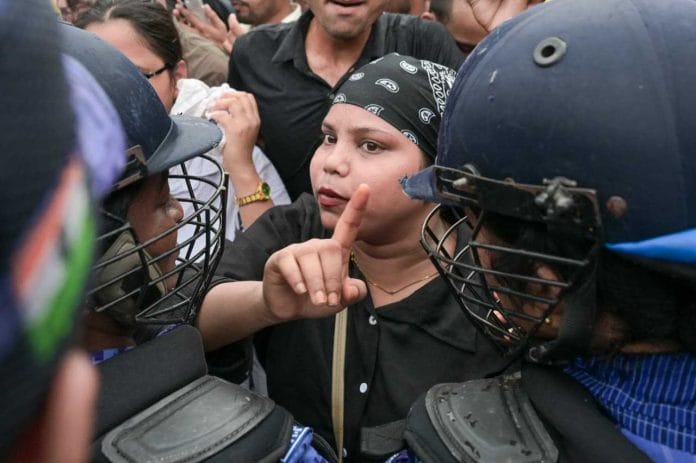
New Delhi: The Supreme Court Tuesday directed the Delhi Police as well as governments of Bihar, Uttar Pradesh, Maharashtra, Madhya Pradesh, Assam, West Bengal and Kerala to immediately release all students aged under 18 years with no criminal antecedents, who were either arrested or detained during the Sansad Chalo protest on 20 July and the following days.
A three-judge bench led by Chief Justice of India (CJI) Surya Kant also directed the police of the above-mentioned states and Delhi to preserve CCTV footage, drone footage, body-worn camera recordings, wireless communication and PCR logs for the days when the protests were happening.
The court was hearing a batch of petitions demanding a fair, independent probe into the violence against students during the NEET (National Eligibility-cum-Entrance Test) leak protests.
It refrained the police from releasing or publicly sharing, for now, data and personal information of student protesters.
As the bench indicated that it would set-up a probe panel, preferably headed by a former CJI, to address the grievances of the protesters, families of police personnel who were injured during the 20 July violence as well as the concerns raised by the Centre, it said the Delhi Police may continue with investigation, but without taking any coercive action against any student.
It also gave liberty to the police to withdraw any case. However, for those with criminal background and found to be anti-social, the bench gave a go ahead to the police to continue with their probe.
After recording the arguments advanced by the petitioners, family members of injured policemen and Centre and Delhi Government, the bench observed in its order: “The allegations made by the petitioner prima facie make out a case of an independent fair probe into the incidents of violence. Such a probe will effectively address the allegations made by police personnel and the concerns raised by the Solicitor General.”
The bench, however, did not want to pass an order on the basis of a tentative opinion and deemed it appropriate to seek a formal response from the Centre and Delhi government to the allegations levelled in a batch of petitions filed in connection with excessive use of force by the police on 20 July and similar incidents reported from the seven above-mentioned states.
While it issued notices to the Union of India and Delhi Government, it asked chief secretaries of the seven states to make an appearance on 3 August, the next date of hearing. These officers can be represented through counsels.
The apex court took serious note of several instances of violence that took place during the recent protests by the youth, mostly students, at Jantar Mantar. This violence spread to other states and complaints of police excesses, committed in violation of the fundamental rights of citizens, poured in from different states.
During the hearing the court agreed that the instances brought to its notice required an independent probe, law must take its own course and responsibility must be fixed.
A battery of senior lawyers, appearing for the petitioners, placed on record a multitude of instances alleging indiscriminate and excessive use of force by the Delhi Police. This included use of pellet guns, lathicharge and teargas etc.
The violence, they alleged, was perpetrated by the police personnel in civilian dress. Those in uniform failed to follow the guidelines laid down through various Supreme Court judgements. It was also pointed out that there was no prohibitory order on 20 July at the spot.
The bench also heard the counsel who appeared for family members of injured cops. They claimed that many anti-social elements had joined the protest and attacked the policemen and injured them seriously.
Both sides submitted photos, pen drives to highlight the instances of violence.
Meanwhile, Solicitor General Tushar Mehta, appearing for the Centre and Delhi Government, said he had no objection against a fair probe, as suggested by this court. He, however, refuted any police excesses and submitted that hardened criminals and undesirable elements at the protest site had indulged in violence.
Mehta pointed out that more than 200 police personnel had suffered serious injuries.“If students were attacked, it is a serious matter and the government cannot take it lightly,” he told the bench.
The petitioners then demanded preservation of log books maintained at police stations, the general diary kept by the police and records to show who requisitioned the arms and ammunition on the day of the Sansad Chalo protest.
An appeal was also made to the top court to ask the Delhi Police to allow e-registration of complaints by students who were attacked on 20 July at Jantar Mantar. The bench was informed that the Delhi Police portal allows e-registration of offences related to theft. The opening of e-registration will enable the students to register their cases online, instead of going to the police station physically to do the same.
During the hearing, the bench also made oral remarks about the lack of adequate protective gear for the police personnel. “Protective gear is more important than offensive gear,” the bench remarked.
At this, the counsel for the petitioners clarified that they were not against the entire team of police personnel, saying it was not a finger-pointing exercise. What they were aggrieved was the non-action by the police against those, who were not in uniform and assaulted the students.
The bench was also told that the police had collected data on students through the facial recognition system that was deployed at the site. The data has been collated with Aadhaar to identify the students, who are now receiving notices from the Delhi Police to appear and record statements.
(Edited by Tony Rai)
Also Read: Mere agitation can’t justify police excess, CJI Surya Kant says on pleas against protest crackdown