





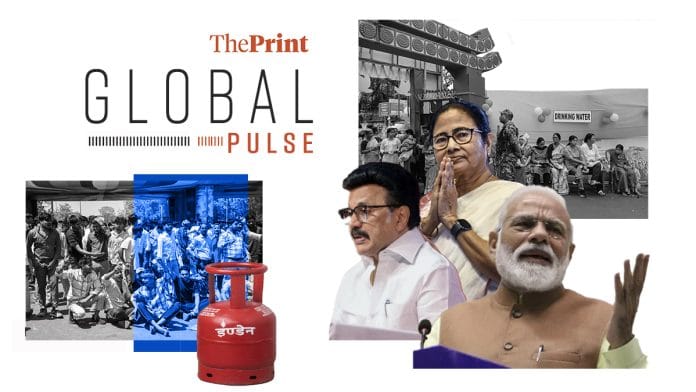


New Delhi: There is considerable interest in global media about the ongoing polls to elect new assemblies in West Bengal and Tamil Nadu, the two states where Prime Minister Narendra Modi’s BJP has never governed.
Voting in the first phase of the assembly poll in West Bengal is taking place amid the controversial electoral roll revision. Soutik Biswas of the BBC reports.
“In West Bengal, where the fiercest contest is unfolding, voting is under way in 152 of 294 seats across 16 districts in the first phase, with 1,478 candidates in the fray. A second phase of polling is scheduled for next week,” he writes.
Voting is also underway in Tamil Nadu, where the BJP is challenging the incumbent DMK. “For the BJP, the contests are a test of its ability to expand in regions where it has struggled, while opposition parties are gauging whether they can challenge its dominance.”
Roughly nine million voters, about 12 percent of the state’s electorate in West Bengal, have been deleted after a Special Intensive Revision (SIR), with officials stating that millions were marked as either absent or deceased, while another 2.7 million are still being reviewed, Biswas reports.
The electoral roll revision has stirred up much controversy in the eastern state, with a tribunal set up to handle and resolve disputes surrounding voter deletions.
“Tensions have been fuelled by political remarks, including from Modi, suggesting the voter roll ‘clean-up’ targets so-called ‘illegal Bangladeshi infiltrators’—a term the Trinamool Congress says is being used to refer to Muslims. However, officials say many Hindu voters have also been excluded from the list.”
With millions going to the polls today amid heavy security, there is a record deployment of about 240,000 central forces across West Bengal, supported by bulletproof vehicles patrolling poll-bound districts.
Sudhi Ranjan Sen of Bloomberg also spotlights the BJP-TMC contest in West Bengal. “A victory for the BJP would cement the party’s national reach, while a loss would leave Banerjee on track for a fourth consecutive term as chief minister, strengthening one of the few regional leaders capable of rallying opposition forces against Modi.”
The TMC is campaigning on Bengali identity, casting Modi’s party as an external force. In response, some BJP candidates have added fish to their door-to-door campaigning, attempting to dispel concerns that the party would push vegetarianism.
“Both parties have also promised cash handouts to woo women voters. The Trinamool Congress is promising between 18,000 rupees ($192) to 20,000 rupees a year to women and a similar amount to unemployed youth, while the BJP has pledged to nearly double the amount if voted to power,” Sen writes.
Andres Schipani and Jyotsna Singh report for Financial Times on the Apple heartland’s verdict in the assembly elections. Tamil Nadu has become a critical hub for assembling iPhones, “part of Prime Minister Narendra Modi’s ‘Make in India’ drive to turn the country into a manufacturing powerhouse and supply chain rival to China.”
“Polls on Thursday will offer a referendum on that industrial strategy.”
Prime Minister Narendra Modi has struggled to make inroads in the South, especially Tamil Nadu. The state is a “bastion of anti-Modi sentiment, with secular leadership that has long resisted the BJP’s hardline Hindu nationalism.”
Tamil Nadu ranks among India’s strongest economic performers, with per capita GDP way above the national average. Its manufacturing sector accounts for about 24 percent of the GDP, closing in on Modi’s 25 percent national target and far exceeding the nationwide average of roughly 17 percent.
Krishna Pokharel and Tripti Lahiri of the Wall Street Journal chronicle the adverse effects of the Strait of Hormuz choking on India’s factory workers.
They write that the recent workers’ protest in Noida was linked to the war in West Asia.
“Sanjit Kumar was sweating profusely. For a third week, the garment worker had sacrificed a day’s wages to stand in line in soaring temperatures to try to buy cooking gas, supplies of which have dried up here during the war in Iran,” the report says.
He is not alone. Kumar joined thousands of factory workers who were protesting in Noida “to demand higher wages, as disruptions from the war have rippled through an economy heavily reliant on imported oil and gas”.
“Before the war throttled shipping through the Strait of Hormuz, Kumar’s family could count on getting the 30-pound cylinder from a government-approved gas agency for around $10. But, for weeks during the continuing conflict, Kumar had to buy gas on the black market at eight times the price, making it impossible for him to cover his family’s other expenses.”
After weeks of war between Iran and the US, the Strait was opened barely before the US decided to maintain its blockade of Iranian ports.
“The energy crisis has exposed how precarious the line between making ends meet and falling into debt is for many Indian workers who had hoped jobs in big cities would help them break into the middle class.”
Protesters in Noida, angered by high cooking gas prices and seeking wage hikes similar to those in a neighbouring state, set vehicles on fire, leading police to deploy tear gas and detain hundreds.
“The demonstrations are a wake-up call for India, the world’s most populous nation, which has avoided widespread worker unrest despite economists warning for years that it is facing a crisis of not enough jobs and stagnating wages.”
(Edited by Ajeet Tiwari)
Also Read: ‘Battle for women voters’ is changing the way elections are fought in India, writes global media