





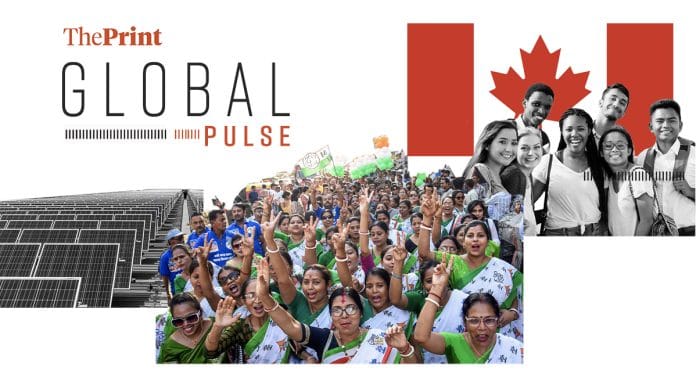

New Delhi: Global media is closely watching the state assembly elections in India.
In a report, ‘A battle for female voters is changing India’s elections’, The Economist writes how women are at the center of campaigning.
“At an election rally on the outskirts of Kolkata, in the state of West Bengal, an all-female marching group leads the way. Women are at the center of campaigning in the state’s election, which takes place in two stages on April 23rd and 29th.”
Tracing the history of women voters in Indian elections is revealing. “Before Independent India’s first general election, in 1951-52, almost 3 million women were struck off voter lists because they had registered not with their own names but simply as the ‘mothers’ and ‘sisters’ of male family members.”
Things have changed dramatically since. In the 2024 Lok Sabha elections, women’s voter turnout surpassed that of men’s. Between 1962 and 2024, men’s turnout in elections increased by just three percent, whereas women’s participation skyrocketed by 20 percent.
“All this is altering how elections are fought. Female voters may be guided by different considerations from male ones. Less than 10 percent of women in one national survey said they plumped for a candidate because of ‘ideology’. Men seem to be more easily riled than women by culture-war issues, as when politicians allege threats to Hinduism or claim a problem of ‘illegal infiltrators’ from Muslim-majority Bangladesh.”
And this battle for women’s votes now reflects in the schemes being rolled out.
Of the 28 states, 16 have unveiled direct cash-transfer schemes, with only women eligible for them—up from only a few in 2022. The amount these programmes supply per woman ranges from Rs 800 to 2,500 per month.
The author concedes that thoughtful cash-transfer schemes have “real merits” but points to why “sober observers of Indian democracy” worry about such schemes. These sober observers, as the column notes, argue that such schemes are “vote-buying dressed up as female emancipation”.
The column notes how cash handouts take a toll on funds that could have been allocated for education and healthcare infrastructure, “two things that could dramatically improve women’s lot”.
“India’s female voters have finally earned the attention of the political class. It’s a shame that they are too rarely offered the truly transformative policies they deserve.”
Shifting focus from electoral politics to the energy sector, Alex Travelli and Suhasini Raj of The New York Times report how the West Asia war has exposed the gaps in India’s clean energy push.
Recalling the milestone India achieved last year with claims that it can generate over half of the country’s electricity from renewable sources, it says, “Getting that electricity to homes and businesses is a whole other challenge.”
With the war forcing India to look to its renewable energy sources, the report says that the situation “has exposed the limits of the country’s outdated, rickety grid”. It is “struggling to deliver reliable, affordable power for its 1.4 billion people”.
India’s investments in renewable energy—especially solar—have been staggering. By the end of last year, it had 55 solar parks, including one that stretched across 14,000 acres of desert. The solar farms alone were producing 40 gigawatts—enough energy to power about 80 million rural households. Smaller rooftop arrays sprouted seemingly everywhere.”
The report highlights that renewable energy, however, cannot be supplied on demand and that the challenge for India is storing surplus energy. It is being produced and has to be delivered consistently to “run businesses or turn on a stove”. “Battery systems and transmission lines can’t be built fast enough.”
Turning to the topic of education abroad, Nikita Yadav, for the BBC, reports on ‘Canada was once a dream destination for Indian students. Is that changing?’
Students are now considering Italy, Germany, and Australia as the new destinations. But Canada is missing from their lists.
According to a consultant cited in the report, “People don’t want to apply to Canada anymore. We are also seeing a very high visa rejection rate.”
Yadav writes: “According to a report submitted by Canada’s auditor general to Parliament last month, the share of Indians in the country’s incoming international student population was just 8.1 percent in September 2025—a sharp drop from 51.6 percent in 2023.”
The report highlights how Canada had a strong appeal among middle-class Indian families. It says the shift comes due to a “mix of policy changes and economic pressures”.
“In early 2024, Canada announced a two-year restriction on how many international students could be admitted to its undergraduate and diploma programmes—capping it at around 3,50,000 study permits per year.”
At the same time, living costs surged in Canada, jobs were harder to find, rents climbed sharply across major cities, and financial requirements grew.
Even the Guaranteed Investment Certificate (GIC)—proof of funds to study and live in Canada—has been doubled.
Besides, the India-Canada diplomatic rift in 2023, following the killing of a Canadian national of Indian origin, hurt cultural associations between the two countries.
(Edited by Madhurita Goswami)
Also Read: Global media says assembly election results can make or break ‘Modi’s Hindutva project’