






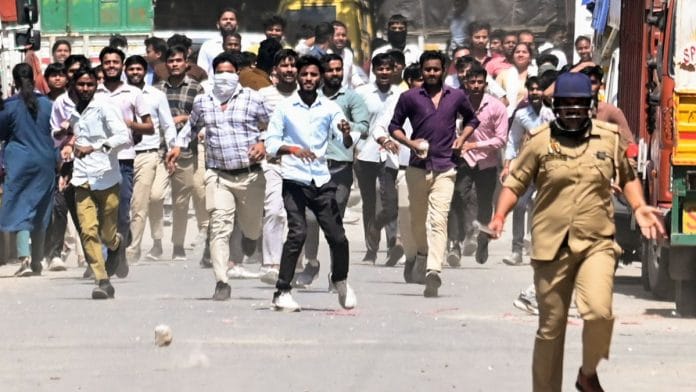


There are several reasons why this week’s protests by workers in Noida are unusual.
In the last decade, it’s unusual for factory employees to stage widespread protests, especially violent ones, especially near the capital.
It’s also not every day that you see domestic employees working in ‘posh’ colonies (Times Now), hit the streets with complaints of low wages.
It’s unusual for news media to give extensive coverage to such demonstrations, be it television news or leading English newspapers.
It’s unusual to hear or read public anger openly expressed on these platforms.
It’s even more unusual for the coverage to be as sympathetic towards the workers as it was Monday morning, when protests—which had begun on 10 April (Friday)—led to arson and clashes with the police.
Late Monday afternoon, the tide began to turn. On TV news channels, such as Republic and CNN News 18, a ‘riot toolkit’ appeared on the screen, with fingers pointed at ‘foreign elements’ behind a ‘conspiracy’ to create unrest by instigating the protests. This possibility was put out by Noida and Uttar Pradesh authorities.
The ‘toolkit’ is an old friend of television news: It is fished out to describe Opposition parties, protesters, and other ‘anti-national’ elements.
And, suddenly, Pakistan was said to have been meddling in the Noida agitation, too (Republic).
By Wednesday morning, we were being shown alleged CCTV footage of the instigation on channels like ABP News. ‘Planned conspiracy’ (is there any other kind?) was making headlines on Times Now. ‘Digital Spark’, CNN News 18 called the social media messages that allegedly ignited the ‘street fire’ in ‘orchestrated rage’.
TV news channels detailed the Noida police FIR, which accused two Rashtriya Janata Dal members of circulating misleading videos, and a WhatsApp group of ‘fake news’.
“The bitter, ugly truth is out,” claimed an expert on Times Now.
However, most news channels acknowledged the ‘spontaneous’ nature of the protests too.
On CNN News 18, anchor Rahul Shivshankar said the violence on the streets and against companies was being “investigated as far more organised… a larger conspiracy” to establish whether this was “spontaneous anger” or “a digitally-fuelled unrest”.
He then added that in Noida, workers’ wages have not been “revised” or adjusted to inflation as had been done in Haryana.
“Shouldn’t this have been taken care of?” he asked.
Amid the protests, UP CM Yogi Adityanath hiked minimum wages in Gautam Buddh Nagar, which includes Noida, and Ghaziabad by 21 per cent.
Also read: This is how Indian TV channels covered Trump threats, ceasefire and Pakistan’s role
Workers’ woes in papers
Delhi editions of English newspapers have championed the cause of the workers.
UP Chief Minister Yogi Adityanath’s reactions to the protests, the steps taken by the administration or the police as well as the suspicions of a well-planned agitation via social media were duly reported by dailies such as The Times of India (TOI), Hindustan Times (HT), The Indian Express (Express), The Hindu. But the big picture was about the worker’s grievances and the protests.
In all their reporting, they had extensive quotes from workers in Noida. In HT’s article titled, ‘As Noida workers stir, stray violence’, Sangeeta said she earns Rs 13,000 working in a stitching factory, and pays Rs 8,000 as rent. “It gets hard to spend money on any other essential items,” she is quoted as saying.
Ramnali told TOI she earns up to Rs 12,000 for domestic work. She pays Rs 4,000 as rent and supports a family of six. Gas is now Rs 500 per kg, and flour is Rs 300 for 5 kg. “I can’t afford to run my house on this income,” she said.
Business newspapers like Economic Times and Business Standard also reported it. ‘Wage anger engulfs Noida’s industrial hub,’ wrote BS. A worker at Samvardhana Motherson told BS that salaries had remained stagnant “for years”.
“My salary increased by Rs 39 last year” was the headline story in Express about workers’ woes.
Trade union representatives were also quoted. Like Amarjeet Kaur of All India Trade Union Congress (AITUC), who said contract workers don’t receive overtime pay (BS).
While the viewpoints of UP government officials and the Noida police are reflected in the reports, factory owners are largely absent. Economic Times, in a report titled ‘Cost fears mount as worker unrest spreads’, wrote that an increase in minimum wages “is expected to widen the cost pressure for companies.’’’
All newspapers noted the Iran war and labour workers returning home as a strain on companies—and workers.
Editorials in the TOI and the Express on Wednesday advised measures to help the workers. In ‘Working Solutions’, TOI said the protest should have been anticipated and that there is a solid argument for NCR neighbourhoods to have uniform wage policy. The large problem is not creating enough jobs in light manufacturing, TOI added.
The Indian Express wrote in ‘Workers’ protests underline precarity,’ “of subdued wage growth juxtaposed with the steep rise in the cost of living and the absence of adequate safety nets.”
Also read: How Indian and global media decoded Pakistan’s ‘vested interests’ in US-Iran mediation
International coverage
Television news devoted most of Monday to the Noida workers’ protests.
Newspapers gave it front page coverage on Monday and Tuesday with photographs—and often a full page on inner pages. A few, like The Times of India and The Indian Express, thought it deserved editorial comment.
Why did the protests receive so much media attention?
On reason was that these were not the first industrial protests, said TV news channels, citing protests in Manesar on 9 April.
The Indian Express explained this in detail on Tuesday, 14 April: “Before Noida, industrial workers had protested in Barauni in Bihar, Surat in Gujarat and Manesar and Panipat in Haryana, demanding better working conditions, higher minimum wages and better overtime payments.”
So this had the makings of a story beyond Noida.
And wider implications too. The workers’ protests were widely reported by international news agencies like Reuters. Nikkei Asia noted worker distress in this story titled, ‘Indian auto, textile production hit as gas crunch drives workers home’.
The article wrote of the ‘exodus’ of migrant workers coming home because of the rising cost of cooking gas since the Iran conflict across India. In Surat, 2,50,000 workers have left since early March. Bahadurgarh, Haryana, has seen 40 per cent of 4,50,000 workers leave for home.
The author tweets @shailajabajpai. Views are personal.
(Edited by Theres Sudeep)
Pick up stones , commit arson and nobody would support any kind of protest.