





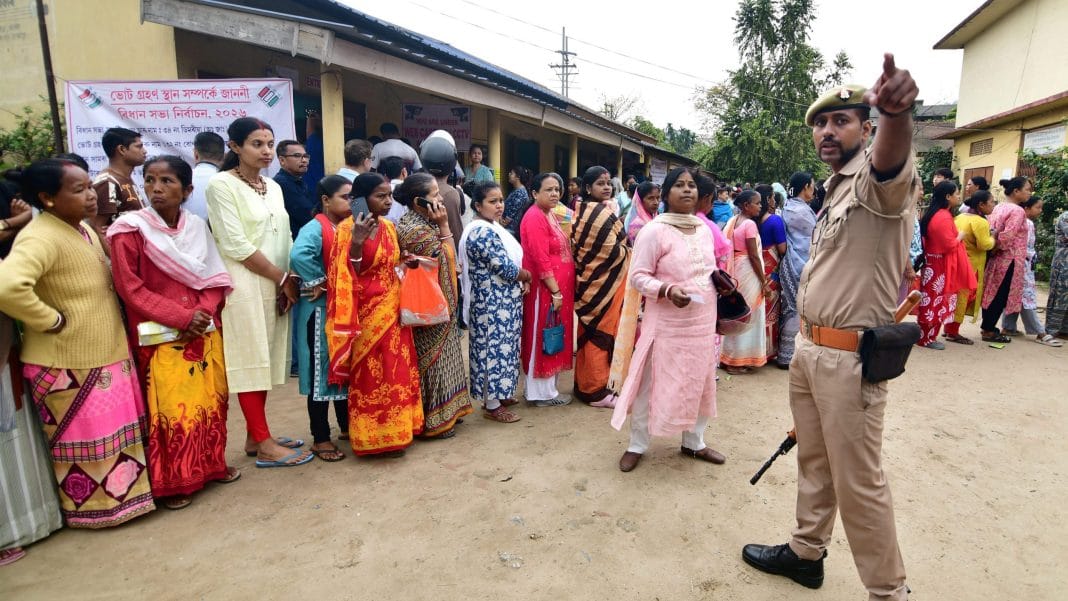


There is a thought that German philosopher Friedrich Nietzsche never quite articulated a formal “theory of democracy”, but it clouds us every election season. The promise of democracy gives citizens a sense of dignity and enables their participation in national life, whereas the state is held accountable by its people.
In India, this is far from the lived reality and is reduced to an event which surfaces every five years. Although legitimacy is maintained, a nihilist would point it out not as a failure, but as a form of structural absurdity.
Political parties have mobilised for multiple assembly elections across India in states such as Kerala, Tamil Nadu, West Bengal and Assam. Both leaders and media have picked up the good old word which comes under threat every five years. Democracy.
The pertinent question is: who threatens democracy and who protects it? And if everyone’s a guardian, is it invoked universally and upheld selectively?
Ashutosh Varshney, writing for ThePrint, takes up the Special Intensive Revision (SIR) of electoral rolls conducted in full force in West Bengal ahead of the polls. He argues that the exercise can impact lower-income and lower-literacy communities who do not have access to the necessary documents and whose vote was earlier ensured by the state itself.
He suggests that if the size of the Muslim electorate in Bengal is considerably reduced, the BJP has increased chances of winning the state.
It then becomes a question for the larger democratic discourse across the world, on how electoral backsliding works: not through rigging or halting the elections, but through quietly manipulating who gets to participate in them.
However, this critique is confined to New Delhi and a nihilistic critique would demand symmetry to form judgements. This is where Varshney loses objectivity.
West Bengal Chief Minister Mamata Banerjee has built her entire poll campaign around resisting the SIR, protecting minorities and their fundamental right to vote and defending the Bengali identity against the Sanghi doctrine, making her the ideal defender of democracy.
Yet the opposition has constantly accused her government of violence and irregularities in governance and these are not partisan allegations. Mamata’s party Trinamool Congress, by many accounts, has surpassed the CPI(M)-led Left Front’s violence against its political opponents, primarily the BJP workers.
Suvendu Adhikari, Leader of the Opposition in the West Bengal Assembly, accused the Trinamool of using state police to frame false cases against BJP workers and alleged that the party had “looted votes all over the state in connivance with a section of government officials” during the panchayat polls.
A Lokniti-CSDS survey post the 2021 Bengal elections had found that around 5 percent of voters reported that they were prevented from voting or abstained due to fear of violence. Five percent in a state of almost 10 crore voters is not a marginal figure. It is lakhs of citizens for whom even the five-year promise was broken, let alone the accountability that never follows.
Criticism of the Trinamool administration has been centred on law enforcement issues, political violence, and the handling of corruption scandals, which include an alleged teachers’ recruitment scam that led to arrests of senior party figures, events in Sandeshkhali involving grave accusations against the local MLA, and the RG Kar Medical College rape and murder case that raised questions about police response.
These are not the hallmarks of a democracy in good health, they depict a political machinery that speaks the language of democratic resistance while practising the contrary.
These undemocratic tendencies are not confined to Bengal or the BJP. In Tamil Nadu, the DMK government under M.K. Stalin anchored its politics around social justice, upholding federalism and the Dravidian ideology. This positions them as the antithesis of what may be perceived as Delhi’s centralised authoritarianism.
And yet, the opposition AIADMK has over the years accused the Tamil Nadu government of attempting to stifle press freedom, with accusations including references to communications involving media groups, and links to the state’s information machinery.
Moreover, what happens when the marginalised themselves challenge the DMK’s welfare narrative? Sanitation workers, largely Dalit women, have been protesting the privatisation of waste management work, and alleged police manhandling with reports of arbitrary detentions and allegations of sexual harassment.
This was not simply a labour dispute but indicates state repression in how demands from the most marginalised are handled. Stalin speaks of the ‘Dravidian Model 2.0’ while his police beat the very people the model was built to protect.
Here then, is the nihilistic understanding of India’s electoral democracy, one that promises participation and legitimacy, but is hollowed from within. The voter arrives once in every five years and is told that this is the moment of sovereignty. But this sovereignty is promised in the backdrop of five years of unaccountable governance.
The promise of democracy in India is real. But its delivery in the space between elections, remains the country’s unfinished and largely unaddressed business.
Suchit Goel is a student of Hindu College, University of Delhi. Views are personal.
Also Read: Chamkila’s murder highlights paternalistic nature of society that sees censorship as protection