






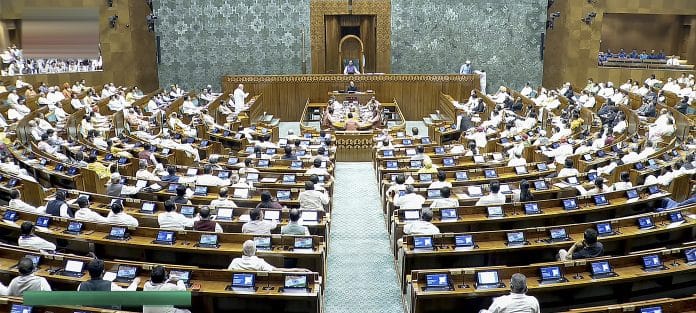


A political fight is brewing over the Modi government’s move to raise the Lok Sabha’s strength to 850 from the current 550 (actual strength: 543) in order to give space for women’s reservation in parliament and state assemblies.
There are two problems with this rushed decision, though directionally it is correct. I have always argued that trying to accommodate a 33 percent women’s quota in the existing 543 seats would be too unsettling, since these seats would also be rotated in different elections. It means no MP can expect to contest the same constituency he has nurtured after one or two elections – as it happens in the case of seats reserved for SCs and STs.
The two things wrong with this initiative, which I broadly support, are, one, the unnecessary rush in the middle of a major set of assembly elections. And, two, not giving people with real objections to state their case in an open forum and argue for a compromise that respects two principles: making most constituency sizes more or less equal so that each vote has the same value, and two, not destabilising the current federal power structure too much by bringing in all the proportionalities at one go.
In any case, the issue is being wrongly projected as a north-south issue, when it really is about developed states (in the west and south), who have achieved faster reductions in birth rates, and less developed states (usually land-locked Hindi belt and eastern states), with slower reductions in fertility rates, though this gap is narrowing. And let us not forget, the north also includes very economically dynamic states like Haryana and Delhi.
If I were among those states which fear they will lose seats if they were allocated according to population strength, I would make a simple point: if political power is going to be determined by population and not economic performance, three things must precede this.
One, states must get more power to work for their own people by a reduction in the centre’s powers, and a reduction of the concurrent list. If I am going to get less political power to influence policies in Delhi, I must have a proportionate increase in fiscal powers so that what is decided by politics does not impact my regional economics.
Two, states must get back a larger proportion of taxes paid to the common pool, with richer states getting back more and poor states being subsidised less. The sixteenth finance commission has already made some moves in this direction, and these can be accelerated through a political consensus.
Three, the increase or decrease, if any, in the proportion of seats allocated to any state must be staggered over four or five general election cycles, and the delimitation exercise must be done next in 2049 (ie, 20 years after the current one), and after that after every decennial census. Things must normalise after the 2051 census.
Most of the current heartburn over the delimitation exercise is because we kept kicking the can down the road after 1976, when we decided that high population growth was a curse, when everywhere it is proving otherwise. Many states are now seeking to increase birth rates, and it is worth recalling that when we talk of a demographic dividend today, it is largely the gift of the northern states.
So, it is wrong to argue that north is the burden and south alone is contributing to GDP, when the reality is that it is the migrants from the north who do the work that southerners won’t do, and for wages the latter would never agree to.
In most countries, migrants tend to naturalise themselves after a decade or more of work in another state, and this is what the southern states should encourage, so that they can retain their seat share at the next delimitation exercise. They can insist on migrants learning the local language, and integrating seamlessly in their adopted state.
In the US, internal migration has raised the share of California, Texas and Florida in terms of electoral votes, while rust-belt states like Pennsylvania have lost votes. It is entirely normal and natural for things to happen this way. It is only in India, where we have linguistic states, that there is resistance to this idea.
It is time we stopped pretending that despite migration we should never change state population levels or their share of MPs.
It is time southern politicians stopped fighting and started to bargain smartly for the best deal possible that is also fair to their poorer brethren in the north and east.
R Jagannathan is an editor and the former editorial director at Swarajya magazine. He tweets @TheJaggi. Views are personal.
This article has been republished from the author’s personal blog. Read the original article here.