





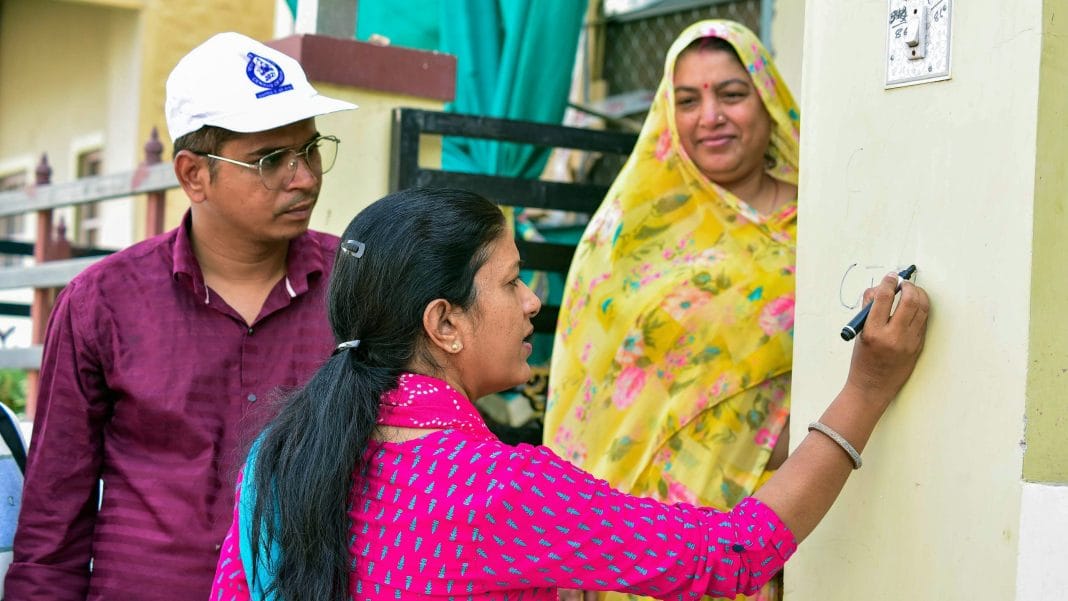


The doorbell rang. “Census!” I heard. The moribund heart of the researcher in me resurrected. Perhaps a nation becomes more mysterious when it ‘assumes’ it already knows itself.
A Census is not a drab administrative exercise, but the republic’s unflattering living mirror, relentlessly knocking every door. It refuses to ensconce inside marble halls of rhetoric and walks barefoot, without shringaar, through timeworn courtyards, precarious rented rooms of voiceless aspiration, weather-wrought bastis stitched to railway lines, shimmering skyscrapers, industrial suburbs lurking like civic afterthoughts, and border villages remote as silences.
Counting has never been politically neutral. Numbers decide who is seen, heard, served, or represented.
India has kept away from this mirror for long. Old mirrors are convenient things. They show a younger wrinkle-free face, like Wilde’s Dorian Gray, and arrange an entangled electorate into a perfect smiling denture. The last Census was in 2011. In 2021, COVID-19 broke the decennial rhythm that had run since the first synchronous Census of 1881, after the non-synchronous modern counts (1865–1872).
Census 2027 is no clerical ritual. It is a palimpsest of firsts. It is India’s 16th Census, the 8th since Independence, and its first self-portrait after sixteen years. Its uniqueness can be summed up through five dimensions of panch mahabhuta.
Like the Earth, it is moored in legal ground. Conducted by the Office of the Registrar General and Census Commissioner under the Ministry of Home Affairs, and governed by the Census Act of 1948 and Census Rules of 1990, Census 2027 will proceed in two phases: Houselisting and Housing Census between April and September 2026, and Population Enumeration in February 2027.
The Census moment is 00:00 hours on 1 March, 2027. In Ladakh and snow-bound areas of Jammu & Kashmir, Himachal Pradesh and Uttarakhand, population enumeration will occur in September 2026, with the reference moment at 00:00 hours on 1 October, 2026.
Wind is the medium of transmission. This will be India’s first digital Census. Enumerators will submit data through mobile applications, while households will access online self-enumeration. Its architecture includes the Houselisting Block Creator web application, HLO mobile application in 16 regional languages, Self-Enumeration portal and Census Management and Monitoring System for real-time tracking.
Behind the screen stand 3.1 million enumerators and supervisors, over 0.1 million census functionaries and 18,600 technical personnel.
Water embodies developmental flow. Census data is India’s largest primary micro-level archive at village, town and ward level, covering housing, amenities, demography, religion, caste, language, literacy, migration and fertility.
The Cabinet-approved outlay of Rs 11,718.24 crore reflects the price of fresh coordinates for PDS and MGNREGA targeting, planning, subsidy and vaccination design, enrolment projections, disaster preparedness, infrastructure, SDG tracking, CPI weights and urbanisation studies.
Without it, the State is like a doctor treating a transformed body through an outdated X-ray. Fragmentation and non-uniformity of administrative data make the Census a crucial anchor for evidence-based policy-making and research.
Fire is the social heat of recognition. Census 2027 will include caste enumeration in the Population Enumeration phase, following the Cabinet Committee on Political Affairs’ decision of 30 April, 2025. It will be the first post-Independence Census to move beyond routine SC/ST enumeration. Caste was excluded from Census operations after Independence, with the last complete caste enumeration in 1931, while the 2011 Socio-Economic and Caste Census was only a survey.
This matters for discourses around backwardness, OBC representation, affirmative action, sub-categorisation, welfare targeting and social justice. It may also sharpen identity mobilisation and caste-based competition. Once sociality is made statistical, politics inevitably ensues.
Ether is the constitutional silence waiting for voice. The 42nd Amendment froze allocation of Lok Sabha and State Assembly seats on the basis of the 1971 Census. This fixture was extended until the first Census after 2026 by the 84th Amendment.
Census 2027 may therefore rekindle delimitation. Articles 81 and 170 seek comparable population-to-seat ratios, while Article 326 anchors universal adult franchise. Theoretically, this is one person, one vote, one value, but in Indian federal politics it is tricky. States that reduced fertility fear losing relative voice, while more populous states may claim greater representation.
Southern anxieties, Northern claims and urban-rural distortions may throng the same table. Women’s reservation, too, enters this constitutional vacuum. The Nari Shakti Vandan Adhiniyam reserved one-third of seats for women in the Lok Sabha, State Assemblies and Delhi Assembly, but takes effect only after Census publication and delimitation.
Census 2027 is beautiful and formidable. Beautiful, because it restores empirical, data-driven seriousness to governance. Formidable, because numbers in India metamorphose into claims, grievances, quotas, constituencies, funds, identities and futures. Transparency, privacy, consultation and methodological care will determine if a dawn emerges after a long statistical dusk, or a mirage distorts representation.
A nation cannot govern forever by memory. Earth will hold the constitutional roots, water will carry welfare, wind will carry data, fire will illuminate social intricacies, and ether will ask who gets a voice. Between counting and aspiration, the republic will confront its own reflection. The mirror is coming. What will India’s face look like?
Tanya Ahuja is a PhD student at IIM Ahmedabad. Views are personal.
Also read: From personal loss to purpose: Why I believe students can help solve India’s water crisis