





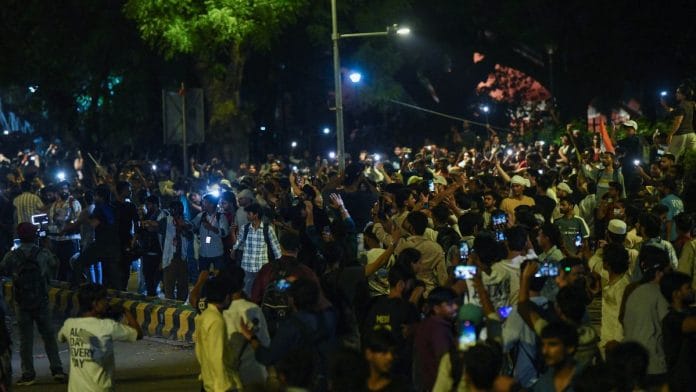


In the wake of the alleged paper leaks in NEET and other competitive examinations , at least twenty students deaths have been linked to the examination related distress. In response, young Indians took courage and formed the Cockroach Janta Party (CJP), a name which was initially used as a judicial taunt but is now being reclaimed as a badge of defiance.
It’s been 20 days since the CJP members started an indefinite hunger strike, protesting against the ill acts of the system and demanding the resignation of Education Minister Dharmendra Pradhan over alleged examination irregularities.
At Jantar Mantar, the students on strike are struggling with the monsoon as the rains soak their bedding and they are forced to sleep in their raincoats. In contrast, the police sit under waterproof tents nearby, not allowing tarpaulins inside the protest site as alleged by CJP founder and president, Abhijeet Dipke, in a video posted on X. Nobody is formally banning the protest. The conditions are simply being made impossible to endure. Frequent power cuts, non-availability of food stalls and inadequate water supply also contribute to the defeat of this noble cause and action.
Social activist Sonam Wangchuk joined the protest on 29th June. Not because he supports the CJP, but for the bigger cause that led to the formation of the party, to hold the government accountable for its actions.
Wangchuk had walked hundreds of kilometres from Ladakh to Delhi last year to protest the erosion of constitutional promises to the people of the region. Currently, he is on a hunger strike. He appealed to the people of the country to participate in the “Sansad Chalo” march on 20th July, a direct invocation of Article 19, ie the right to petition parliament. At every moment, though, the state’s response has been to make the exercise of that right physically difficult without formally banning it.
The Constitution of India protects the right to protest under Article 19(1)(a) and the rights of speech and peaceful assembly under 19(1)(b) . The Supreme Court has held that this right cannot be restricted except on constitutionally specified grounds. Not allowing tarpaulins to be taken inside the protest site is not a direct restriction on assembly, but adverse conditions forced on the protesters as the price of exercising a constitutional right is something the Constitution never intended. There is a difference between restricting a protest and simply outlasting it.
In a video, Wangchuk described his recent visit to Switzerland and walking inside the parliament freely. Through the video he explained that the largest democracies in the world like Sweden, Denmark, Australia and New Zealand have a designated place for protest before their Parliaments where people are allowed to show their dissent and organise peaceful protests.
But in India, despite being one of the world’s largest democracies, it does not have a designated place for its people to show dissent against the government and ask questions. Wangchuk, invoking Gandhi and Ram, urged protesters to remain committed to peaceful and principled activism, saying “we have to bring accountability… this movement is about asking questions of the government.”
Wangchuk is not just a supporter of the CJP protest. He carries two separate constitutional grievances simultaneously—the demand for NEET accountability and Ladakh’s unfulfilled constitutional promises. His presence at this protest is the living argument that the right to be heard by this government requires a person to risk their body, not just their time.
The 20th July march to Parliament is not a spontaneous event. Wangchuk has explicitly said Parliament is the right forum. The march is scheduled for the first day of the monsoon session, when MPs are present, when questions can be raised, when the protest has the maximum chance of reaching those with the power to act. This is constitutional democracy working as designed, citizens walking to demand accountability from their elected representatives. The question is how Parliament will receive them.
A tarpaulin is not a constitutional argument. But the refusal to allow one while protesters on hunger strike lie in monsoon rain and police officials sit in the dry nearby says a lot about how the state understands the right to protest. Not as a right to be exercised in comfort. Not as a right that demands a response. But as a right to be tolerated, minimally, uncomfortably, until the people exercising it go home. On 20th July, a group of students and one man on hunger-strike plan to walk to Parliament. They are not asking for comfort. They are asking to be heard. That is what Article 19 was written for.
Adhiraj Sahgal is a student of National University of Study and Research in Law, Ranchi. Views are personal.
Also read: Supreme Court wants faster judgements from high courts. Shouldn’t it do the same?