



New Delhi: Thirty-year-old Vaqar has been following the Cockroach Janta Party students’ protest at Jantar Mantar relentlessly on his phone, scrolling through social media to make sure he doesn’t miss a single update. He wanted to join the protest in person, but memories of his own experience during the 2019 anti-CAA protests at Jamia Millia Islamia held him back.
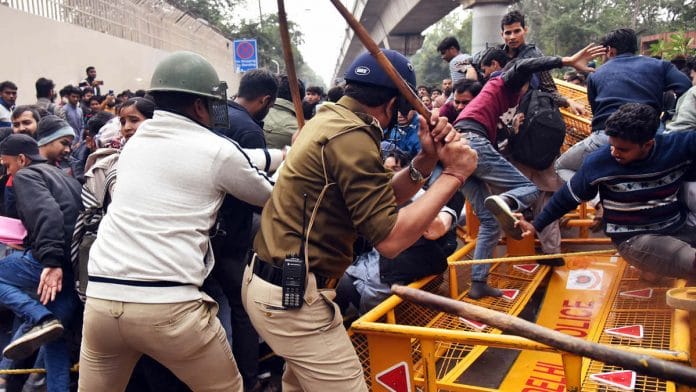
As tensions escalated on Monday, with Delhi Police using lathis and tear gas to disperse students marching toward Parliament, many at Jamia Millia Islamia said they found the scenes hauntingly familiar—but with one crucial difference.
“The moment our protest started, we were branded anti-national. Only our families and friends stood with us. Women from our community helped us, stood in front of police when they attacked students. But today, the whole nation is standing with the students—from celebrities to politicians,” Vaqar said.
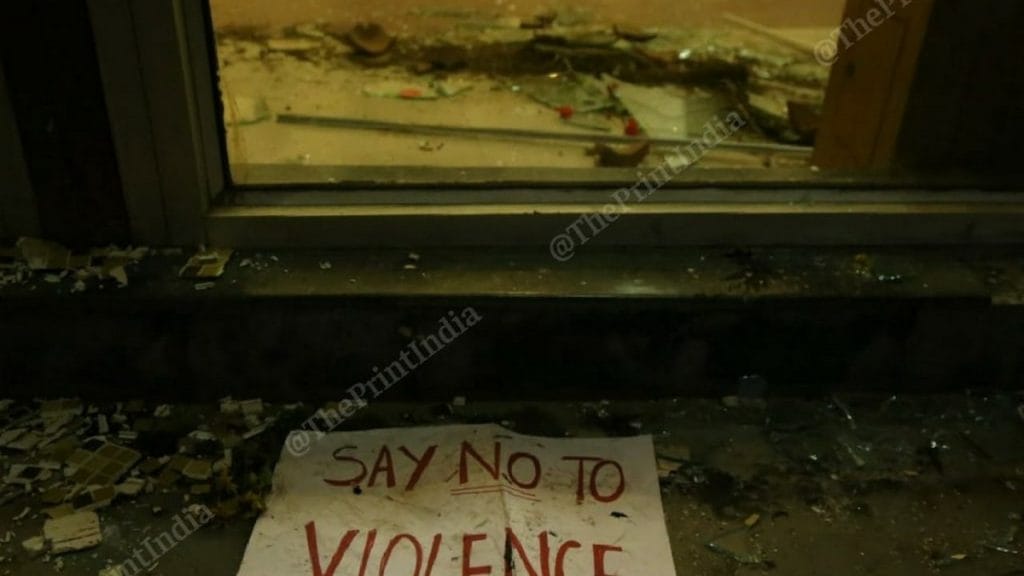
During the widespread protests against the Citizenship Amendment Act (CAA), Delhi Police entered the Jamia Millia Islamia campus on 15 December 2019 while pursuing people allegedly involved in violence and arson. Students alleged that police entered without permission and used batons and tear gas inside the university library and other academic buildings, leaving many injured.
Vaqar said being labelled anti-national and seeing students arrested under the Unlawful Activities (Prevention) Act (UAPA) left many fearful of joining future protests.
“The police beat students at Jantar Mantar, and they beat students at Jamia too. But what happened inside the Jamia campus made sure many of us would think twice before ever standing at another protest again,” Vaqar said.
The Cockroach Janta Party movement was launched online by Abhijeet Dipke on 16 May 2026 after remarks by the Chief Justice of India comparing some unemployed youth to “cockroaches” sparked outrage among young people. The first organised protest at Jantar Mantar was held on 6 June, before evolving into an indefinite sit-in demanding action over the alleged NEET 2026 paper leak and the resignation of Union Education Minister Dharmendra Pradhan.
On 20 July, the CJP organised the “Sansad Chalo” march from Jantar Mantar towards Parliament, during which Delhi Police stopped the procession, detained several protesters, and clashes followed.
While this time the police action has been widely condemned, Nida, another Jamia student, said people had actively egged on officers in 2019.
“People used to chant, ‘Delhi Police lath bajao, hum tumhare saath hain’ (Delhi Police, keep beating them, we are with you). Today everyone is condemning police brutality. But when Jamia students were beaten, why did nobody speak up? Was it because many of us were Muslims?”
Also Read: Artists are documenting the CJP protest, one cartoon at a time
‘Nobody has been held accountable’
On 15 December 2019, Md Minhajuddin, then a law student at Jamia Millia Islamia, was working on a project with friends in the university library when Delhi Police entered the campus and launched a baton charge.
A lathi blow struck Minhajuddin in the face, leaving him blind in his left eye.
Nearly seven years later, watching videos of Delhi Police using force against students at Jantar Mantar, he said the memories came rushing back. For him, the similarities lay not only in the violence but also in the lack of accountability.
“I lost one of my eyes, and I am still fighting for justice. Nobody has been held accountable for the police action in 2019, and I don’t think anyone will be held accountable in 2026 either,” he said.
Now a PhD scholar at Jamia Millia Islamia, Minhajuddin continues to pursue his case in the Delhi High Court, seeking accountability for the injuries he suffered during the 2019 crackdown.
“We have submitted videos and other evidence showing the police brutality and how I lost my eye, but the police continue to deny what happened,” he said.
The injury, he added, affected every aspect of his life. He struggled to pay for treatment and had to rely on donations to cover medical expenses. Losing vision in one eye made everyday tasks, including crossing the road, significantly more difficult. The legal battle, still pending years later, continues to reopen old wounds.
“Every time I go to court, I relive that day,” he said.
Minhajuddin added that the violence against unarmed students at Jamia did not lead to any groundswell of public or political support for those seeking justice.
“If the country had stood with us against the police action back then, maybe the police would not have repeated the same brutality against students at Jantar Mantar today,” he said.
Also Read: How indie track ‘Taare’ became the unofficial anthem of the CJP protests
Old wounds, new protests
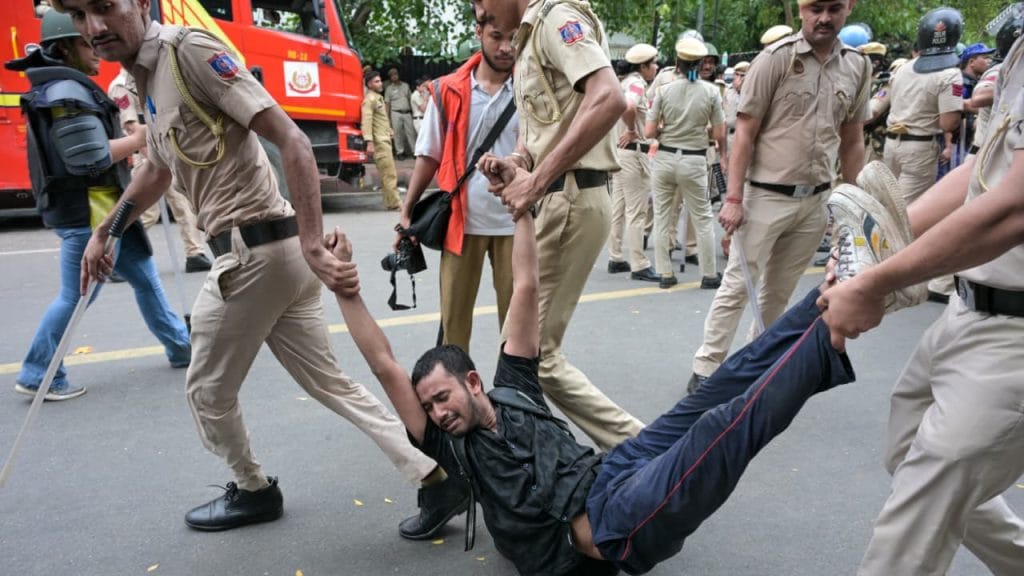
Police lined the streets with batons in hand. Tear gas filled the air. Students ran in panic, shielding one another as officers charged into the crowd. Some stumbled while others were dragged away during the CJP’s “Sansad Chalo” march on 20 July.
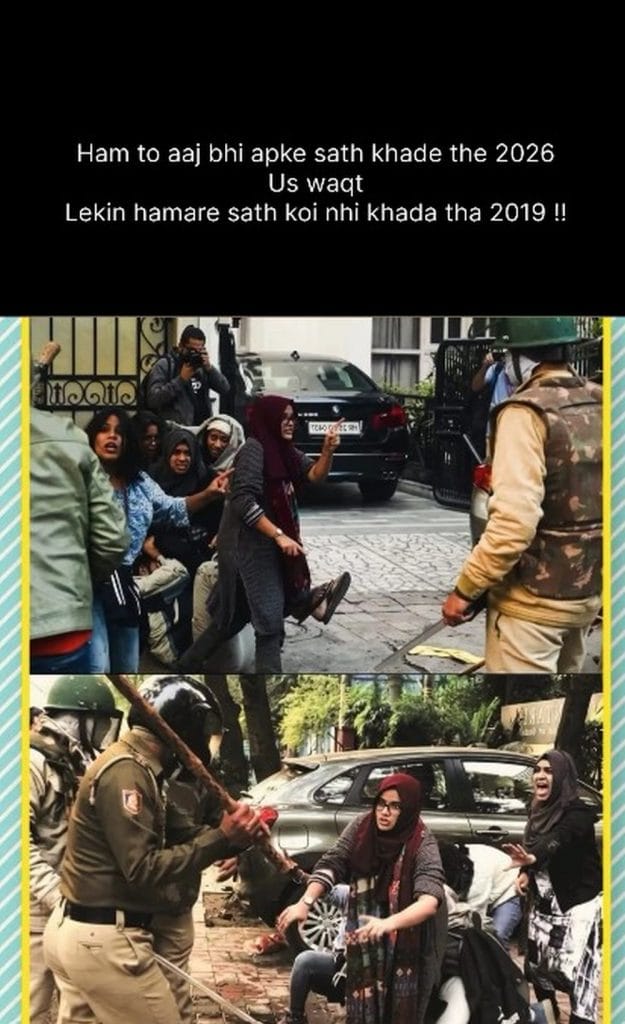
Within hours, parallels were being drawn. Social media was also flooded with photographs and videos from the 2019 Jamia protest. Side by side, users compared the two moments—separated by seven years but connected by similar scenes of students facing police batons. But many pointed to a major difference: the level of support the two protests received.
“Hum to aaj bhi aapke saath khade hain, lekin hamare saath us waqt koi nahi khada tha” (We stand with you even today, but back then, no one stood with us), read one Instagram post comparing the two protests.
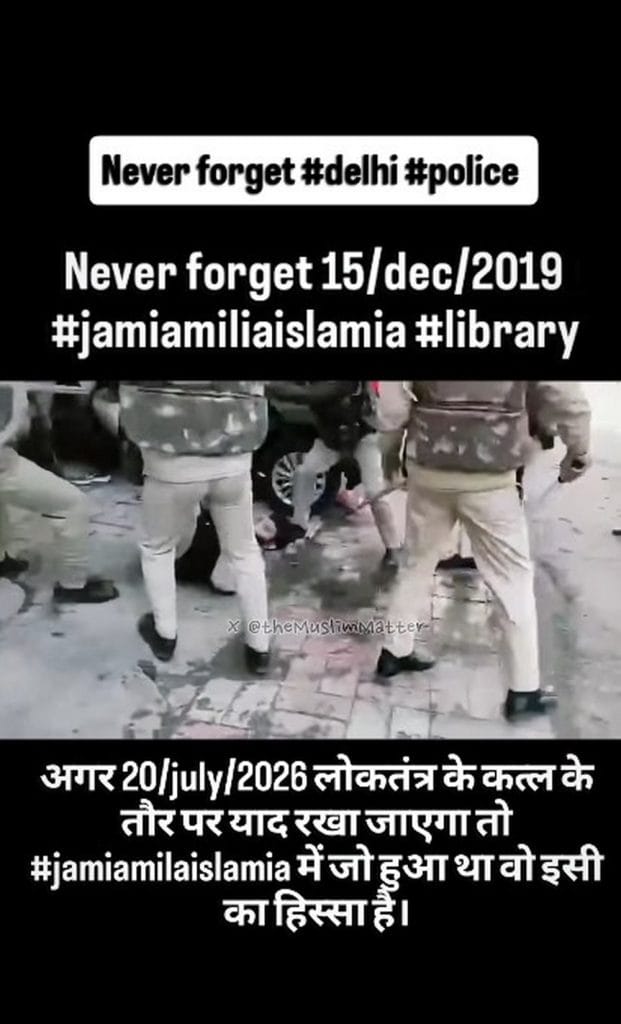
One widely shared video shows a group of students standing together with their hands raised in surrender while armed police personnel confront them. Another captures officers dragging a male student onto the road and repeatedly striking him with batons as women in hijabs rush forward in an attempt to shield him.
“If 20 July is remembered as the murder of democracy, then what happened at Jamia Millia Islamia is also part of that story,” read the caption of one such post on Instagram.
Another post, showing bloodied people with injuries to their heads, eyes, hands and legs from the 2019 Shaheen Bagh and Jamia protests, carried the words: “Jo hum pe guzre the ranj saare, jo khud pe guzre to log samjhe” — People understood our pain only when they experienced it themselves.
Thirty-year-old Asif Iqbal Tanha was pursuing a BA in Persian during the anti-CAA protests. He said the police acted “more aggressively” and even targeted the families of students.
“Families were questioned, raids were conducted at homes, and investigations were carried out against students,” said Tanha, who was later named as an accused in the 2020 Delhi riots conspiracy case and booked under the Unlawful Activities (Prevention) Act (UAPA). “Students facing FIRs and cases are still struggling in their lives. Many were blacklisted by the university, and some cannot leave the city or the country because of ongoing court hearings.”
The Jamia experience has had a lasting chilling effect, according to Vaqar.
“Many are still fighting UAPA cases. Seven years later, many of our lives are still on hold,” he said. “Not much has changed. Even today, if four students gather together, the police keep watch. If we seek permission for a meeting or a protest, notices are sent to students.”
Vaqar said he and others still tried to express solidarity with the Jantar Mantar protesters, but even those efforts were stopped.
“We tried to distribute pamphlets near Jamia to inform people about the protest and the 20 July ‘Sansad Chalo’ march. The police took away our pamphlets and stopped us from distributing them,” he said. “We don’t have the freedom to protest. The moment we step onto the streets, we are labelled terrorists and called names.”
(Edited by Asavari Singh)
Why would any Indian in his right senses support Jamia students?
Jamia students are infamous for being Islamists – there have been several cases where national security agencies have arrested and prosecuted Jamia students and alumni. In fact, quite a few of them have been convicted by the judiciary too for being involved with terrorist outfits or possessing Islamist fundamentalist literature.
It’s common knowledge that Jamia is a fertile ground for recruitment for terrorist outfits.
It’s a shame that Jamia students are now getting involved in the NEET protests. The CJP and it’s leaders must ensure that such anti-national elements find no place in the demonstrations and protests.
Because Jamia students are Pakistan sympathisers. They form the core of the “Aman Ki Asha” gang.
Jamia students have been found to be involved in communal activities including leading mobs during riots. Quite often, they are found associated with Islamist terrorist outfits too. The region around Jamia is quite dangerous – the Batla House encounter is proof of that.
Even the venerable courts have convicted several Jamia students for being involved in riots and terrorist activities. One can check newspapers and media reports to verify the same.
Jamia was and remains a hotbed of Islamist thought and action.
Hence, no patriotic Indian wishes to stand with Jamia students.
Medieval tactics of the police, unfortunately.
Oh My…the perpetual eternal victimhood m/c is back with WhatAboutery
We didn’t stand with you due to your demands and the comments being made – remember Sharjeel Imams cutting of north east comment..?
Maybe stop with the selective amnesia and victimhood narrative..