





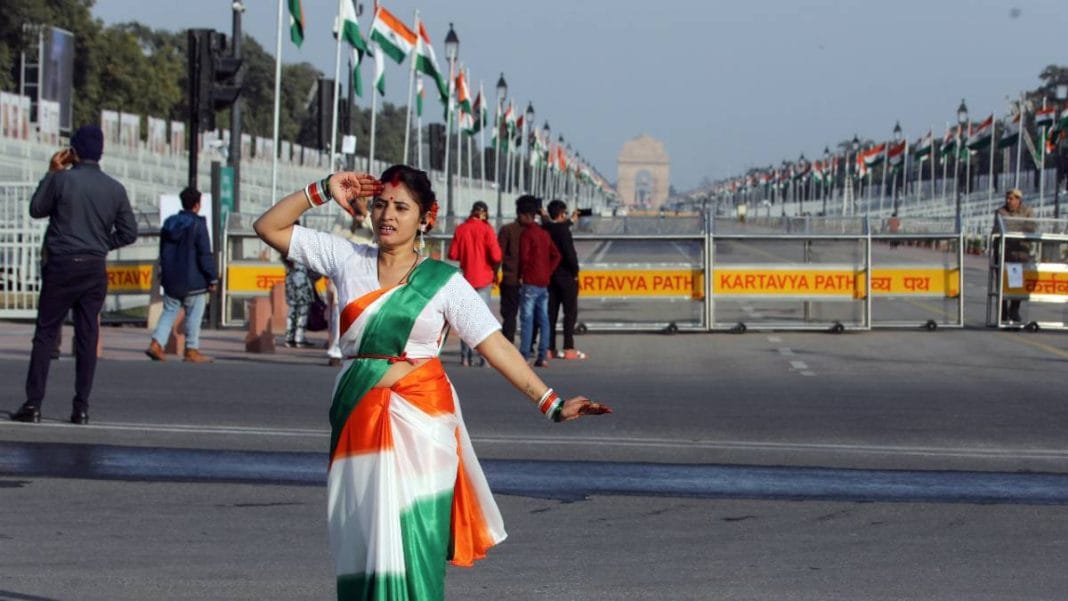


A piece of clothing over your torso and arms does more than just cover your bare skin. It shows that you are a woman of value, honor, dignity, and… fear. Of what? Of disgrace perhaps. Of being shunned by society for having similar features as your male counterparts—who have no responsibility towards society except for producing testosterone—and not hiding them. Or… at least that’s what the colonisers thought.
And that’s why the English word “blouse” is still so deeply stitched into the fabric of Indian culture, tradition, and fashion almost eight decades after the fall of colonisation in the Indian subcontinent. It ought to be really important. But how?
To understand the history behind the invention of the blouse we must go back almost two centuries, verbally, anyway.
Up until the late 19th century, women in India would drape nine yards of fabric around their bodies with precision and grace, covering their lower bodies whole and carefully wrapping the remaining end of the saree across their chests and over the left arms. It was perfect for the climatic conditions that India was endowed with.
From hard-working, laborious women to landladies and thakurains, everyone loved to feel breezy without anything shackling their diaphragm. But the capitalist man and the corset-wearing woman did not like seeing women liberated, did they?
This attire was widely accepted and preferred in India. Simple, practical, empowering.
But also, obscene. Unfit for the “modern”, colonial society. The classy society. The patriarchal society.
Time passed. Indians evolved. Pride in their culture turned to feelings of shame and resentment. Matching the English standard became their way of belonging in their own country.
Similar was the case with Jnanadanandini Devi, a social reformer and sister-in-law of famous polymath Rabindranath Tagore. Once denied entry in a club for wearing a “vulgar garment”—a traditional Bengali saree without a blouse—she thought about bringing change in the fashion and cultural scene of native Indian women of British-India, and transforming their social standing from mere ornaments for men to women with real voice and influence, without any attire holding them back.
If only she could have seen what was in store for her women!
On a tour to Gujarat with her husband, Jnanadanandini Devi saw an opportunity for innovation. Inspired by the Parsi way of wearing a saree and Victorian ruffled blouses, she decided to make her own version of the Indian saree both modest and fashionable.
A Victorian-esque jacket replaced the stanapatta (a thin piece of cloth that would go around the chest under sarees in some regions of India) and Indian women saw the birth of the new notion of modesty, modernity and decency. This fresh and acceptable way of wearing the saree soon became a staple among upper-class Indian women. It became a way of being heard. Of being taken seriously. Of being seen beyond your skin.
Women of influence and politics donned this elegant attire—one that made them look timid—and started to look down upon those who chose to dress in the same way they once used to. Bare arms? Shameful! Savage! I’m proper. I’m better.
1947, the British left India physically, but the colonial hangover stuck for decades to come.
The divide in classes, carved bold into the impressionable minds of Indians by the cunning scalpel of colonisers, was evident and upsetting. It was everywhere: cuisine, jobs, education, language, and now, fashion too. The extent to which you were willing to trade your cultural identity for foreign validation determined your “class”. You either “walked English, talked English, laughed English” or you weren’t as important, if at all.
Women caved. Like always. They had to. Like always.
From flamboyant Bollywood movies to the housemakers watching them, everyone loved the blouse. But also, imposed it. History really does repeat itself, only through different skin tones and accents! Everyone took pride in the blouse and anyone who didn’t was just not a true Indian woman. Too modern for “traditional” Indian fashion values.
Someone needed history lessons back then, am I right? Unfortunately, they still do.
The Indian culture unified once again—in theory anyway—but only based on something not exactly Indian. The blouse. Oh, the little blouse. So dainty yet questioning of a woman’s chastity.
The very few new-gen women in the workplace would now wear sarees to work with sleeved blouses of cotton, neck high and unforgiving in the heat. But only now it was not to feel accepted—that time was gone—but to feel protected instead.
Protected from whom? Oh, I think we all know.
One who chose to wear anything but an Indian outfit was not only wicked, but also entitled to get violated by the opposite sex. I mean, she was asking for it, right? That’s what society dictated. That’s how things went and how they were to be accepted.
The blouse, thus, became a shield. Quite flimsy and easily ripped by a shaky sense of masculinity, but we don’t talk about that.
Now? Well, it’s a free world! Now the saree is a choice. But only to be chosen if a blouse comes with it. If not, then you don’t value your country’s culture. Be gone!
Ironic that the folks far west removed the dead weight of corsets and long sleeves, but left a scar so deep on our skin that it still makes us afraid to show it.
So, the blouse was important. But only to make us unconfident about our fashion. Yes, the blouse made us more “modest” and “civilised” but let me ask you this, were we really so savage to begin with?
Arohi Sharma is a Class 12 student of Maharaja Sawai Bhawani Singh School, Jaipur. Views are personal.
Also Read: Delhi’s jhuggis are right next to gas pipelines. They still cannot get a connection