





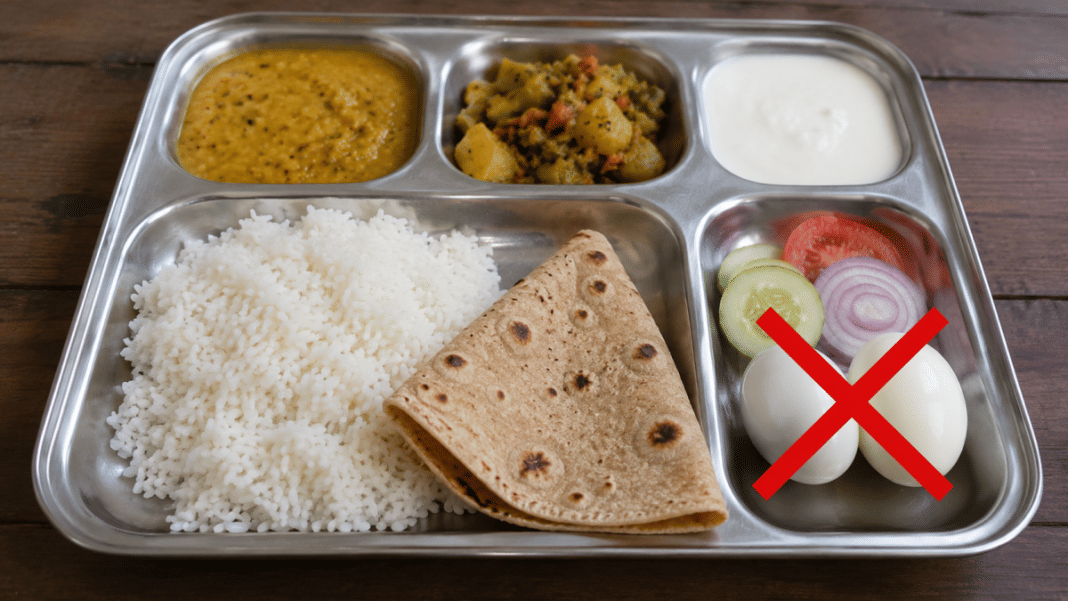


Hansda Sowvendra Sekhar’s short story They Eat Meat! published in 2015 in The Adivasi Will Not Dance is the story of a family, of tribal origins from the state of Jharkhand, used to the “simple sin” of an egg, meat and fish, and cooking their beloved Sim-Jill and Jill-Haku for lunch and dinner. They were reduced to an egg once a month in the state of Gujarat.
In the words of one of the characters, Jhapan Di, “Jyamon des tyamon bhes (you act according to the place you’re in).” However, both Gujarat and Jharkhand are places within India, and a person’s cuisine and diet shouldn’t have to adjust to the majoritarian culture of a particular state.
The religious policing of cuisine has been going on for years in the country. Meat and eggs are ascertained to be “impure” or “dirty” because they come from killing animals or exploiting them.
Milk, on the other hand, is considered “pure” in spite of involving horrifying exploitative practices. It cannot be declared “impure” because number one, the Vedas and Shastras do not decree so, number two, what would happen to the 4.2 percent contribution of the dairy industry to the economy and number three, what would replace paneer, curd, milk and ghee as sources of vegetarian protein in India?
One would think “Rajma-Chawal” would be the answer to all our worries. In the words of ISKCON vice-president Radharaman Das, (clearly the highest authority of both chefs and health professionals in the country), bestowed with the responsibility of cooking mid-day meals for school children under the new BJP government in West Bengal, the answer is soya chunks, rajma, paneer, beans, dals and pulses.
Undercooked and undersoaked Rajma is notorious for digestive issues, it contains complex carbohydrates like stachyose and raffinose, which can cause gas, bloating and stomach pain. Questions of protein digestibility and quality are clearly thrown out with eggs. Paneer meanwhile is largely costlier, the amount in each serving can only decide its sufficiency. Served together they still do not equal the WHO recommended protein intake which should ideally be greater than 15 percent of total daily energy intake during adolescence.
Cheap and easily absorbable source of protein, eggs are difficult to adulterate and contain essential nutrients. Rajma on the contrary contains anti-nutrients as well. The National Institute of Nutrition in its Dietary Guidelines for Indians strictly mentions the need to consume foods of animal origin such as milk, eggs and meat and recommends consumption of at least 3 eggs per week.
Why should school meals and Hinduism be tied together in a country where Muslims, Christians, Jains, Sikhs, Buddhists and tribals exist alongside Hindus? A government sanctioned religious centralisation of cuisine in a country of over 1.47 billion with diverse backgrounds is a significant attempt at subverting local food habits, culture and contexts. Can the children of Bengal used to “Mach-Bhaat (fish and rice)” adjust to “Rajma-Chawal”?
A significant number of children in poorer districts come to school solely for free food and the parents, who send them to eat what they cannot provide at home, have not been taken into consideration, discussion or consultation. It isn’t clear what would happen to the livelihoods of women who were previously engaged in preparing mid-day meals.
ISKCON’s position on caste is also essentially problematic. ISKCON’s official website clearly states that caste divisions are inherently not wrong. Instead of being based on birth, they should exist based on psycho-physical abilities. It doesn’t refute the caste system from its roots, something Dr. BR Ambedkar spent a lifetime writing about, instead it sanitises the caste system to appear more acceptable to the educated Indians.
Determining a person’s psycho-physical abilities as something worth cleaning upper-caste waste is inherently discriminatory. Psycho-physical abilities also do not develop in an “ahistorical social vacuum”, as pointed out by Arundhati Roy in her essay “The Doctor and the Saint”.
There will inherently exist a difference in the kind of education an upper-caste and lower-caste individual can afford and thus differences in abilities, which can only be solved through a system of positive discrimination.
In Roy’s words, people in the rest of the world also do not seem to have any issues “dealing with their shit without making such a fuss” about the psycho-physical abilities of other people. Under such existing views it isn’t clear how far the act of giving ISKCON the responsibility of mid-day meals is justified.
Never have the Bengalis associated religion with vegetarianism. Bengalis serve red meat when they worship the Goddess Kali. Bengali children shouldn’t have to give up on their culture or delicacies solely because of religious sentiments that are essentially foreign to them. These are attempts at erasure of identity and centralisation of an inherently diverse Indian culture.
In They Eat Meat! Sekhar writes, “In Odisha, Panmuni Jhi could be a Santhal, an Odia, a Bengali. In Gujarat, she had to be only a Gujarati.” Unfortunately enough for people like Panmuni Jhi, it appears that now in Bengal itself, Bengalis would have to be Gujarati.
Atreyee Ghosh is a student at Jadavpur University, Kolkata. Views are personal.
Also read: TMC crisis: How a seemingly invincible political powerhouse imploded