





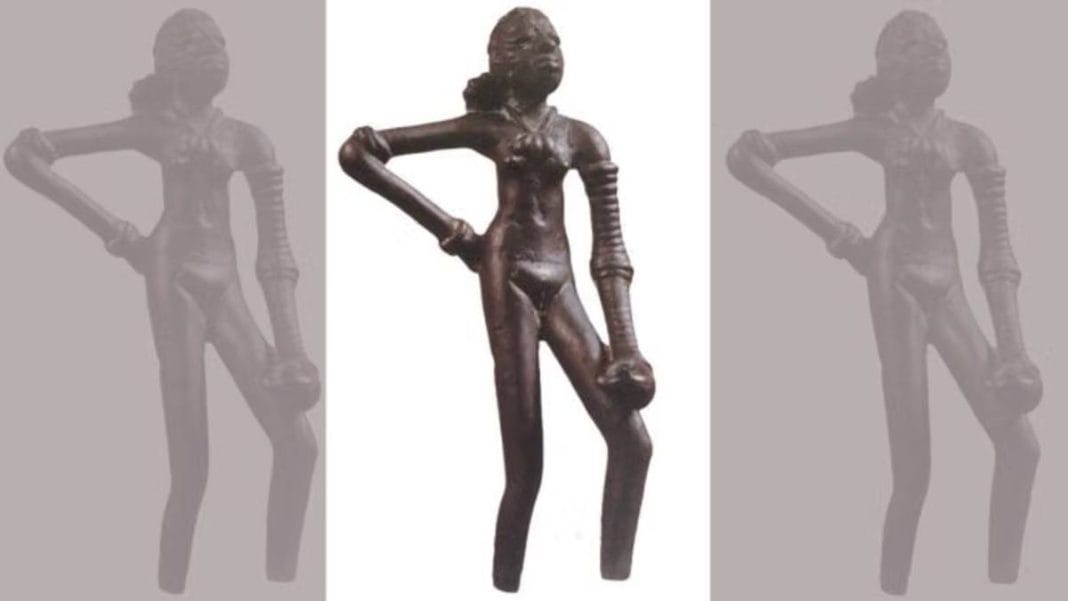


NCERT’s new Art textbook for Class IX, Madhurima, recently sparked controversy by censoring the naked body of an icon of Indian history—the Dancing Girl of Mohenjo-daro. And it was done in the most inelegant manner possible. The original depiction was restored after backlash.
A conservative, patriarchal society has always conceived of a woman’s body as something to be hidden behind the veils of chastity. Stylistic depictions of nudity, and obscenity, appear the same to their eyes.
From the early medieval times, the purdah system—which was never peculiar to the Muslim community alone—had enforced this notion, which got cemented further in the last few centuries when Victorian morality guided the newly educated Indians.
Coming back to the topic of this piece, there are other obscure ways by which the new Art textbook has tried to censor the female body. When discussing Mauryan art, it fails to mention Didarganj Yakshini, nor does it mention the exquisite sculptures of Mahabalipuram, where the feminine body is carved in all its might and eloquence.
In many instances, any possible references to nudity are altogether avoided—be it male or female. There is no wonder why the erotic sculptures of Khajuraho are altogether left aside (the only exception is the reference to drummers from the Khajuraho panel on p.28).
To represent the feminine body either “modestly covered” or as “sexually enthralling” is a false dichotomy that the patriarchal superstructure wants us to conform to. But the truth is that throughout the history of the subcontinent, the representation of the woman’s body never strictly belonged to either of these categories.
At various Buddhist shrines, elegant figurines of Yakshis (female nature spirits) were carved on stone with little apprehension about causing a public outrage. For a long time, many female divinities appeared with bare torsos, apart from some exquisite jewelry, until (painter) Ravi Varma decided to clad them in colourful draperies.
Overt sexualisation of a woman’s breast also seems to be something recent. Gōvindācārya’s Saṁgrahacūḍhāmaṇi has a verse where he refers to music and literature as the two stana (breasts) of Saraswati, the Hindu goddess of learning, arts, and knowledge.
The phrase also made its way into Muttuswāmi Dīkṣitaṟ’s work Sarasvatyā Bhagavatyā. If speaking of a woman’s bosom was obscene, neither of them would have dared to speak about it in such a context. Even within the Mughal empire, miniature paintings often represented cheerful princesses as wearing almost see-through jackets.
So where exactly does the problem arise? It is with our perspective. A recent advertisement by apparel brand XYXX, “If Baniyans Were Bras”, highlights this more clearly.
A male-dominated society views women as subservient to the male sex (resulting in women naturally becoming the ‘Second Sex’ as Simone de Beauvoir said). Women become either chaste wives or dutiful mothers. If not, she’s promiscuous, lascivious, and voluptuous.
Though the feminine body was more freely represented in pre-modern times in art and literature, this particular attitude restricting and disabling women was not unheard of then too. From Dīṟghajihva, who was killed amid an act of copulation, to the amorous woman who was ingeniously kept “in control” by a parrot committed to its master’s honour in the Śukasaptati, to stories the European travellers fervently noted down about the paramours of Mughal princes and harems, all these reveal the same pathetic attitude a conservative male has towards women.
With such attitudes getting normalised in school textbooks, it becomes altogether difficult to change them. Textbooks have an important role in shaping the coming generation. For many, textbooks are the primary (and in a lot of cases the only) sources of much of the established systems of knowledge.
Subjects like history are known to many people only through their school textbooks and later, through WhatsApp forwards. That was why academicians throughout India have been very critical of some recent changes brought in NCERT history textbooks.
There are also other aspects that textbooks can help cement or change. Giving an image of a dark-skinned woman as an example of “ugliness” fosters racial prejudices, while always presenting the outline of a male body in science textbooks enforces masculine primacy at the cost of making women less human.
Censoring the Dancing Girl of Mohenjo-daro presents many problems—it pushes not only femininity but also Indian history behind a veil. Patriarchy, with its corrupt views on gender, morality and sexuality, triumphs over constitutional and modern conceptions of the same.
Madhurima loses all its sweetness when art is not allowed to present itself in its real and original form. Nothing artificial can replace its inherent beauty!
Alan M. George is a Master’s student of Integrated History, Pondicherry University. Views are personal.
Also Read: The futility of linguistic chauvinism