





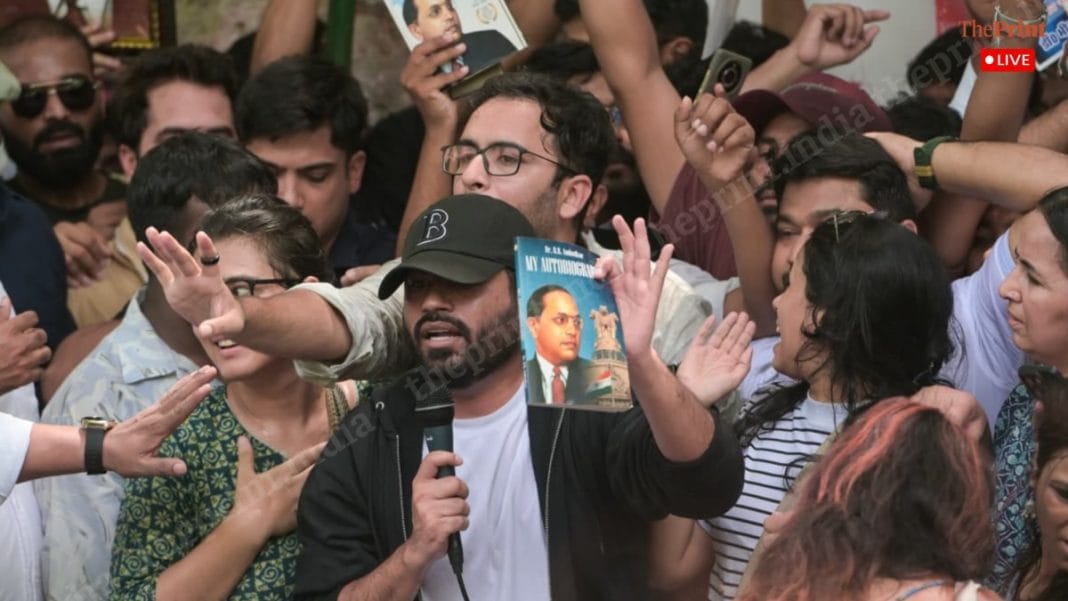


Whether confronting intersectionality or state repression, one of the enduring strengths of the Left has been its ability to critique. While often among the first to identify structural weakness, what happens when critique becomes so central to political culture that every emerging movement is judged inadequate from the outset, undermining the possibility of building a potential political bloc before it has even had a chance to develop?
Anand Teltumbde noted that progressive movements often weaken themselves when they become fragmented into competing ideological camps, making coalition-building difficult even when structural conditions favour mobilisation. This has become increasingly relevant in debates around the Cockroach Janata Party. While CJP has attracted significant attention among young Indians having little engagement with organised politics, it has also been met with considerable skepticism from sections of the left calling it insufficiently radical, vague, or too focused on optics.
History suggests that most people do not enter political life with a fully formed ideological worldview. People become politicised through participation. The anti-corruption movement of 2011, the protests following the 2012 Delhi gang rape, or the farmers’ protest brought millions into political action through a common cause first, rather than a strong ideological coherence.
Organisations, such as AISA and SFI, while have played important roles in defending Civil liberties were viewed by the masses, fairly or unfairly, as too radical, leftist, at times anti-national, caused by decades of established ideological baggage, thus limiting their broad appeal. CJP, on the other hand, appears to occupy a rather liberal space, where participants are not required to adopt a comprehensive political doctrine at first to participate.
The reception of recent protest movements also illustrates the growing tendency of online political commentary culture trapped in reflexive cynicism, where exposing flaws becomes easier than building alternatives. Gandhi’s insistence on nonviolence is remembered as moral discipline, yet when contemporary organisations emphasise the same, it is framed as capitulation or CJP as a probable right-wing seed.
In a political environment where activists witness prolonged incarceration, legal scrutiny, and accusations of being anti-national, strategic emphasis on peaceful constitutional protests is not necessarily an evidence of ideological surrender, but a rational response to the political realities. Seeing how mere dissent can be criminalised, the youth’s emphasis on constitutional language is understandable.
Emerging political formations are often judged less by what they can become and more by what they currently lack. While every political movement should be examined critically, there is a difference between criticism aimed at helping a movement grow and criticism that dismisses it as politically meaningless.
Does it possess a comprehensive critique of capitalism? Does it sufficiently address caste? Does it have a coherent ideological programme? Has it identified the structural roots of the problem? These are important questions. But when they become the primary criteria for judging whether a movement deserves support, it risks becoming a competition to identify mere shortcomings.
The question, therefore, is not whether CJP is revolutionary enough. The question is whether the Indian left can still recognise a beginning when it sees one. If every emerging democratic experiment is judged primarily by what it lacks, rather than by what it enables, then the left risks becoming a spectator to mobilisation rather than a participant in it.
While not meeting the standards of a revolutionary organisation, CJP does appear to function as a mobilising platform for youth who were so far politically disengaged. The problem with contemporary left discourse is not that it criticizes too much. Criticism is indispensable, but critique alone does not generate political capacity.
None of this means that CJP should be immune to criticism. Every movement must be challenged to deepen its politics, expand its vision, and strengthen its organisation. Because without the willingness to nurture imperfect beginnings, critique ceases to be a tool for transformation and becomes merely a language of disappointment.
Both reformist complacency and rupture fantasies need real institutions that can mobilise people. CJP can fail to satisfy every ideological criterion while nonetheless expanding the space of democratic participation.
While not a defense of the CJP at all, it is a critique of a particular tendency within contemporary progressive politics. Because while the left’s greatest achievements have emerged when it combined critique with mass participation, its greatest failures have often arrived when it confused ideological purity with political effectiveness.
Arpita Jain is a student at Miranda House, University of Delhi. Views are personal.
Also Read: Cockroach Janta Party faces its first street test today. Will it go beyond virality?