





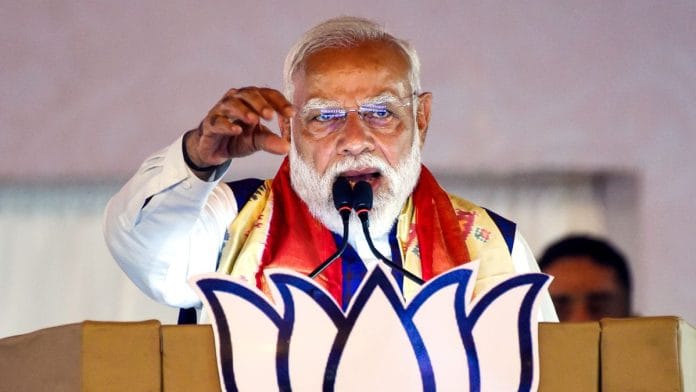

It is rare for Prime Minister Narendra Modi to admit that there’s trouble on the horizon. He has built his public image around success and security, reassuring his faithful voters that nothing out there in a troubling and dangerous world will be allowed to touch them as long as he is in charge. That is why it was startling when this weekend, he appealed to Indians to change their consumption habits in an attempt to insulate the economy from the fallout of the Gulf crisis.
Modi made seven requests of citizens: to work from home, use public transport, stop buying gold, cut down on cooking oil, avoid imported goods and trips abroad, and use less fertilizer. The markets were able to read the obvious message: The government is worried about the current account balance. Fuel, fertilizer, cooking oil, and vast amounts of gold are bought from abroad; unless the import bill is slashed, India might be looking at a balance-of-payments crisis. The rupee crashed to its weakest-ever level on Tuesday, trading at 95.63 to a dollar.
The Indian economy may look like a complex machine, but its operation depends upon two indispensable gears. The monsoon rains must come on time, and the price of oil can’t go too high. It is clear that fuel costs are going to be elevated for a while, and now there are worries about a drought as well, with an expected El Niño weather pattern likely to result in below-normal rainfall.
Every single time that commodity prices have spiked globally, India has come close to a financial crisis. In normal times, it can export enough to pay the dollars needed to cover imports, but not when the cost of the fuel it buys increases. One of those crises, following Saddam Hussein’s invasion of Kuwait in 1991, helped drive the liberalization of the Indian economy. And political turmoil has often followed; years of high oil prices drove the period of inflation and discontent that rendered the prime minister’s predecessors unpopular, propelling him into office in 2014.
Modi has been relatively lucky since then. Fuel price spikes have been offset by ample inflows of dollar-denominated investment. But this time capital is flowing out — foreign investors sold more than $12 billion worth of Indian shares in the first month after war broke out in the Gulf — and oil prices will take some time to return to normal.
Government officials often boast — as the prime minister himself did recently, ironically on the very day before the US-Israeli strikes on Iran — that, before Modi came to power, India was one of the “fragile five” emerging markets that were most exposed to capital outflows, but now the macro-economy is stable. But the truth is they had very little to do with it. This is the first time he’s being tested the way his predecessors were.
The good news is that the government seems to have at last woken up to the scale of the problem. Other countries in Asia began to introduce some forms of rationing weeks ago. Perhaps New Delhi was distracted by the need to win state elections, and now that those are done, they can get around to the small matter of a possible crisis.
Hopefully Modi won’t limit himself to pious exhortations. It’s hard to imagine that Indians will voluntarily cut down on cooking oil or gold jewelry. Fortunately, the best method for changing consumer behavior already exists, and requires the government to do very little: the price mechanism.
The government must allow the price of imports to rise if it is serious about cutting the import bill and ensuring financial stability. The Reserve Bank will have to let the rupee fall. And, even more importantly, the increase in the price of fuel must be passed on to customers.
This goes against Modi’s natural instincts. While fuel prices are supposedly decontrolled, in reality the government tries to manage them as best it can: absorbing any losses through the balance sheets of state-run oil companies. Costs have been held steadily for four years now, and the government has touted that as a major achievement.
Discontent is inevitable. But if higher prices are passed on transparently to consumers, the government might have a chance of subsidizing the worst-off while showing that it is doing the best it can. If, instead, Modi repeats the mistakes of his predecessors — allowing deficits, internal and external, to grow unmanageably — he may well wind up facing a political crisis, not just an economic one.
Disclaimer: This report is auto generated from the Bloomberg news service. ThePrint holds no responsibility for its content.