





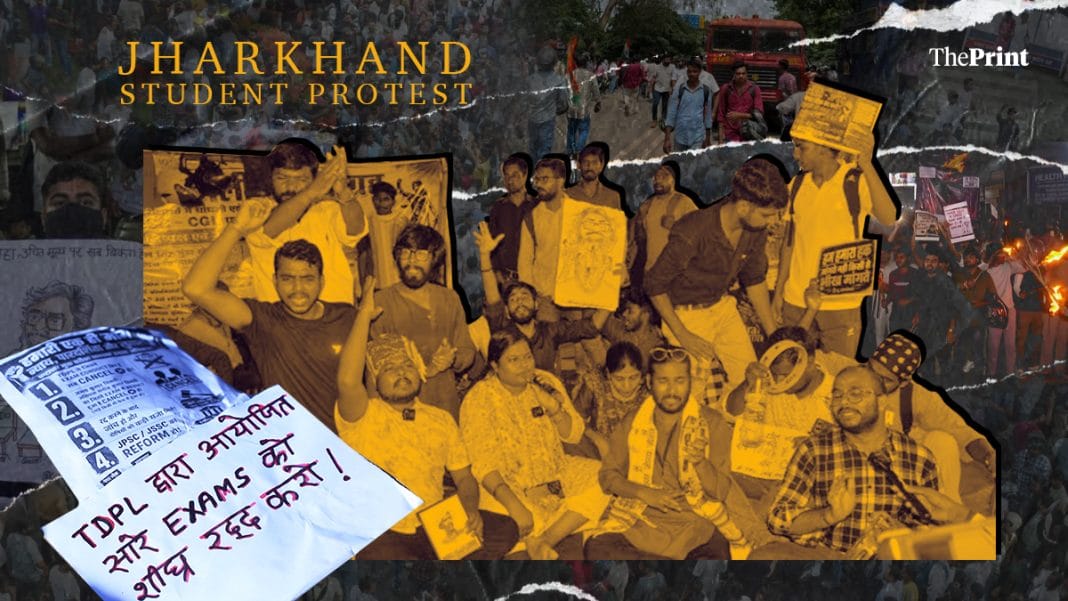


For the last few days, Ranchi’s Jaipal Singh Munda Stadium has been a protest camp, not a playground. There are hundreds of aspirants of the Jharkhand Public Service Commission (JPSC) and Jharkhand Staff Selection Commission (JSSC) in Jharkhand who have been sitting in protest since 29 July, and since then, the agitation has escalated into hunger strikes, torch rally and subsequent crackdown by authorities.
The trigger was seemingly small. A viral photo that showed a candidate’s OMR sheet, in which he had allegedly attempted just 48 of 100 questions and still advanced to the next round. The CID has since arrested the candidate, Suman Saurav, and 10 others, including people it believes were involved in the alleged leak. But it has not been enough to appease the anger of candidates, because for the aspirants camped outside, this was never about just one candidate.
Let’s remember what exactly the JPSC is. It is not a government department where such a restructuring can be done discreetly; it is a constitutional body, established under Articles 315 to 323 of the Constitution, which mandates Public Service Commissions for the Union and the states and lays down safeguards for their functioning.
Its constitutional status is intended to protect the independence and credibility of the public recruitment process. That is the promise, aspirants say, that has been broken.
Taught by Jantar Mantar
This protest has also drawn from the scale of student mobilisation in Delhi. Just a few weeks before the sit-in at Jantar Mantar over the NEET-UG 2026 paper-leak controversy, the Cockroach Janta Party-led protests had grown into a major agitation that culminated in the resignation of Union Education Minister Dharmendra Pradhan.
Jharkhand’s aspirants noticed that momentum. “The momentum of the CJP-led protests in Delhi has enabled us to be more confident and believe that accountability can be restored to those responsible for our present crisis, and hence we have launched our first non-violent indefinite protest,” said Vinay Mehta, a core committee member who had been subjected to three FIRs over previous agitations.
A national exam scandal led to a minister’s resignation within a few weeks. In Jharkhand, the commission has faced allegations of irregularities and controversies for over two decades, yet there has been no comparable accountability at the top.
No one scandal: A pattern
Strip away the current headlines, and the deeper story is a state examination system that has been dogged by allegations of paper leaks, delays and irregularities for years. The problem goes back to the early years of the state, with JPSC’s civil services examinations repeatedly facing controversies and delays.
The leak issue goes back to 2003, when allegations surfaced that the History paper had leaked, prompting JPSC to cancel the exam held in August 2003. It was then conducted again in 2004. The result-delay problem reappeared in 2023-24, when the JSSC’s CGL results were not released for more than a year, until the Jharkhand High Court came to the rescue.
The interview-marking and favouritism issues surfaced starkly in the 2012 JPSC examination, where a CBI probe found that several successful candidates who went on to join the services were related to politicians, civil servants and JPSC officials.
It took 12 years for the CBI to file a chargesheet in the case, naming more than 50 people, including a former JPSC chairman. Even basic aspects of the examination process have come under scrutiny: in May, the Governor’s office ordered a probe after a JPSC paper was reported to have errors in 78 of 100 questions.
The company at the heart of this year’s scandal, TDPL, had already been blacklisted by the JSSC after withdrawing from its contract to conduct the Jharkhand General Graduate Level Combined Competitive Examination in 2024. It was subsequently awarded the JPSC prelims contract, raising questions about the process by which it was selected.
JPSC chairman L. Khiangte was questioned four times by the CID and faced raids at his residential and office premises in Ranchi before resigning from his post.
What it costs
Piyush Singh, a 34-year-old from Bokaro, has qualified for JPSC’s prelims seven times without ever landing a job; this is a big deal for the community, and the pattern isn’t abstract. “The process has become a punishment for us students in the state,” he told ThePrint.
He is not unusual. Aspirants who began preparing in their early twenties are now approaching middle age and still waiting for it. The constitutional safeguards surrounding public service commissions are meant to protect the independence and credibility of the recruitment process. For these aspirants, that credibility is now at stake.
Why it matters now
Jharkhand enacted its own anti-cheating legislation in November 2023, before Parliament passed the Public Examinations (Prevention of Unfair Means) Act, 2024. The Central law was aimed at preventing unfair means in examinations conducted by specified central government authorities and bodies; it does not automatically govern state recruitment examinations such as those conducted by the JPSC.
But for the protesting students, it’s not just about which law is in charge. They want to see real accountability from the state’s recruitment agency. They’re calling for exams to be split across multiple vendors so no single player controls the process. They also want the government to check if any firm looking for a contract has a shady past and, crucially, to publish and stick to a clear exam calendar. Small steps like these can start to rebuild trust.
None of these measures requires reinventing the system. They require the safeguards associated with Article 315 to translate into a recruitment process that candidates can trust.
Minisha Kakool is a student of National University of Study and Research in Law, Ranchi. Views are personal.
Also Read : Can the new anti-paper leak law restore faith in India’s public examinations?